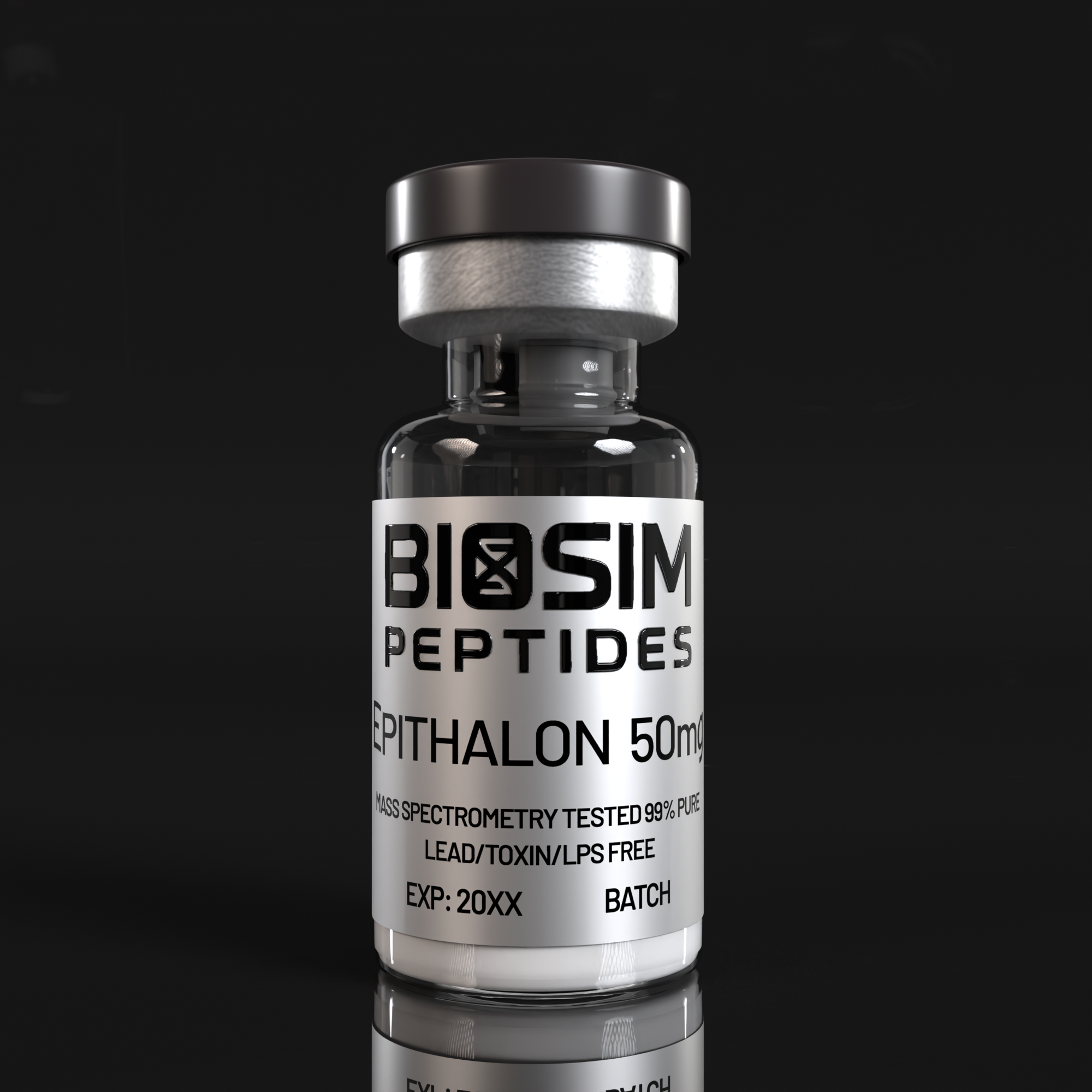
Epithalon 50mg: Research Overview
Epithalon (also known as Epitalon or AEDG peptide) is a synthetic tetrapeptide with the amino acid sequence Alanine-Glutamic Acid-Aspartic Acid-Glycine (Ala-Glu-Asp-Gly). Developed by Professor Vladimir Khavinson at the Saint Petersburg Institute of Bioregulation and Gerontology, Epithalon was designed as a synthetic analogue of epithalamin — a polypeptide complex extracted from the pineal gland that has been studied for over four decades in the context of aging biology. This 50 mg lyophilized preparation is supplied exclusively for controlled laboratory research investigating cellular senescence, telomere biology, gene expression regulation, and pineal-derived peptide signaling pathways. All experimental protocols must be conducted in appropriate laboratory settings by qualified research personnel.
Epithalon has garnered significant attention in the research community due to its demonstrated capacity to activate telomerase — the ribonucleoprotein enzyme responsible for maintaining telomeric DNA repeats at chromosome ends — across multiple cell types including human somatic cells, neuronal stem cells, and germline models. The compound has been identified as an endogenous constituent of the pineal gland polypeptide complex, confirming its biological relevance beyond synthetic design.[3] A 2025 comprehensive review published in the International Journal of Molecular Sciences characterized Epithalon as a highly bioactive pineal tetrapeptide with promising properties spanning telomerase activation, epigenetic regulation, and antioxidant activity.[7] Researchers investigating the molecular mechanisms of cellular aging, oxidative stress resistance, and neuroendocrine regulation will find Epithalon a valuable tool compound for in vitro and ex vivo experimental paradigms.
Molecular Background & Mechanism of Action
Epithalon belongs to the class of short regulatory peptides known as cytomedins or peptide bioregulators. The tetrapeptide sequence Ala-Glu-Asp-Gly was rationally derived from the more complex epithalamin polypeptide mixture after systematic structure-activity relationship studies identified this minimal motif as sufficient for biological activity. Endogenous identification of the AEDG peptide within the pineal gland’s polypeptide complex was confirmed through mass spectrometric analysis, establishing its physiological relevance.[3] Unlike larger protein-based therapeutics, Epithalon’s short chain length facilitates cell membrane penetration and nuclear localization in experimental models, enabling direct interaction with chromatin and transcriptional machinery.
The primary mechanism of action elucidated in laboratory studies centers on telomerase activation. Pioneering work by Khavinson and colleagues demonstrated that Epithalon induces telomerase catalytic activity and concomitant telomere elongation in human somatic cells, effectively overcoming the Hayflick division limit in cultured fibroblast models.[1,2] This effect has been corroborated in multiple independent investigations: a 2025 study published in Biogerontology confirmed that Epithalon increases telomere length in human cell lines through telomerase upregulation and, notably, also via the Alternative Lengthening of Telomeres (ALT) pathway in telomerase-negative cell models.[8] The peptide’s capacity to engage both telomerase-dependent and ALT-dependent telomere maintenance mechanisms represents a unique dual-pathway activation profile not commonly observed with other telomere-targeting research compounds.
Beyond telomerase activation, Epithalon exhibits epigenetic regulatory properties. Studies using neuronal differentiation models have demonstrated that the AEDG peptide stimulates gene expression and protein synthesis during neurogenesis through possible epigenetic mechanisms involving chromatin remodeling.[4] Specifically, Epithalon has been shown to promote heterochromatin decondensation in aged cellular models, facilitating the reactivation of silenced gene loci associated with proliferative capacity and cellular repair pathways. The peptide interacts with DNA in a sequence-selective manner analogous to transcription factors, binding within the minor groove of double-helical DNA and influencing promoter accessibility.[4] Complementary research on mitochondrial function has indicated that Epithalon modulates mitochondrial staining patterns and ribosomal protein L7A expression during pineal and thymic cell senescence in vitro, suggesting multi-organelle effects relevant to cellular aging research.
Preclinical & Clinical Evidence
The experimental evidence base for Epithalon spans in vitro cellular models, ex vivo tissue studies, and in vivo animal investigations. The foundational studies established that Epithalon induces telomerase activity and enables human somatic cells to exceed their normal replicative division limit, with treated fibroblast cultures demonstrating extended proliferative lifespans compared to untreated controls.[1,2] These observations established Epithalon as one of the earliest peptide-based telomerase activators described in the peer-reviewed literature and sparked sustained research interest in peptide bioregulators as tools for studying cellular aging mechanisms.
In germline and reproductive biology models, Epithalon has demonstrated notable protective effects against aging-related cellular damage. A 2022 study in Aging journal reported that Epithalon protects against post-ovulatory aging-related damage in mouse oocytes in vitro, preserving mitochondrial function, reducing oxidative stress markers, and maintaining spindle/chromosome structure integrity in aging oocytes.[5] Extending this line of investigation, a 2025 study in Life Sciences showed that Epithalon-activated telomerase enhances bovine oocyte maturation rate and post-thawed embryo development, with treated oocytes exhibiting improved cleavage rates, blastocyst formation, and cryotolerance compared to untreated controls.[6] These findings position Epithalon as a valuable tool compound for reproductive biology laboratories investigating oocyte quality, embryonic development, and the role of telomere maintenance in gamete competence.
The neurogenic potential of Epithalon has been explored in stem cell differentiation models. Research published in the International Journal of Immunopathology and Pharmacology demonstrated that short peptides including Epithalon influence neuronal differentiation of stem cells, modulating lineage commitment through effects on gene expression programs.[4] The 2020 study in Molecules further characterized the epigenetic dimension, showing that AEDG peptide stimulates gene expression and protein synthesis during neurogenesis, with differential effects on specific neuronal markers and transcription factors.[4] A 2025 study expanded the therapeutic research scope by demonstrating that Epithalon enhances delayed wound healing in an in vitro model of diabetic retinopathy, suggesting applications in oxidative stress-related cellular damage models beyond classical aging research. Collectively, the preclinical corpus supports Epithalon’s multi-target profile affecting telomere biology, epigenetic regulation, mitochondrial function, and cellular stress response pathways — all within well-controlled laboratory model systems.
Research Applications
- Cellular Senescence & Telomere Biology: Epithalon serves as a research tool for investigating telomerase activation mechanisms, telomere length dynamics, and replicative senescence bypass in human and animal somatic cell lines. Researchers use Epithalon to study the relationship between telomere maintenance and extended cellular proliferative capacity.
- Aging Model Research: The compound is employed in in vitro and ex vivo aging models to examine interventions that modulate age-related cellular phenotypes, including mitochondrial dysfunction, oxidative stress accumulation, and chromatin remodeling changes associated with cellular aging.
- Neurogenesis & Stem Cell Differentiation: Epithalon is utilized in neural stem cell and neuronal differentiation protocols to study peptide-mediated regulation of lineage specification, neurogenic gene expression, and epigenetic reprogramming during neuronal maturation.
- Reproductive Biology: Laboratories investigating oocyte maturation, embryonic development, and gamete cryopreservation use Epithalon to examine the role of telomerase activity in oocyte quality, post-ovulatory aging, and post-thaw developmental competence.
- Pineal Gland & Neuroendocrine Research: As a synthetic analogue of an endogenous pineal peptide, Epithalon facilitates research into pineal-derived signaling molecules, their effects on circadian biology, immune-pineal axis communication, and neuroendocrine regulation of aging processes.
- Epigenetic Research: Epithalon’s demonstrated capacity to modulate chromatin structure and gene expression through epigenetic mechanisms makes it a valuable probe for studying heterochromatin dynamics, gene silencing reversal, and transcription factor-like peptide-DNA interactions.
Comparative Context
Epithalon occupies a distinct niche within the landscape of laboratory compounds studied for telomere and aging research. Unlike plant-derived cycloastragenol or synthetic small molecules (e.g., TA-65, BIBR1532), Epithalon is an endogenous-mimetic tetrapeptide whose sequence is found within the native pineal polypeptide complex. This biological provenance distinguishes it from xenobiotic telomerase modulators. In comparative in vitro studies, Epithalon has demonstrated a broader mechanistic profile than single-target telomerase activators, engaging both catalytic telomerase (hTERT) and ALT-pathway telomere maintenance, while simultaneously modulating gene expression and chromatin architecture.[7,8]
| Compound | Target / Mechanism | Key Research Property |
|---|---|---|
| Epithalon (AEDG) | Telomerase + ALT activation; epigenetic chromatin modulation; gene expression regulation | Endogenous-mimetic pineal tetrapeptide; dual-pathway telomere maintenance; multi-target cellular effects |
| Epithalamin (polypeptide complex) | Multi-peptide pineal extract; complex mixture | Natural source material; less defined composition than synthetic Epithalon |
| TA-65 (cycloastragenol) | hTERT activation via MAPK pathway | Plant-derived small molecule; single-target telomerase activation; no ALT pathway engagement |
| BIBR1532 | Telomerase inhibitor (non-competitive) | Research tool for telomerase inhibition; opposite experimental paradigm to Epithalon |
| Thymalin (L-Glu-L-Trp) | Thymic peptide bioregulator; immune modulation | Related peptide bioregulator class; different tissue specificity (thymus vs. pineal) |
Safety & Laboratory Handling
Store lyophilized Epithalon at -20°C protected from light and moisture. The lyophilized powder is stable for extended periods under these conditions. Reconstitute with sterile bacteriostatic water (not included) to the desired working concentration for experimental protocols. Reconstituted solutions should be stored at 2-8°C and used within 30 days to ensure peptide integrity and activity. Avoid repeated freeze-thaw cycles, as these may cause peptide aggregation or degradation. Use appropriate personal protective equipment (PPE) including laboratory gloves, eye protection, and a lab coat when handling. Work with the lyophilized powder in a properly ventilated area or biosafety cabinet to prevent aerosol dispersion. Disposal should comply with institutional guidelines for peptide-based laboratory reagents. For laboratory research use only — not for diagnostic, therapeutic, veterinary, or human consumption applications. BioSim Peptides guarantees ≥98% purity by HPLC; however, researchers should independently verify concentration and activity for their specific experimental protocols.
References
- Khavinson VKh, Bondarev IE, Butyugov AA. (2003). “Epithalon peptide induces telomerase activity and telomere elongation in human somatic cells.” Bulletin of Experimental Biology and Medicine. PMID: 12937682.
- Khavinson VKh, Bondarev IE, Butyugov AA. (2004). “Peptide promotes overcoming of the division limit in human somatic cell.” Bulletin of Experimental Biology and Medicine. PMID: 15455129.
- Khavinson VK, Kopylov AT, Vaskovsky BV. (2017). “Identification of Peptide AEDG in the Polypeptide Complex of the Pineal Gland.” Bulletin of Experimental Biology and Medicine. PMID: 29124531.
- Khavinson V, Diomede F, Mironova E, et al. (2020). “AEDG Peptide (Epitalon) Stimulates Gene Expression and Protein Synthesis during Neurogenesis: Possible Epigenetic Mechanism.” Molecules. PMID: 32019204.
- Yue X, Liu SL, Guo JN, et al. (2022). “Epitalon protects against post-ovulatory aging-related damage of mouse oocytes in vitro.” Aging (Albany NY). PMID: 35413689.
- Ullah S, Haider Z, Perera CD, et al. (2025). “Epitalon-activated telomerase enhance bovine oocyte maturation rate and post-thawed embryo development.” Life Sciences. PMID: 39788414.
- Araj SK, Brzezik J, Mądra-Gackowska K, et al. (2025). “Overview of Epitalon—Highly Bioactive Pineal Tetrapeptide with Promising Properties.” International Journal of Molecular Sciences. PMID: 40141333.
- Al-Dulaimi S, Thomas R, Matta S, et al. (2025). “Epitalon increases telomere length in human cell lines through telomerase upregulation or ALT activity.” Biogerontology. PMID: 40908429.
⚠ Research Use Only: Sold exclusively for in vitro laboratory research. Not evaluated by the FDA or any regulatory authority for human or veterinary therapeutic use. Not for diagnostic applications, human consumption, or clinical administration.

Reviews
There are no reviews yet.