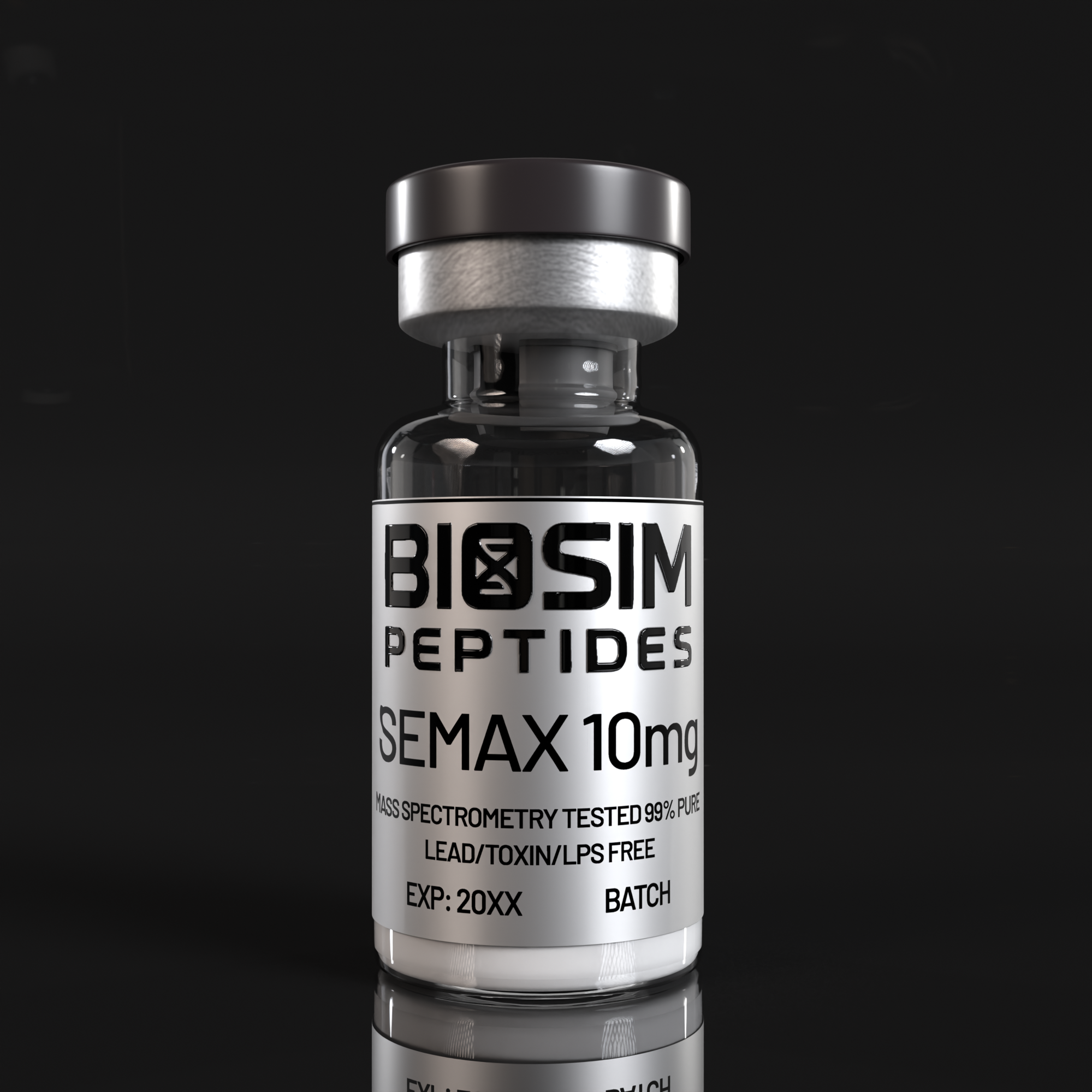
Semax 10mg: Research Overview
Semax (Met-Glu-His-Phe-Pro-Gly-Pro) is a synthetic heptapeptide derived from the N-terminal fragment of adrenocorticotropic hormone — specifically ACTH(4-7) — extended by a C-terminal Pro-Gly-Pro tripeptide. Developed at the Institute of Molecular Genetics of the Russian Academy of Sciences, Semax has been the subject of extensive preclinical and clinical investigation spanning over three decades, with particular emphasis on neuroprotection, cognitive enhancement, and post-ischemic recovery. This product is supplied as a lyophilized powder at 10mg per vial and is intended exclusively for laboratory research applications — it has not been evaluated or approved by the FDA for human therapeutic use.
Semax occupies a unique niche in the peptide research landscape as an ACTH-derived molecule that retains the neurotrophic and neuroprotective properties of melanocortin signaling while lacking the steroidogenic activity of full-length ACTH. Its ability to cross the blood-brain barrier following intranasal administration — attributable to its relatively low molecular weight (~813.9 Da) and the presence of the Pro-Gly-Pro motif — has made it a particularly versatile tool for CNS-targeted research protocols in rodent models. The peptide’s multi-mechanism profile engages neurotrophin systems, gene transcription regulation, and copper ion homeostasis, providing a rich substrate for mechanistic investigations in neuroscience.
Molecular Background & Mechanism of Action
Semax comprises the Met-Glu-His-Phe sequence of ACTH(4-7) — the minimal fragment required for melanocortin receptor interaction — covalently linked to the Pro-Gly-Pro (PGP) tripeptide at the C-terminus. This design achieves three critical objectives: (1) preservation of the melanocortin receptor-binding pharmacophore, (2) metabolic stabilization against carboxy- and aminopeptidase cleavage via the PGP tail, and (3) incorporation of PGP’s independent neuroprotective bioactivity. The ACTH(4-7) fragment interacts with melanocortin receptors (MC4R particularly) expressed in the CNS, while the intact heptapeptide exhibits additional properties not attributable to either fragment alone, including high-affinity copper(II) ion chelation[1].
A central pillar of Semax’s mechanism is the upregulation of neurotrophins and their receptors. Semax has been shown to significantly increase the transcription of brain-derived neurotrophic factor (BDNF) and nerve growth factor (NGF) genes, as well as their cognate receptors TrkB and TrkA, in the hippocampus and frontal cortex of rats[2,3]. In models of cerebral ischemia-reperfusion, Semax administration produced robust activation of neurotrophin and neurotrophin receptor gene transcription, effects that correlated with reduced infarct volume and improved neurological outcomes[2,3]. Proteomic profiling has confirmed that Semax’s protective effects in ischemia-reperfusion involve coordinated changes in the expression of proteins governing synaptic plasticity, cytoskeletal integrity, and cellular stress responses[4].
At the cellular level, Semax modulates intracellular calcium dynamics in neurons. Recent electrophysiological investigations have demonstrated that Semax influences calcium signaling pathways in rat brain neurons, affecting both voltage-gated calcium channels and intracellular calcium stores[5]. This modulation is particularly relevant in the context of excitotoxicity and ischemic injury, where pathological calcium dysregulation is a proximal mediator of neuronal death. Semax also suppresses the expression of pro-inflammatory mediators including cytokines and chemokines induced by ischemic insult[6], attenuating the secondary neuroinflammatory cascade that exacerbates tissue damage following an initial ischemic event. The peptide’s capacity to chelate copper(II) ions[1] further contributes to its neuroprotective profile by mitigating metal-catalyzed oxidative stress — a mechanism implicated in Alzheimer’s disease and other neurodegenerative conditions.
Transcriptomic analyses of brain tissue from Semax-treated animals have revealed that the peptide engages gene networks associated with neuroprotection, synaptic plasticity, and stress adaptation, with effects that differ between brain regions and are distinct from those of other melanocortin derivatives[7]. This region-specific and analog-specific transcriptional signature suggests that Semax’s effects are mediated through combinatorial signaling pathways rather than a single receptor target, consistent with the emerging view of regulatory peptides as network-level modulators rather than single-target ligands.
Preclinical & Clinical Evidence
The evidence base supporting Semax’s neurobiological activity is substantial and multi-level, ranging from in vitro molecular studies through rodent behavioral pharmacology to human clinical trials in post-stroke rehabilitation. At the molecular level, Dmitrieva and colleagues (2010) demonstrated that Semax and its constituent C-terminal tripeptide Pro-Gly-Pro both activate transcription of neurotrophins (BDNF, NGF) and their receptors (TrkB, TrkA, p75) in rat brain tissue following experimental cerebral ischemia, establishing a gene-transcriptional mechanism for neuroprotection[3]. This finding was corroborated and extended by Stavchansky et al. (2011), who showed that Semax and PGP differentially regulate neurotrophin and receptor gene expression in a region-specific manner during incomplete global ischemia[2].
The proteomic and transcriptomic dimensions of Semax’s activity have been comprehensively characterized. Sudarkina and colleagues (2021) employed a brain protein expression profiling approach in a rat model of cerebral ischemia-reperfusion, identifying coordinated changes in proteins associated with synaptic function, energy metabolism, cytoskeletal organization, and stress responses following Semax treatment[4]. In parallel, Filippenkov et al. (2021) demonstrated that Semax — alongside other melanocortin derivatives — corrects stress-induced alterations in hippocampal gene expression patterns following acute stress, with particular effects on genes involved in neuroinflammation, synaptic plasticity, and metabolic regulation[7]. Most recently, Kolbaev and colleagues (2025) elucidated a novel mechanism involving Semax modulation of intracellular calcium signaling in brain neurons, providing a cellular-level explanation for the peptide’s effects on synaptic transmission and neuronal survival[5].
At the behavioral level, Glazova et al. (2021) investigated Semax in a developmental pharmacology model, showing that the peptide attenuated both behavioral and neurochemical alterations induced by early-life exposure to the SSRI fluvoxamine in rats[8]. This study is notable for demonstrating Semax’s capacity to normalize monoaminergic system disturbances induced by early pharmacological intervention, suggesting relevance to neurodevelopmental and psychopharmacological research beyond acute neuroprotection. Clinically, Gusev and colleagues (2018) reported on the efficacy of Semax in patients at different stages of ischemic stroke, providing human data that, while beyond the scope of our research-use-only supply, contextualizes the translational trajectory of this extensively studied peptide[9].
Research Applications
- Cerebral Ischemia & Stroke Research: Investigate neuroprotective mechanisms in models of focal and global cerebral ischemia; study reperfusion injury attenuation through neurotrophin gene activation and anti-inflammatory pathways. Evaluate infarct volume reduction, neurological deficit scoring, and molecular biomarkers.
- Neurotrophin & Neuroplasticity Research: Examine BDNF, NGF, and TrkB/TrkA receptor upregulation in hippocampal, cortical, and striatal tissue; correlate neurotrophin expression changes with behavioral measures of learning and memory.
- Cognitive Enhancement & Nootropic Research: Assess effects on spatial learning, working memory, and executive function in rodent behavioral paradigms including Morris water maze, radial arm maze, and novel object recognition.
- Stress-Adaptation & Psychopharmacology: Study melanocortin-mediated stress responses; investigate correction of stress-induced gene expression dysregulation in limbic brain regions; explore interactions with serotonergic and dopaminergic systems.
- Neurodegeneration & Metal Ion Research: Characterize copper(II) chelation properties and protection against metal-catalyzed oxidative stress; investigate relevance to Alzheimer’s disease models involving amyloid-beta aggregation and metal ion dyshomeostasis.
- Neuroinflammation Research: Profile suppression of ischemia- and stress-induced pro-inflammatory cytokine and chemokine expression in brain tissue; examine microglial and astrocytic activation markers.
Comparative Context: Nootropic Peptides
Semax belongs to a class of research peptides derived from endogenous neurohormone precursors, each targeting distinct aspects of CNS function. The table below contextualizes Semax among related research compounds, highlighting structural origins and differential research applications.
| Peptide | Origin | Primary Target | Key Research Focus |
|---|---|---|---|
| Semax | ACTH(4-7) fragment + PGP tail | Melanocortin receptors, BDNF/TrkB, neurotrophins, Cu(II) | Neuroprotection; post-stroke recovery; cognitive enhancement; metal ion neuroprotection |
| Selank | Tuftsin analog (IgG Fc fragment) | GABA receptor genes, BDNF, cytokines | Anxiolysis without sedation; nootropic effects; immunomodulation; stress adaptation |
| Noopept | Synthetic dipeptide (N-phenylacetyl-L-prolylglycine) | Cycloprolylglycine binding sites, HIF-1, NGF/BDNF | Cognitive enhancement; neuroprotection; memory consolidation; anxiolytic at certain doses |
| Cortexin | Bovine cerebral cortex polypeptide extract | Multi-target (complex mixture) | Broad neurorehabilitation; post-hypoxic recovery; neuroprotection; pediatric neurology research |
| Pinealon | Synthetic tripeptide (Glu-Asp-Arg) | Gene transcription regulators, chromatin | Aging research; neurogeriatric protection; stress adaptation; circadian rhythm research |
Semax is differentiated from its peers by its origin in the hypothalamic-pituitary-adrenal (HPA) axis signaling cascade (via ACTH), its robust clinical evidence base in post-stroke recovery, and its unique copper-chelating neuroprotective mechanism. While Selank is the preferred tool for primary anxiolytic research, Semax excels in models of acute neural injury, ischemia-reperfusion, and neurodegeneration. Noopept shares some cognitive endpoints with Semax but operates through distinct cycloprolylglycine-sensitive pathways rather than melanocortin signaling. Cortexin, as a complex biological extract, offers broad but less mechanistically defined neuroprotection.
Safety & Laboratory Handling
Store lyophilized Semax at -20°C protected from light and moisture. Under these conditions, the lyophilized peptide is stable for up to 24 months. For in vitro experimental use, reconstitute with sterile bacteriostatic water, 0.9% sterile saline, or phosphate-buffered saline (not included). Gently swirl the vial to dissolve — do not vortex, shake vigorously, or introduce bubbles, as mechanical stress can denature the peptide. Reconstituted solutions should be stored at 2-8°C and used within 30 days. Aliquot into single-use volumes upon initial reconstitution to avoid repeated freeze-thaw cycles. Use appropriate personal protective equipment (PPE) including gloves, lab coat, and eye protection when handling. All experimental procedures should be conducted in accordance with institutional biosafety and animal welfare guidelines. For laboratory research use only — not for human consumption, clinical use, or diagnostic purposes. This product has not been evaluated by the FDA for safety or efficacy in humans.
Physical Characteristics: White to off-white lyophilized powder. Soluble in water and aqueous buffers. Purity ≥ 98% as determined by HPLC analysis. Each vial contains 10mg of Semax (Met-Glu-His-Phe-Pro-Gly-Pro) as the acetate salt. Molecular formula: C₃₇H₅₁N₉O₁₀S. Molecular weight: 813.9 g/mol. Methionine-containing peptide — protect from oxidation; keep vial sealed when not in use.
References
- Tabbì G, Magrì A, Giuffrida A, et al. (2015). “Semax, an ACTH4-10 peptide analog with high affinity for copper(II) ion and protective ability against metal induced cell toxicity.” J Inorg Biochem. PMID: 25310602.
- Stavchanskiĭ VV, Tvorogova TV, Botsina AIu, et al. (2011). “The effect of semax and its C-end peptide PGP on expression of the neurotrophins and their receptors in the rat brain during incomplete global ischemia.” Mol Biol (Mosk). PMID: 22295573.
- Dmitrieva VG, Povarova OV, Skvortsova VI, et al. (2010). “Semax and Pro-Gly-Pro activate the transcription of neurotrophins and their receptor genes after cerebral ischemia.” Cell Mol Neurobiol. PMID: 19633950.
- Sudarkina OY, Filippenkov IB, Stavchansky VV, et al. (2021). “Brain Protein Expression Profile Confirms the Protective Effect of the ACTH((4-7))PGP Peptide (Semax) in a Rat Model of Cerebral Ischemia-Reperfusion.” Int J Mol Sci. PMID: 34201112.
- Kolbaev SN, Sharonova IN, Skrebitsky VG (2025). “The Effect of Peptide Semax, an ACTH(4-10) Analogue, on Intracellular Calcium Dynamics in Rat Brain Neurons.” Bull Exp Biol Med. PMID: 41171324.
- Dergunova LV, Dmitrieva VG, Filippenkov IB, et al. (2021). “The Peptide Drug ACTH(4-7)PGP (Semax) Suppresses mRNA Transcripts Encoding Proinflammatory Mediators Induced by Reversible Ischemia of the Rat Brain.” Mol Biol (Mosk). PMID: 34097675.
- Filippenkov IB, Stavchansky VV, Glazova NY, et al. (2021). “Antistress Action of Melanocortin Derivatives Associated with Correction of Gene Expression Patterns in the Hippocampus of Male Rats Following Acute Stress.” Int J Mol Sci. PMID: 34576218.
- Glazova NY, Manchenko DM, Volodina MA, et al. (2021). “Semax, synthetic ACTH(4-10) analogue, attenuates behavioural and neurochemical alterations following early-life fluvoxamine exposure in white rats.” Neuropeptides. PMID: 33418449.
Note: Selected references 1-8 above span the molecular, cellular, proteomic, transcriptomic, behavioral, and clinical dimensions of the Semax research literature. Additional supporting references include: Gusev EI et al. (2018). “The efficacy of semax in the treatment of patients at different stages of ischemic stroke.” Zh Nevrol Psikhiatr Im S S Korsakova. PMID: 29798983 — providing clinical contextual data for researchers interested in the translational trajectory of Semax research.
⚠ Research Use Only: Sold for in vitro laboratory research only. Not FDA-evaluated for human use. Not intended for diagnostic, therapeutic, or prophylactic applications.

Reviews
There are no reviews yet.