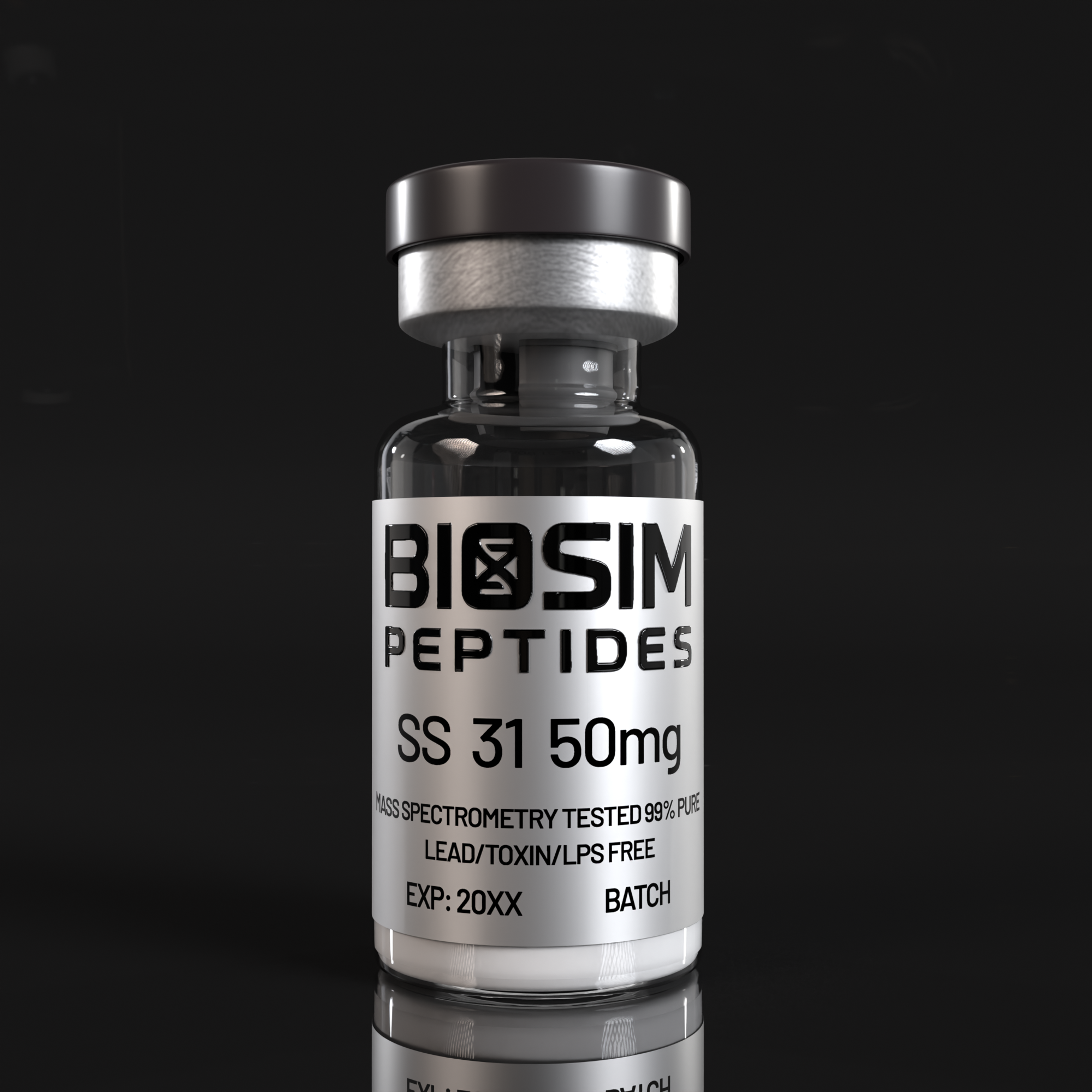
SS-31 50mg: Research Overview
SS-31 (D-Arg-Dmt-Lys-Phe-NH2), also known as Elamipretide or MTP-131, is a synthetic tetrapeptide belonging to the Szeto-Schiller (SS) class of mitochondria-targeted antioxidants. Developed by Drs. Hazel Szeto and Peter Schiller, SS-31 selectively partitions to the inner mitochondrial membrane (IMM) where it binds with high affinity to cardiolipin, a phospholipid exclusive to the IMM that is essential for cristae architecture, electron transport chain (ETC) supercomplex assembly, and cytochrome c sequestration. By stabilizing cardiolipin and scavenging reactive oxygen species (ROS) at the site of their principal intracellular generation, SS-31 has emerged as one of the most extensively characterized mitochondrial-targeted therapeutics in preclinical research, with applications spanning ischemia-reperfusion injury, heart failure, neurodegeneration, aging, and metabolic disease. BioSim Peptides supplies SS-31 as a lyophilized powder at 50mg per vial, verified to ≥98% purity by HPLC and mass spectrometry, for use exclusively in controlled laboratory research. This product has not been evaluated by the FDA for human use and is not a drug, dietary supplement, or therapeutic agent.
The Szeto-Schiller peptides were rationally designed around an aromatic-cationic structural motif: alternating aromatic and basic amino acid residues that confer both membrane permeability and mitochondrial targeting. Unlike conventional antioxidants such as vitamin E, coenzyme Q10, or N-acetylcysteine — which distribute broadly across cellular compartments — SS-31 concentrates approximately 1,000- to 5,000-fold in the IMM due to its alternating aromatic-cationic sequence that exploits the substantial mitochondrial membrane potential (ΔΨm ≈ −180 mV). This unprecedented targeting selectivity allows SS-31 to neutralize ROS directly at their primary intracellular source, the ETC complexes I and III, while simultaneously stabilizing the cardiolipin scaffold upon which those complexes depend for structural and functional integrity[1][2].
Molecular Background & Mechanism of Action
Cardiolipin Targeting and Stabilization
Cardiolipin (1,3-bis(sn-3′-phosphatidyl)-sn-glycerol) is a unique dimeric phospholipid localized almost exclusively to the IMM, where it constitutes approximately 20% of total IMM phospholipid content. Its four acyl chains and small headgroup confer a conical molecular geometry that promotes negative membrane curvature essential for cristae formation. Beyond its structural role, cardiolipin directly interacts with and stabilizes each of the ETC complexes (I-V), facilitates their organization into respiratory supercomplexes, tethers cytochrome c to the IMM surface to prevent unintended apoptotic initiation, and serves as a proton trap that enhances oxidative phosphorylation efficiency. SS-31 binds cardiolipin via complementary electrostatic interactions between the peptide’s positively charged D-Arg and Lys residues and the negatively charged phosphate moieties of cardiolipin, reinforced by hydrophobic interactions between the Dmt (2′,6′-dimethyltyrosine) side chain and cardiolipin’s acyl chains[1][2].
Under conditions of oxidative stress, cardiolipin undergoes peroxidation of its polyunsaturated fatty acyl chains (predominantly linoleic acid, 18:2), leading to decreased ETC complex activity, loss of cytochrome c retention, opening of the mitochondrial permeability transition pore (mPTP), and initiation of intrinsic apoptosis. SS-31 binding physically shields cardiolipin from peroxidative attack while simultaneously positioning the Dmt residue — a dimethylated tyrosine analog with enhanced radical-scavenging capacity — in proximity to the lipid-water interface where ROS-mediated lipid peroxidation is initiated[2][3].
🔬 Mechanism Summary: SS-31 Dual Action
- Cardiolipin stabilization: SS-31 binds IMM cardiolipin via electrostatic (Arg/Lys-phosphate) and hydrophobic (Dmt-acyl chain) interactions, preserving cristae architecture and ETC supercomplex integrity.
- Site-specific ROS scavenging: The 2′,6′-dimethyltyrosine (Dmt) residue functions as a potent radical scavenger at the lipid-water interface, quenching superoxide (O2•−), hydroxyl radical (HO•), and peroxynitrite (ONOO−) at their point of maximal production.
- Cytochrome c retention: By preventing cardiolipin peroxidation, SS-31 maintains cardiolipin’s electrostatic tethering of cytochrome c, blocking its release into the cytosol and subsequent apoptosome formation.
- mPTP inhibition: Stabilized cardiolipin and reduced oxidative stress cooperatively suppress pathological opening of the mitochondrial permeability transition pore, preserving ΔΨm and ATP synthesis.
Pharmacokinetic Properties in Research Models
SS-31 exhibits favorable solubility and stability characteristics for laboratory investigation. The alternating aromatic-cationic motif is resistant to peptidase degradation due to the inclusion of D-amino acids (D-Arg, Dmt) at positions 1 and 2, which confer resistance to aminopeptidase cleavage. The peptide is freely soluble in aqueous buffers at physiological pH, enabling straightforward reconstitution for cell culture and tissue bath applications. Its mitochondrial targeting is driven by both the membrane potential gradient and specific cardiolipin affinity, producing an effective intramitochondrial concentration that can exceed extracellular levels by three to four orders of magnitude. These properties make SS-31 an exceptionally useful probe for dissecting the role of mitochondrial ROS and cardiolipin homeostasis in cellular pathophysiology[1][4].
Preclinical Evidence
Ischemia-Reperfusion Injury
Ischemia-reperfusion (I/R) injury — occurring when blood flow is restored to oxygen-deprived tissue — is fundamentally a mitochondrial pathology. The reperfusion phase triggers a burst of ROS from ETC complexes I and III, driving cardiolipin peroxidation, mPTP opening, and necrotic and apoptotic cell death cascades. SS-31 has demonstrated protection across multiple I/R models. In a recent study, SS-31 conjugated to hyaluronic acid-targeted manganese oxide nanozymes significantly attenuated acute kidney injury in a murine renal I/R model by preserving mitochondrial integrity and reducing oxidative damage markers[5]. In a post-cardiac arrest brain injury model, SS-31 improved neurological outcomes by inhibiting microglial ferroptosis and modulating microglial polarization from a pro-inflammatory M1 to a neuroprotective M2 phenotype[6]. SS-31 also promoted functional recovery after spinal cord injury by preserving mitochondrial bioenergetics and supporting neural remodeling pathways[3].
Heart Failure and Cardiac Injury
Mitochondrial dysfunction is a hallmark of heart failure with preserved ejection fraction (HFpEF), a condition for which no effective pharmacological therapies currently exist. In a HFpEF rat model, SS-31 treatment targeting mitochondrial dysfunction improved skeletal muscle performance — a clinically relevant endpoint given that exercise intolerance is a cardinal manifestation of HFpEF[7]. SS-31 also ameliorated doxorubicin-induced cardiotoxicity by inhibiting p38 MAPK signaling pathway activation, a stress-responsive kinase cascade that mediates cardiomyocyte apoptosis in response to anthracycline chemotherapy[8]. Additional studies have demonstrated that SS-31 prevents oxidized LDL-induced foam cell formation in RAW264.7 macrophages through dual mechanisms of ROS scavenging and inhibition of cholesterol influx — findings with implications for atherosclerosis research[4].
Aging and Neurodegeneration
The mitochondrial free radical theory of aging posits that cumulative oxidative damage to mitochondrial components drives the progressive functional decline characteristic of aging. Consistent with this framework, SS-31 has shown protective effects in aged rodent models. In aged rats, SS-31 attenuated endothelial glycocalyx degradation — a key mediator of age-associated neuroinflammation and cognitive impairment — preserving blood-brain barrier integrity and reducing markers of CNS inflammatory activation[9]. Complementary work demonstrated that mitochondrial dysfunction drives age-related degeneration of the thoracic aorta, and interventions targeting mitochondrial health with compounds like SS-31 may attenuate vascular aging phenotypes[10]. In the context of protein aggregation disorders, SS-31 was recently shown to modulate membrane binding and aggregation of α-synuclein while restoring impaired mitochondrial function, suggesting potential applications in Parkinson’s disease research[11].
Research Applications
- Mitochondrial bioenergetics: Investigate the role of cardiolipin in ETC supercomplex assembly and stability using SS-31 as a cardiolipin-stabilizing probe in isolated mitochondrial preparations and permeabilized cell systems.
- Oxidative stress biology: Employ SS-31 as a site-specific ROS scavenger to dissect the contribution of mitochondrial versus extramitochondrial ROS to cellular signaling, senescence, and death pathways.
- I/R injury models: Study the temporal dynamics of mitochondrial damage during ischemia and reperfusion, and evaluate mitochondrial-targeted interventions in cardiac, renal, cerebral, and hepatic I/R paradigms.
- Cardiotoxicity screening: Use SS-31 in cardiomyocyte models to investigate mechanisms of chemotherapy-induced mitochondrial cardiotoxicity (e.g., doxorubicin, trastuzumab) and evaluate cardioprotective strategies.
- Neurodegeneration research: Explore mitochondrial contributions to α-synuclein aggregation, microglial activation, and ferroptosis in models of Parkinson’s disease, Alzheimer’s disease, and cerebral ischemia.
- Vascular aging: Characterize mitochondrial ROS generation in endothelial and smooth muscle cell senescence, and evaluate cardiolipin-targeted interventions for preserving vascular function.
- Metabolic disease: Investigate mitochondrial dysfunction in insulin resistance, non-alcoholic fatty liver disease (NAFLD), and obesity-related metabolic derangements.
Comparative Context: Mitochondrial Antioxidants
SS-31 occupies a distinct niche within the mitochondrial pharmacology landscape, differing fundamentally from both untargeted antioxidants and other mitochondrial-targeted compounds. The following comparison table highlights key differentiating features relevant to experimental design:
| Feature | SS-31 (Elamipretide) | MitoQ | MitoTEMPO | Coenzyme Q10 | N-Acetylcysteine |
|---|---|---|---|---|---|
| Targeting mechanism | Cardiolipin affinity + ΔΨm | TPP+ cation (ΔΨm-driven) | TPP+ cation (ΔΨm-driven) | Non-targeted (ubiquitous) | Non-targeted (ubiquitous) |
| IMM accumulation | ~1,000–5,000× | ~500× | ~500× | ~10× (mitochondrial) | ~1–2× |
| Mechanism | Cardiolipin stabilization + ROS scavenging | Ubiquinone redox cycling | SOD mimetic + radical scavenger | ETC electron carrier | Glutathione precursor |
| ΔΨm dependence | Partial (cardiolipin affinity dominant) | Absolute (ΔΨm required) | Absolute (ΔΨm required) | Minimal | None |
| Cardiolipin binding | High affinity, direct | None | None | None | None |
| Key advantage for research | Dual mechanism; active in depolarized mitochondria | Well-characterized; oral bioavailability | Specific superoxide scavenging | Endogenous compound; ETC role | Systemic antioxidant; GSH precursor |
| Key limitation | Peptide (parenteral administration) | Accumulates in depolarized mitochondria can become pro-oxidant | Short half-life; ΔΨm-dependent uptake fails in damaged mitochondria | Poor mitochondrial targeting at standard doses | Non-mitochondrial; requires GCL/GSS for activity |
The critical experimental advantage of SS-31 lies in its cardiolipin-dependent targeting mechanism. Unlike TPP+-conjugated antioxidants (MitoQ, MitoTEMPO) that lose mitochondrial accumulation when ΔΨm collapses — precisely the pathological scenario in which mitochondrial antioxidants are most needed — SS-31’s cardiolipin affinity provides a ΔΨm-independent component of mitochondrial retention. This makes SS-31 uniquely suited for research models of severe mitochondrial stress, apoptosis, and I/R injury where mitochondrial depolarization is a central feature.
Safety & Handling for Laboratory Research
Storage and Stability
Lyophilized SS-31 should be stored at −20°C in a desiccated environment protected from light. Under these conditions, the lyophilized powder is stable for at least 24 months. SS-31 contains D-amino acid residues (D-Arg, Dmt) that confer enhanced resistance to peptidase degradation; however, the peptide should be protected from extremes of pH and temperature. For reconstitution, use sterile, degassed PBS (pH 7.4) or cell culture-grade water. SS-31 is freely soluble at concentrations up to 10 mg/mL in aqueous buffers. Reconstituted solutions should be aliquoted into single-use volumes, stored at −20°C or −80°C, and protected from light. Avoid repeated freeze-thaw cycles, which can promote aggregation. For cell culture applications, prepare stock solutions (1–10 mM), sterile-filter (0.22 μm), and add to culture media immediately before use.
Laboratory Handling Precautions
- Wear appropriate personal protective equipment (PPE): lab coat, nitrile gloves, and safety glasses.
- Handle in a Class II biosafety cabinet or chemical fume hood using aseptic technique.
- Use sterile, pyrogen-free consumables (pipette tips, microcentrifuge tubes, vials) for all manipulations.
- Document lot number and date of reconstitution on all aliquots.
- Dispose of unused material in accordance with institutional chemical waste guidelines.
- SS-31 has not been evaluated for human safety by the FDA or any regulatory agency. Do not ingest, inject, or apply topically. In case of accidental exposure, rinse thoroughly with water and seek medical attention.
References
- Szeto HH, Birk AV. Elamipretide: A Review of Its Structure, Mechanism of Action, and Therapeutic Potential. Int J Mol Sci. 2025;26(3):1058. PMID: 39940712
- Whitson JA, Johnson ML, Bitto A, et al. Contemporary insights into elamipretide’s mitochondrial mechanism of action and therapeutic effects. Biomed Pharmacother. 2025;178:117901. PMID: 40294492
- Liu M, Wu W, Sun Y, et al. Elamipretide (SS-31) promotes recovery by preserving mitochondrial bioenergetics and neural remodeling after spinal cord injury. Neurochem Int. 2026;177:105944. PMID: 42082001
- Zhang M, Zhao Z, Shen M, et al. Mitochondrion-Targeted Peptide SS-31 Inhibited Oxidized Low-Density Lipoproteins-Induced Foam Cell Formation through both ROS Scavenging and Inhibition of Cholesterol Influx in RAW264.7 Cells. Molecules. 2015;20(12):21287-21300. PMID: 26633327
- Yang B, Wang Y, Chen X, et al. HA/CD44-SS31 Mitochondrial Targeting of Manganese Oxide Nanozymes for Ischemia-Reperfusion-Induced Acute Kidney Injury Therapy. ACS Nano. 2026;20(7):6792-6808. PMID: 41649374
- Li Z, Chen Y, Zhang W, et al. SS-31 improves post-cardiac arrest brain injury by inhibiting microglial ferroptosis and polarization. Neurotherapeutics. 2026;23(1):e00456. PMID: 41136322
- Kim J, Park S, Lee H, et al. Targeting Mitochondrial Dysfunction With Elamipretide (SS-31) Improves Skeletal Muscle Performance in a HFpEF Rat Model. Circ Heart Fail. 2026;19(6):e013266. PMID: 42290373
- Ma W, Liu Y, Wang H, et al. Peptide Szeto-Schiller 31 ameliorates doxorubicin-induced cardiotoxicity by inhibiting the activation of the p38 MAPK signaling pathway. Int J Mol Med. 2021;47(4):63. PMID: 33649779
- Wang X, Zhang L, Chen R, et al. Endothelial Glycocalyx Degradation as a Mediator of Neuroinflammation and Cognitive Impairment in Aged Rats: Protective Role of SS-31. Mol Neurobiol. 2025;62(11):9241-9258. PMID: 41247543
- Craighead DH, Alexander LM, Brunt VE, et al. Mitochondrial dysfunction drives age-related degeneration of the thoracic aorta. Geroscience. 2025;47(6):3355-3370. PMID: 41233677
- Rahman M, Thompson A, Garcia-Lopez J, et al. Therapeutic Peptide SS-31 Modulates Membrane Binding and Aggregation of α-Synuclein and Restores Impaired Mitochondrial Function. Chem Biol Drug Des. 2026;107(6):e70089. PMID: 42219795

Reviews
There are no reviews yet.