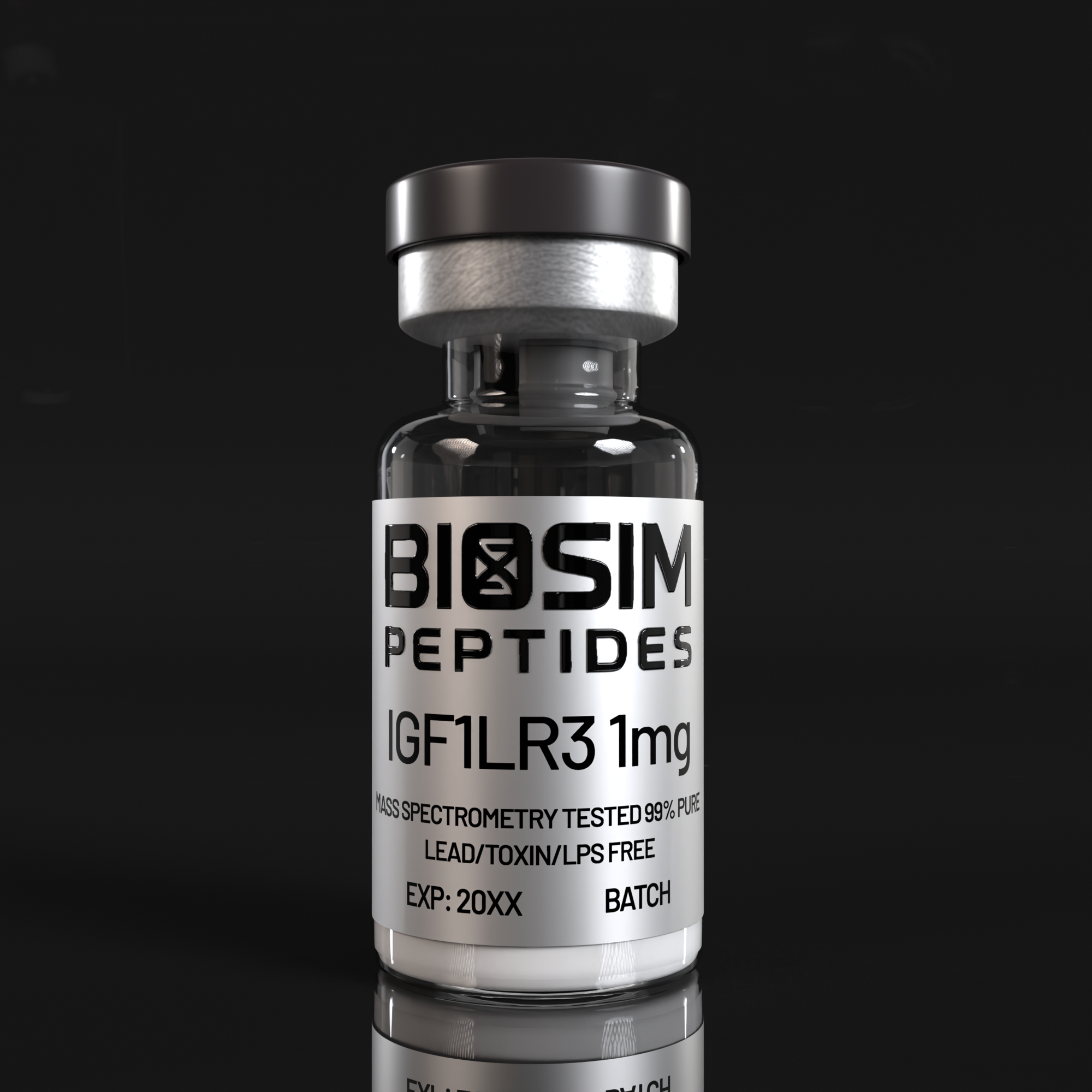
IGF-1 LR3 1mg: Research Overview
Insulin-like Growth Factor-1 Long R3 (IGF-1 LR3) is a recombinant analog of native IGF-1 engineered for enhanced stability and potency in laboratory research settings. This 83-amino-acid variant features a glutamate-to-arginine substitution at position 3 of the mature IGF-1 sequence combined with a 13-amino-acid N-terminal extension peptide, yielding a molecule with markedly reduced affinity for IGF-binding proteins (IGFBPs) and an extended biological half-life in vitro. BioSim Peptides supplies IGF-1 LR3 as a lyophilized powder at 1mg per vial, verified to ≥98% purity by HPLC and mass spectrometry, for use exclusively in controlled laboratory research investigating growth factor signaling, myogenesis, and tissue regeneration pathways.
Native IGF-1 is the primary mediator of growth hormone’s anabolic effects in skeletal muscle and other tissues, acting through the IGF-1 receptor (IGF-1R) to activate the PI3K/AKT and Ras/MAPK signaling cascades. However, native IGF-1 is rapidly sequestered in vivo by six high-affinity IGFBPs that limit its bioavailability to approximately 1% of the total circulating pool. IGF-1 LR3 was specifically designed to overcome this limitation: the combined Arg³ substitution and N-terminal extension reduce IGFBP binding affinity by over 100-fold while preserving full agonist activity at the IGF-1R, making this analog a powerful tool for researchers studying growth factor biology without the confounding influence of endogenous binding proteins12.
Molecular Background & Mechanism of Action
IGF-1 LR3 engages the type 1 IGF receptor (IGF-1R), a heterotetrameric transmembrane tyrosine kinase, with affinity comparable to wild-type IGF-1. Ligand binding induces receptor autophosphorylation at tyrosine residues within the intracellular kinase domain, creating docking sites for insulin receptor substrate (IRS) proteins and Shc adaptor proteins. IRS-1/2 phosphorylation recruits the p85 regulatory subunit of phosphatidylinositol 3-kinase (PI3K), which generates phosphatidylinositol (3,4,5)-trisphosphate (PIP₃) at the plasma membrane, leading to membrane recruitment and phosphorylation of AKT (PKB). Activated AKT phosphorylates downstream targets including mTORC1, FoxO transcription factors, and GSK-3β, collectively promoting protein synthesis, inhibiting proteolysis, and driving cell cycle progression23.
The critical structural feature of IGF-1 LR3 is its resistance to IGFBP-mediated neutralization. Crystallographic and mutagenesis studies have established that the N-terminal region of native IGF-1 (residues 1-3) forms essential contacts with IGFBP-3 and IGFBP-5. The Glu³→Arg substitution in LR3 introduces both a charge reversal and a steric clash with the IGFBP binding cleft, while the 13-residue N-terminal extension peptide derived from porcine growth hormone further obstructs the IGFBP interaction surface. The result is a molecule that remains freely diffusible in culture media and tissue preparations, providing sustained IGF-1R activation that more closely models continuous receptor stimulation14.
Additionally, IGF-1 LR3 retains cross-reactivity with the insulin receptor (IR) and IGF-1R/IR hybrid receptors, though with approximately 10-fold lower affinity than at the cognate IGF-1R. Researchers should account for this pharmacological overlap when interpreting results in cell types co-expressing both receptor families. The extended half-life of LR3 — estimated at 20-30 hours in most experimental systems compared to 10-20 minutes for native IGF-1 — enables convenient once-daily dosing protocols in longitudinal cell culture and tissue explant studies15.
Preclinical & Clinical Evidence
The biological activity of Long R3 IGF-1 in myogenic systems has been extensively characterized. Xi et al. (2004) demonstrated that Long-R3-IGF-I dose-dependently stimulated both proliferation and differentiation of L6 rat myogenic cells, and critically, that co-administration of recombinant IGFBP-3 inhibited wild-type IGF-I activity but failed to suppress Long-R3-IGF-I-mediated responses, confirming the analog’s functional resistance to binding protein antagonism2. In a complementary study using porcine embryonic myoblast cultures, Pampusch et al. (2005) showed that IGFBP-5 was equally ineffective at blocking Long-R3-IGF-I-stimulated myoblast proliferation, while it potently suppressed native IGF-I activity3.
Early in vivo metabolic studies established the translational relevance of the LR3 modification. Hill et al. (1999) administered Long(R3)-IGF-1 to beef heifers and documented significant reductions in plasma amino acid concentrations and urea nitrogen, consistent with increased whole-body protein synthesis and reduced amino acid oxidation — effects that were substantially more pronounced and sustained compared to equivalent doses of native IGF-11. In a landmark 2010 analytical study, Kohler et al. developed a mass spectrometry method for detecting His-tagged Long-R³-IGF-I and unequivocally identified the analog in confiscated products, establishing that LR3 migrates with a distinct mass shift consistent with the N-terminal extension and confirming its structural identity as a discrete molecular entity4.
Contemporary applications highlight the versatility of IGF-1 LR3 as a research tool. Lu et al. (2023) reported successful recombinant expression of LR3 IGF-1 fused with xylanase in Pichia pastoris, achieving high-yield soluble production suitable for large-scale experimental use and demonstrating that the LR3 modification is compatible with fusion protein strategies5. Most recently, Yavuz et al. (2025) incorporated controlled-release IGF-1 LR3 into a decellularized plant-stem-based nerve conduit and demonstrated significantly enhanced sciatic nerve regeneration in a rat model, with improved axonal alignment, myelination, and functional recovery compared to conduits without growth factor supplementation — a compelling illustration of LR3’s utility in complex tissue engineering applications7. In a complementary study examining growth-restricted fetal physiology, White et al. (2025) administered IGF-1 LR3 to late-gestation growth-restricted fetal sheep and found that while the analog did not reverse established growth restriction, it provided important negative data clarifying the temporal limitations of IGF-1R-targeted interventions in developmental contexts, underscoring the importance of treatment timing in experimental design8.
Research Applications
- Skeletal Muscle Myogenesis: Investigate the role of sustained IGF-1R signaling in myoblast proliferation, differentiation, and fusion using C2C12 or L6 myogenic cell lines. IGF-1 LR3’s IGFBP resistance enables researchers to study growth factor effects without interference from endogenously secreted binding proteins23.
- Satellite Cell Biology: Examine the effects of prolonged IGF-1 exposure on muscle satellite cell activation, self-renewal, and commitment to the myogenic lineage in primary cell cultures and isolated fiber preparations.
- PI3K/AKT/mTOR Pathway Studies: Utilize IGF-1 LR3 as a potent and sustained activator of the PI3K/AKT signaling axis to dissect downstream phosphorylation cascades, including mTORC1-mediated protein synthesis, FoxO-regulated proteolysis, and GSK-3β-mediated metabolic control.
- Tissue Engineering & Regenerative Medicine: Incorporate IGF-1 LR3 into biomaterial scaffolds, hydrogels, or controlled-release systems to evaluate its effects on cell survival, proliferation, and tissue remodeling in three-dimensional culture models7.
- Comparative Growth Factor Signaling: Compare the signaling kinetics, receptor trafficking, and transcriptional outputs of IGF-1 LR3 versus native IGF-1, insulin, and mechano-growth factor (MGF) to dissect ligand-specific versus shared signaling nodes.
- Protein Metabolism Research: Model the effects of sustained IGF-1 tone on protein synthesis and degradation rates using isotopic tracer methodologies in cell and tissue culture systems1.
Comparative Context
Researchers evaluating growth factor tools for myogenesis and tissue regeneration studies often weigh IGF-1 LR3 against native IGF-1, mechano-growth factor (MGF), and IGF-1 DES (1-3). The table below summarizes key differentiating features relevant to experimental design. IGF-1 LR3’s most distinctive advantage is its near-complete resistance to IGFBP sequestration, which translates to markedly prolonged signaling duration and reduced experimental variability from culture-condition-dependent IGFBP expression. MGF (IGF-1Ec) preferentially activates satellite cell proliferation through a somewhat distinct receptor interaction profile, while IGF-1 DES (a truncated IGF-1 lacking the N-terminal tripeptide) exhibits intermediate IGFBP affinity and a shorter half-life than LR3. For experiments requiring sustained, high-amplitude IGF-1R activation in serum-containing media or complex co-culture systems where endogenous IGFBPs are present, IGF-1 LR3 represents the research tool of choice236.
| Compound | Target | Key Property |
|---|---|---|
| IGF-1 LR3 | IGF-1R (full agonist) | IGFBP-resistant; ~20-30 hour half-life in vitro |
| Native IGF-1 | IGF-1R (full agonist) | High IGFBP affinity; ~10-20 min free half-life |
| IGF-1 DES (1-3) | IGF-1R (full agonist) | Reduced (not eliminated) IGFBP binding |
| MGF (IGF-1Ec) | IGF-1R (biased signaling) | Satellite cell proliferation bias; shorter half-life |
Safety & Laboratory Handling
Store lyophilized IGF-1 LR3 at -20°C protected from light and moisture. For reconstitution, use sterile bacteriostatic water or dilute acetic acid (10-20 mM) — the peptide exhibits optimal solubility under mildly acidic conditions (pH 3-4). Do not use saline or neutral phosphate buffers for initial reconstitution, as IGF-1 LR3 may precipitate near physiological pH. Reconstituted stock solutions should be aliquoted, stored at 2-8°C, and used within 30 days. For long-term storage, aliquot and freeze at -20°C or -80°C. Avoid repeated freeze-thaw cycles, which promote aggregation and loss of bioactivity. Use appropriate personal protective equipment (PPE) including gloves, lab coat, and eye protection. Work in a certified biosafety cabinet when preparing sterile solutions. This product is for laboratory research use only — not for diagnostic or therapeutic applications. Not for human or veterinary use.
References
- Hill RA, Hunter RA, Lindsay DB, Owens PC. “Action of long(R3)-insulin-like growth factor-1 on protein metabolism in beef heifers.” Domest Anim Endocrinol. 1999 May;16(4):219-229. PMID: 10370861.
- Xi G, Kamanga-Sollo E, Pampusch MS, White ME, Hathaway MR, Dayton WR. “Effect of recombinant porcine IGFBP-3 on IGF-I and long-R3-IGF-I-stimulated proliferation and differentiation of L6 myogenic cells.” J Cell Physiol. 2004 Sep;200(3):387-394. PMID: 15254966.
- Pampusch MS, Xi G, Kamanga-Sollo E, Loseth KJ, Hathaway MR, Dayton WR. “Production of recombinant porcine IGF-binding protein-5 and its effect on proliferation of porcine embryonic myoblast cultures in the presence and absence of IGF-I and Long-R3-IGF-I.” J Endocrinol. 2005 Apr;185(1):197-206. PMID: 15817840.
- Kohler M, Thomas A, Walpurgis K, Terlouw K, Schänzer W, Thevis M. “Detection of His-tagged Long-R³-IGF-I in a black market product.” Growth Horm IGF Res. 2010 Oct;20(5):386-390. PMID: 20675162.
- Lu Z, Liu N, Huang H, Wang Y, Tu T, He Y. “Recombinant expression of IGF-1 and LR3 IGF-1 fused with xylanase in Pichia pastoris.” Appl Microbiol Biotechnol. 2023 Jul;107(14):4495-4509. PMID: 37261455.
- Engel MG, Narayan S, Cui MH, Branch CA, Zhang X, de la Monte SM. “Intranasal long R3 insulin-like growth factor-1 treatment promotes amyloid plaque remodeling in cerebral cortex but fails to preserve cognitive function in male 5XFAD mice.” J Alzheimers Dis. 2025 Jan;103(2):351-364. PMID: 39610283.
- Yavuz E, Sağır MS, Ercan A, Erginer M, Barlas FB, Güner FS, Köse GT. “Revolutionary decellularized Alstroemeria stem-based nerve conduit integrated with GelMA and controlled IGF-1 LR3 release for enhanced rat sciatic nerve regeneration.” Int J Biol Macromol. 2025 Nov;297:147888. PMID: 41015370.
- White A, Stremming J, Wesolowski SR, Al-Juboori SI, Dobrinskikh E, Brown LD. “IGF-1 LR3 does not promote growth in late-gestation growth-restricted fetal sheep.” Am J Physiol Endocrinol Metab. 2025 Jan 1;328(1):E21-E32. PMID: 39679943.
⚠ Research Use Only: This product is sold exclusively for in vitro laboratory research. Not evaluated by FDA for human use. Not for diagnostic, therapeutic, veterinary, or clinical applications. Proper institutional biosafety and IACUC approvals are the purchaser’s responsibility.
Frequently Asked Research Questions — IGF-1 LR3 (Long R3 Insulin-like Growth Factor-1)
What is IGF-1 LR3 and how is it different from regular IGF-1?
IGF-1 LR3 (Long R3 IGF-1) is a recombinant analog of human IGF-1 with two modifications: an arginine substitution at position 3 and a 13-amino-acid N-terminal extension. These changes reduce binding to IGF-binding proteins (IGFBPs) by 100-fold, dramatically extending its half-life from ~10 minutes (native IGF-1) to 20-30 hours. This makes it far more practical for extended research protocols.
What cellular pathways does IGF-1 LR3 activate?
IGF-1 LR3 activates both the IGF-1 receptor (IGF1R) and, at higher concentrations, the insulin receptor. Downstream signaling includes: PI3K/Akt pathway (cell survival and growth), MAPK/ERK pathway (proliferation), and mTOR pathway (protein synthesis). It promotes myogenesis (muscle cell differentiation), inhibits protein degradation, and supports satellite cell activation in muscle research models.
What are the primary research applications for IGF-1 LR3?
Key research applications include: muscle hypertrophy and myogenesis studies, muscle atrophy prevention research (disuse, denervation, cachexia models), tissue regeneration and repair, bone growth and osteoblast activity research, and comparative studies of IGF-1 isoforms and their binding-protein interactions. It is also used in cell culture as a growth supplement for specific cell lines.
How is IGF-1 LR3 reconstituted and stored for research?
Reconstitute IGF-1 LR3 with sterile water or acetic acid solution (10mM) rather than bacteriostatic water to prevent peptide aggregation. After reconstitution, store at 2-8°C and use within 30 days. Avoid vortexing or aggressive shaking which can denature the protein. Lyophilized powder should be stored at -20°C. BioSim provides 1mg vials verified by HPLC and mass spectrometry.

Reviews
There are no reviews yet.