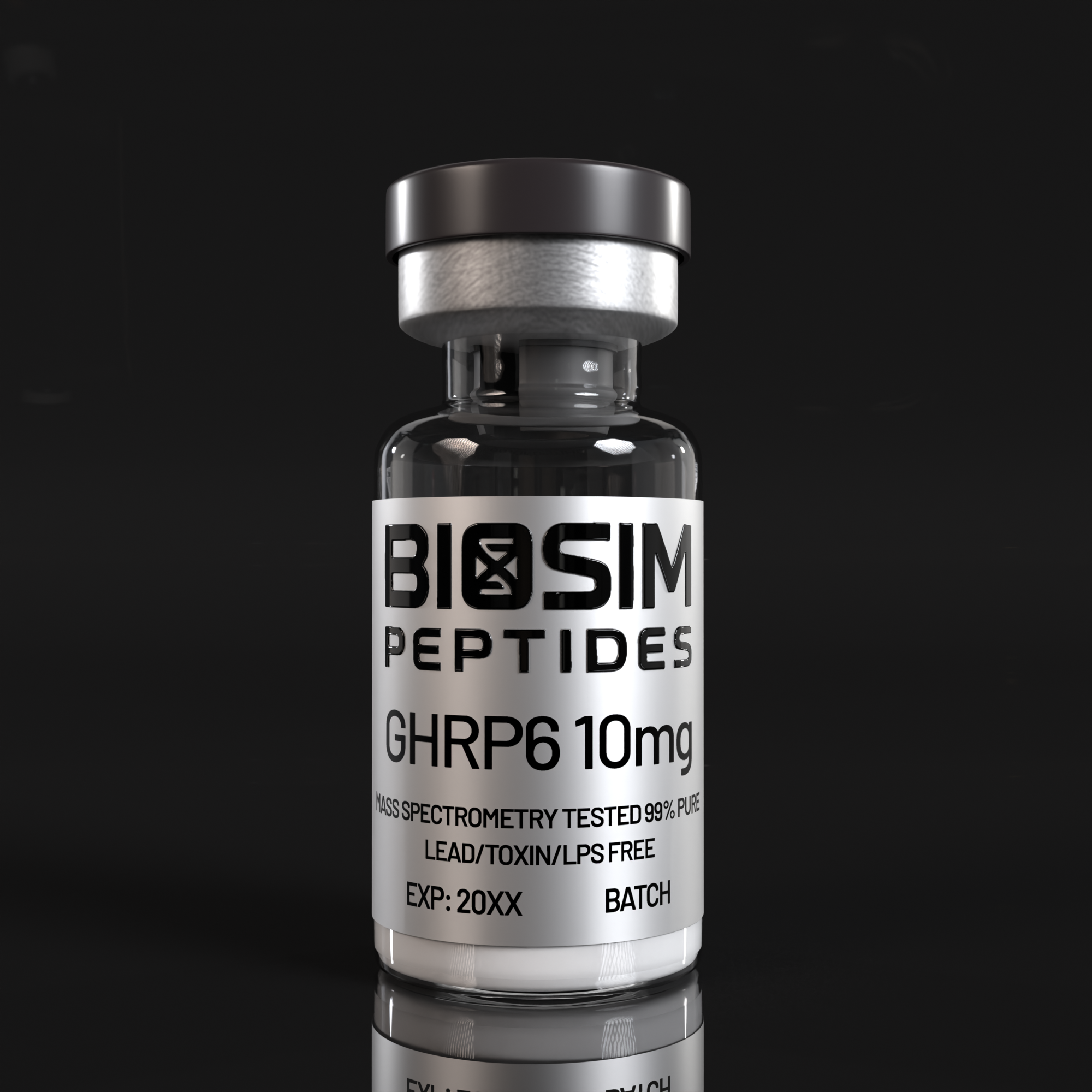
GHRP-6 10mg: Research Overview
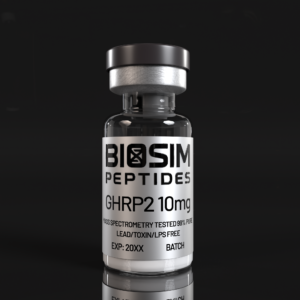
Growth Hormone Releasing Peptide-6 (GHRP-6) is a synthetic hexapeptide (His-D-Trp-Ala-Trp-D-Phe-Lys-NH₂) and a potent agonist of the growth hormone secretagogue receptor type 1a (GHS-R1a), the cognate receptor for the endogenous hormone ghrelin. First characterized by Bowers and colleagues as part of systematic peptide optimization efforts, GHRP-6 has become one of the most extensively studied ghrelin mimetics in preclinical research, distinguished by its dual capacity to stimulate pituitary growth hormone (GH) release and to activate hypothalamic orexigenic circuits that drive feeding behavior. This pronounced appetite-stimulating property, which exceeds that of other GHS-R1a agonists such as GHRP-2 and ipamorelin, has made GHRP-6 a principal research tool in the study of cachexia, muscle wasting, and metabolic regulation. BioSim Peptides supplies GHRP-6 at ≥98% purity as a lyophilized powder (10mg) for in vitro laboratory research use exclusively. It has not been evaluated by the FDA for human use and is not intended for diagnostic, therapeutic, or clinical applications.
Molecular Background & Mechanism of Action
GHRP-6 binds with nanomolar affinity to GHS-R1a, a Gαq/11-coupled seven-transmembrane domain receptor whose cryo-electron microscopy structure in complex with GHRP-6 was recently resolved, revealing critical molecular determinants of ligand recognition and receptor activation — including key interactions between the peptide’s D-Trp² and D-Phe⁵ residues and the receptor’s orthosteric binding pocket[1]. Upon agonist binding, GHS-R1a undergoes conformational rearrangement that promotes guanine nucleotide exchange on the Gαq/11 subunit, leading to phospholipase C (PLC) activation, generation of inositol trisphosphate (IP₃) and diacylglycerol (DAG), and mobilization of intracellular Ca²⁺. In pituitary somatotrophs, the resultant rise in cytosolic calcium triggers the exocytotic release of GH from secretory vesicles. In hypothalamic arcuate nucleus neurons, GHS-R1a activation by GHRP-6 stimulates neuropeptide Y (NPY) and agouti-related protein (AgRP) neuronal populations while indirectly modulating pro-opiomelanocortin (POMC) neurons, producing a net orexigenic signal that potently drives food-seeking behavior[2][3].
Unlike acylated ghrelin, GHRP-6 does not require post-translational n-octanoylation for receptor activation, rendering it resistant to deacylation by serum esterases and providing consistent pharmacological activity across experimental conditions. The peptide also engages convergent signaling with the GHRH receptor at the level of adenylyl cyclase/cyclic AMP, producing synergistic enhancement of GH secretion when both receptors are co-activated[2]. This property is particularly relevant for research protocols investigating combinatorial secretagogue approaches.
Preclinical & Clinical Evidence
The therapeutic potential of GHRP-6 in catabolic disease states was elegantly demonstrated by Xu and colleagues, who showed that GHRP-6 administration in a rat model of chronic heart failure significantly improved cardiac function, attenuated cachectic weight loss, suppressed circulating stress hormones (corticosterone, norepinephrine), and reduced cardiomyocyte apoptosis[4]. This study established that GHS-R1a agonism can simultaneously address cardiac dysfunction and systemic wasting, providing a foundation for subsequent cachexia research.
The orexigenic circuitry engaged by GHRP-6 was mapped in detail by Pirnik and colleagues, who conducted c-Fos immunohistochemistry studies demonstrating that GHRP-6 administration robustly activates neurons in hypothalamic nuclei critical for feeding regulation — including the arcuate nucleus, paraventricular nucleus, and lateral hypothalamic area — with a pattern that mirrors but is not identical to that of native ghrelin[2]. Fujitsuka et al. further demonstrated that potentiation of ghrelin signaling, using approaches including GHRP-6, attenuated cancer anorexia-cachexia and prolonged survival in tumor-bearing rodent models, implicating GHS-R1a as a viable node for cachexia intervention research[3].
More recent investigations have expanded the research profile of GHRP-6 into tissue protection and repair. Berlanga-Acosta and colleagues demonstrated that GHRP-6 pretreatment prevented doxorubicin-induced myocardial and extra-myocardial damage by activating pro-survival signaling cascades including PI3K/Akt and ERK1/2 pathways, while also attenuating oxidative stress markers[5]. A 2025 study developed a GHRP-6-loaded hydrogel system that demonstrated efficacy in a murine acute kidney injury model through metabolic regulation and attenuation of ferroptosis, highlighting the peptide’s versatility in tissue injury paradigms[6]. Extending this tissue-protective profile, Wang and colleagues showed that GHRP-6 ameliorated acute lung injury and prevented subsequent interstitial fibrosis progression in preclinical models[7]. Most recently, GHRP-6 was shown to ameliorate post-infarct ventricular remodeling and preserve systolic function in a permanent coronary ligation model, further supporting its relevance to cardioprotection research[8].
Research Applications
- Cachexia & Muscle Wasting Research: GHRP-6 is a preferred research tool for investigating ghrelin-mediated anti-cachectic mechanisms. Its demonstrated ability to attenuate body weight loss, preserve lean mass, and suppress catabolic stress hormones in heart failure and cancer cachexia models makes it central to wasting disorder research[3][4].
- Appetite Regulation & Feeding Neurocircuitry: GHRP-6 activates key hypothalamic feeding centers (NPY/AgRP neurons) and is employed to map orexigenic signaling pathways, investigate ghrelin-mediated hedonic feeding, and study the neuroendocrine integration of energy balance[2].
- Cardioprotection & Cardiac Remodeling: Multiple independent studies have characterized GHRP-6-mediated cardioprotective effects, including reduction of infarct size, attenuation of adverse ventricular remodeling, and preservation of systolic function in permanent coronary ligation models[4][8].
- Tissue Injury & Fibrosis Research: Emerging evidence positions GHRP-6 as a relevant probe in acute organ injury paradigms, including acute kidney injury, acute lung injury, and pulmonary fibrosis, where GHS-R1a-mediated pro-survival signaling pathways are under investigation[6][7].
- GH Secretion Dynamics: As a direct GHS-R1a agonist, GHRP-6 is used in studies characterizing GH pulsatility, somatotroph calcium signaling, and the synergistic interaction between GHS-R1a and GHRH receptor pathways in anterior pituitary research[1].
Comparative Context: GHRP-6 vs. GHRP-2 vs. Ipamorelin
GHRP-6 is one of three major synthetic GHS-R1a agonists commonly employed in preclinical research. While all three stimulate GH release through the same receptor, GHRP-6 is uniquely characterized by its pronounced orexigenic effect — a property that makes it the preferred choice for appetite and cachexia studies. GHRP-2 offers greater GH-releasing potency, while ipamorelin provides maximal receptor selectivity with the most favorable off-target profile. The table below summarizes the key differentiating features for research protocol design.
| Compound | Primary Target | GH Release Potency | Appetite Stimulation | Cortisol/Prolactin Effects | Best Research Fit |
|---|---|---|---|---|---|
| GHRP-6 | GHS-R1a | High (++) | Pronounced (+++) | Mild elevation at high doses | Cachexia, appetite, tissue protection |
| GHRP-2 | GHS-R1a | Very High (+++) | Moderate (++) | Mild elevation at high doses | GH axis, muscle, body composition |
| Ipamorelin | GHS-R1a (selective) | Moderate-High (++) | Minimal (+) | Negligible | Selective GH studies, minimal off-target |
Safety & Laboratory Handling
Store lyophilized GHRP-6 at -20°C, protected from light and moisture. Prior to reconstitution, allow the vial to reach ambient temperature to prevent condensation. Reconstitute with sterile bacteriostatic water (0.9% benzyl alcohol; not included) to the desired concentration. Reconstituted solutions should be stored at 2–8°C and used within 30 days. For extended storage, aliquot into single-use volumes and freeze at -80°C. Avoid repeated freeze-thaw cycles, which promote peptide aggregation and oxidation, particularly at the tryptophan residues present in the GHRP-6 sequence. Use appropriate personal protective equipment (PPE) including nitrile gloves, laboratory coat, and safety goggles. All handling should be performed in a laminar flow hood or biosafety cabinet using aseptic technique. For laboratory research use only — not for diagnostic, therapeutic, veterinary, or any clinical application. Not for human consumption.
References
- Wang Y, Guo S, Zhuang Y, et al. “Molecular recognition of an acyl-peptide hormone and activation of ghrelin receptor.” Nat Commun. 2021;12(1):5064. PMID: 34417468.
- Pirnik Z, Bundziková J, Holubová M, et al. “Ghrelin agonists impact on Fos protein expression in brain areas related to food intake regulation in male C57BL/6 mice.” Neurochem Int. 2011;59(6):889-895. PMID: 21843570.
- Fujitsuka N, Asakawa A, Uezono Y, et al. “Potentiation of ghrelin signaling attenuates cancer anorexia-cachexia and prolongs survival.” Transl Psychiatry. 2011;1(7):e23. PMID: 22832525.
- Xu XB, Pang JJ, Cao JM, et al. “GH-releasing peptides improve cardiac dysfunction and cachexia and suppress stress-related hormones and cardiomyocyte apoptosis in rats with heart failure.” Am J Physiol Heart Circ Physiol. 2005;289(5):H2070-H2078. PMID: 15951341.
- Berlanga-Acosta J, Cibrian D, Valiente-Mustelier J, et al. “Growth hormone releasing peptide-6 (GHRP-6) prevents doxorubicin-induced myocardial and extra-myocardial damages by activating prosurvival mechanisms.” Front Pharmacol. 2024;15:1404641. PMID: 38873418.
- Zhao X, Pan K, Li R, et al. “Growth hormone-releasing peptide 6 (GHRP-6) hydrogel for acute kidney injury therapy via metabolic regulation.” J Nanobiotechnology. 2025;23(1):315. PMID: 41327290.
- Wang L, Berlanga-Acosta J, Yu H, et al. “Growth hormone releasing peptide-6 (GHRP-6) ameliorates acute lung injury and its subsequent evolvement to interstitial fibrosis.” Int Immunopharmacol. 2026;148:114160. PMID: 41534456.
- Wang L, Rodriguez-Ulloa A, Berlanga-Acosta J, et al. “Growth Hormone-Releasing Peptide-6 (GHRP-6) Ameliorates Post-Infarct Ventricular Remodeling and Systolic Dysfunction in a Model of Permanent Coronary Ligation.” Pharmaceuticals (Basel). 2026;19(3):372. PMID: 41901314.
⚠ Research Use Only: This product is sold exclusively for in vitro laboratory research. It has not been evaluated by the FDA for human use and is not intended for diagnostic, therapeutic, or any clinical application. Statements regarding biological mechanisms describe preclinical and clinical research findings and do not constitute claims about product efficacy for any purpose in humans.

Reviews
There are no reviews yet.