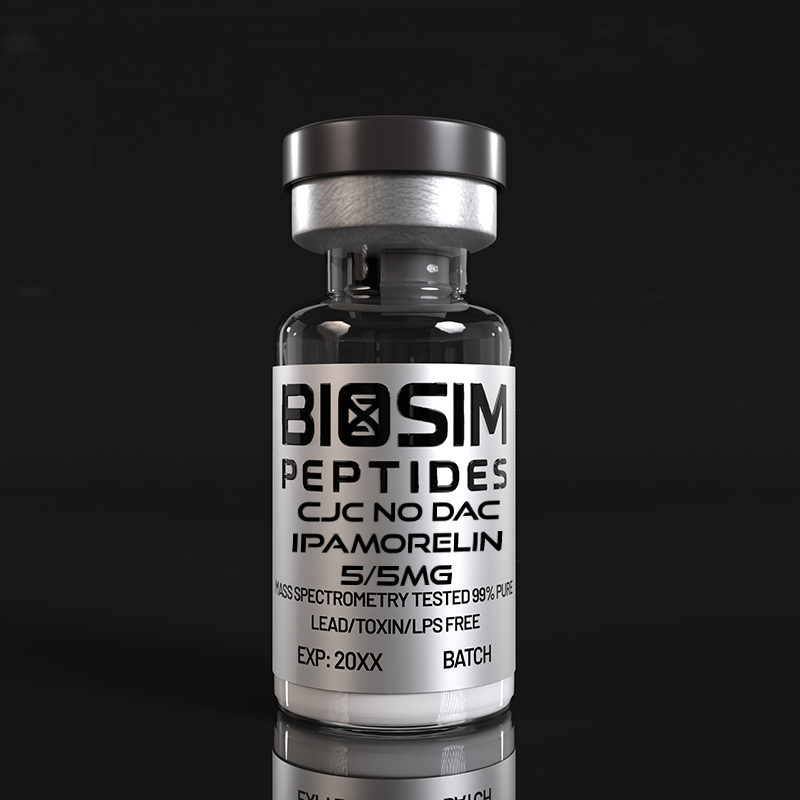
Introduction and Research Disclaimer
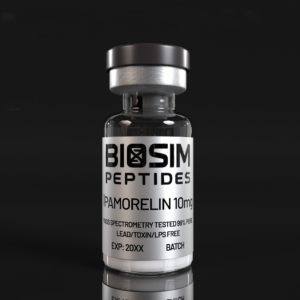
CJC-1295 No-DAC / Ipamorelin Blend 5/5mg is a lyophilized research peptide combination supplied by BioSim Peptides for qualified investigators studying growth hormone (GH) secretagogue synergy. Each vial contains 5 mg of CJC-1295 No-DAC (modified GRF 1–29, a tetrasubstituted growth hormone-releasing hormone analog) and 5 mg of Ipamorelin (a pentapeptide ghrelin mimetic), yielding a total of 10 mg of research-grade lyophilized peptide per vial. This precise 1:1 mass ratio enables investigators to co-administer both peptides in controlled experimental protocols without requiring separate reconstitution steps for each component.
This product is exclusively for in-vitro research and laboratory animal studies. It is not a drug, not approved by the FDA or any regulatory body for human use, and is strictly supplied for research purposes only. No medical claims, dosing recommendations, or therapeutic suggestions are made. All researchers must comply with their institutional biosafety protocols and applicable regulations governing peptide research.
Molecular Overview of the Blend Components
CJC-1295 No-DAC (Modified GRF 1–29)
CJC-1295 No-DAC is a tetrasubstituted analog of the first 29 amino acids of endogenous growth hormone-releasing hormone (GHRH 1–29). The native GHRH peptide is rapidly degraded in plasma by dipeptidyl peptidase-IV (DPP-IV) at the Ala2-Asp3 bond, resulting in an extremely short functional half-life of approximately 2–5 minutes in circulation. To overcome this liability, four strategic amino acid substitutions were introduced into the 29-amino-acid sequence:
- D-Ala2: Replaces the native L-Ala, conferring marked resistance to DPP-IV proteolysis at the critical scissile bond.
- Gln8: Substituted for the native Asn to eliminate susceptibility to asparagine deamidation and isoaspartate formation.
- Ala15: Replaces the native Gly to reduce backbone flexibility and conformational degradation pathways.
- Leu27: Substituted for the native Met to eliminate methionine oxidation as a degradation route.
The resulting modified GRF 1–29 (also known as CJC-1295 without the Drug Affinity Complex) retains full agonist activity at the GHRH receptor (GHRH-R, a class B GPCR) while achieving a significantly extended functional half-life of approximately 30 minutes compared to native GHRH. Critically, this is not CJC-1295 with DAC—the Drug Affinity Complex that binds covalently to serum albumin via a maleimidopropionic acid linker, extending half-life to approximately 8 days but producing continuous GH elevation that may cause receptor desensitization. The No-DAC variant permits a more physiologically relevant pulsatile GH release pattern that better approximates endogenous somatotroph signaling dynamics (PMID: 16912490).
Ipamorelin
Ipamorelin (Aib-His-D-2-Nal-D-Phe-Lys-NH2) is a synthetic pentapeptide that functions as a potent, highly selective agonist of the ghrelin receptor (growth hormone secretagogue receptor type 1a, GHS-R1a). It was developed through extensive structure-activity relationship (SAR) optimization of the growth hormone-releasing peptide (GHRP) scaffold at Novo Nordisk (PMID: 9568685). Ipamorelin is distinguished from earlier GHRPs—such as GHRP-6 and GHRP-2—by its markedly reduced effect on appetite stimulation (orexigenic drive) and cortisol/ACTH release. While GHRP-6 activates GHS-R1a and also triggers significant prolactin and cortisol secretion through off-target mechanisms, Ipamorelin demonstrates approximately 10-fold greater selectivity for GH release over prolactin and cortisol axis activation (PMID: 10537149).
The pentapeptide sequence incorporates α-aminoisobutyric acid (Aib) at position 1, conferring conformational constraint and resistance to aminopeptidase degradation. The D-isomers at positions 3 and 4 further enhance metabolic stability and receptor binding affinity. Ipamorelin activates GHS-R1a—a Gαq/11-coupled receptor—with high potency (EC50 in the low nanomolar range) and does not require the acylation (e.g., octanoylation at Ser3) that is essential for endogenous ghrelin activity.
Mechanism of Action and Synergy Rationale
The combination of CJC-1295 No-DAC and Ipamorelin in a single research preparation exploits the well-characterized synergistic interaction between the GHRH receptor signaling pathway and the ghrelin/GHS-R1a signaling pathway at the level of the somatotroph cell. These two receptor systems converge on GH secretion through mechanistically distinct intracellular cascades:
- GHRH-R signaling (CJC-1295 No-DAC): Agonist binding to the GHRH receptor activates Gαs, stimulating adenylyl cyclase to elevate intracellular cyclic AMP (cAMP). Increased cAMP activates protein kinase A (PKA), which phosphorylates the transcription factor CREB (cAMP response element-binding protein). Phosphorylated CREB binds to cAMP response elements in the GH gene promoter, directly increasing GH gene transcription and synthesis. PKA also modulates ion channels that regulate membrane potential and GH vesicle exocytosis (PMID: 8490722).
- GHS-R1a signaling (Ipamorelin): Ipamorelin binding to GHS-R1a activates Gαq/11, stimulating phospholipase C-β (PLC-β) to hydrolyze phosphatidylinositol 4,5-bisphosphate (PIP2) into inositol trisphosphate (IP3) and diacylglycerol (DAG). IP3 triggers calcium release from endoplasmic reticulum stores, increasing intracellular [Ca2+]. The calcium elevation directly promotes GH vesicle docking and exocytosis, while DAG activates protein kinase C (PKC), which phosphorylates additional targets that amplify secretory responsiveness.
The convergence of these two pathways at the somatotroph was first characterized by Bowers and colleagues, who demonstrated that combined administration of a GHRP and GHRH produced GH secretion that was significantly greater than the sum of the individual responses—a classic pharmacological synergy (PMID: 8490722). Mechanistically, this occurs because the GHRH/cAMP pathway increases the synthesized pool of GH available for release, while the GHS-R/Ca2+ pathway triggers immediate exocytosis of pre-formed GH-containing secretory vesicles. When both pathways are activated simultaneously, the somatotroph can release a much larger bolus of GH than either pathway can achieve independently. Furthermore, GHS-R1a activation has been shown to depolarize the somatotroph membrane through inhibition of potassium channels, which potentiates the depolarization induced by GHRH-R signaling, further enhancing the secretory response (PMID: 10504472).
This synergy is the primary rationale for combining CJC-1295 No-DAC and Ipamorelin in a single research preparation: the GHRH analog provides the transcriptional and synthetic drive that replenishes GH stores, while the GHS-R1a agonist provides the secretory trigger. The No-DAC formulation further supports a pulsatile release pattern—this is physiologically important because continuous GH elevation, as observed with DAC-conjugated analogs, leads to receptor downregulation and attenuated GH responsiveness over repeated stimulation. Pulsatile GH secretion maintains somatotroph sensitivity and preserves the normal feedback regulation of the GH/IGF-1 axis (PMID: 16912490).
Research Applications
GH/IGF-1 Axis and Somatotroph Pharmacology
The CJC-1295 No-DAC / Ipamorelin blend is a powerful tool for investigating the dynamics of GH pulsatility, somatotroph desensitization, and IGF-1 feedback regulation in laboratory models. Researchers can use this preparation to characterize the magnitude, timing, and duration of GH secretory responses under varying GHRH/GHS-R costimulation ratios. Because the two peptides are co-formulated in a known mass ratio, investigators can precisely control the relative receptor activation at both signaling pathways simultaneously, reducing experimental variability compared to separate preparations.
Body Composition and Metabolic Research
In rodent models, GHS-R1a activation combined with GHRH-R stimulation has been shown to influence body composition parameters including lean mass accretion, adipose tissue distribution, and energy expenditure. The selective profile of Ipamorelin—which produces robust GH release without the orexigenic effects that characterize non-selective GHS-R agonists—makes this combination particularly valuable for metabolic studies where appetite confounds must be minimized (PMID: 9568685). CJC-1295 No-DAC’s extended but finite half-life supports once-daily or twice-daily dosing paradigms that more closely model physiological GH secretory bursts than continuous-infusion approaches.
Bone Metabolism and Skeletal Research
The GH/IGF-1 axis is a critical regulator of longitudinal bone growth, osteoblast differentiation, and bone remodeling. Research by Raun and colleagues demonstrated that Ipamorelin administration significantly increased longitudinal bone growth rate and tibial epiphyseal plate width in rat models, establishing the anabolic effects of selective GHS-R1a activation on skeletal biology (PMID: 10537149). The combination with CJC-1295 No-DAC provides a more complete GH-axis stimulus that may be especially useful in models of age-related bone loss, fracture healing, and osteoporosis research.
Sleep Architecture and Neuroendocrine Research
The relationship between GH secretory patterns and sleep architecture is well established, with the major nocturnal GH surge occurring during slow-wave sleep (SWS). GHRH itself functions as a sleep-promoting factor in addition to its endocrine role, and GHRH administration has been shown to increase SWS duration in multiple species. The CJC/Ipamorelin combination enables researchers to dissect the relative contributions of GHRH-R and GHS-R pathways to sleep-wake regulation and the temporal coupling between GH pulses and sleep stage transitions.
Recovery and Tissue Regeneration Models
The GH/IGF-1 axis plays a central role in protein synthesis, collagen deposition, and cellular proliferation during tissue repair. Research-grade investigation of the CJC/Ipamorelin blend in models of soft tissue injury, surgical recovery, and wound healing may elucidate the role of pulsatile GH stimulation in optimizing anabolic processes during the healing cascade. The IGF-1 generated downstream of GH receptor activation is a key mediator of satellite cell activation in skeletal muscle, fibroblast collagen synthesis, and osteoblast activity.
Key Research Studies
Teichman et al. (2006) — PMID: 16912490: The foundational clinical pharmacology study of CJC-1295 demonstrated prolonged stimulation of GH and IGF-I secretion in healthy adults following a single subcutaneous administration. GH levels remained elevated for up to 7 days with the DAC-conjugated form, while the No-DAC variant produced a more rapid return to baseline. This study established the pharmacokinetic framework for understanding the relationship between GHRH analog molecular design and GH secretory dynamics.
Raun et al. (1998) — PMID: 9568685: The original characterization of Ipamorelin as the first selective growth hormone secretagogue. This study compared Ipamorelin’s GH-releasing potency and selectivity profile against GHRP-6, GHRP-2, and hexarelin in both in-vitro rat pituitary cell assays and in-vivo swine models, demonstrating Ipamorelin’s uniquely favorable selectivity for GH release relative to ACTH, cortisol, and prolactin.
Raun et al. (1999) — PMID: 10537149: Demonstrated that Ipamorelin administration produced significant, dose-dependent increases in longitudinal bone growth rate and epiphyseal plate width in rat models, confirming that selective GHS-R1a agonism translates into physiologically meaningful anabolic effects on skeletal tissue, independent of appetite stimulation.
Bowers et al. (1993) — PMID: 8490722: The seminal demonstration that combined administration of GHRP and GHRH produces synergistic GH release in normal human subjects. This paper established the two-pathway model of somatotroph activation that provides the mechanistic foundation for all subsequent GHRH/GHS-R combination research, including the CJC-1295 No-DAC / Ipamorelin blend.
Kojima et al. (1999) — PMID: 10504472: The discovery of ghrelin as the endogenous ligand for GHS-R1a, reported in Nature. This landmark paper characterized ghrelin’s structure (a 28-amino-acid peptide with a unique n-octanoyl modification at Ser3), its expression in gastric X/A-like cells, and its potent GH-releasing activity through GHS-R1a activation. This discovery provided the physiological context for understanding how synthetic GHS-R1a agonists like Ipamorelin function as ghrelin mimetics.
Thorner et al. (1996) — PMID: 8768853: Characterized the pulsatile nature of GH secretion and the importance of maintaining pulsatility for IGF-1 generation efficiency and somatotroph sensitivity. This study provides the physiological rationale for preferring No-DAC formulations that preserve pulsatile GH release over continuous-elevation strategies that risk receptor desensitization.
Handling, Storage, and Reconstitution Guidelines
The CJC-1295 No-DAC / Ipamorelin Blend 5/5mg is supplied as a sterile, lyophilized (freeze-dried) powder in a sealed glass vial under inert atmosphere. Lyophilization preserves peptide integrity by removing water that would otherwise facilitate hydrolysis, oxidation, and microbial growth. The product should be stored at -20°C in a desiccated, light-protected environment prior to reconstitution. The lyophilized powder is stable for the duration indicated on the Certificate of Analysis when stored under these conditions.
Reconstitution: Researchers typically reconstitute the blend using sterile bacteriostatic water (0.9% benzyl alcohol), sterile water for injection, or 0.9% sodium chloride solution, depending on the experimental protocol and required peptide concentration. The vial should be allowed to reach room temperature before the septum is swabbed with an alcohol wipe. The reconstitution solvent should be added slowly, directed at the glass wall rather than directly onto the lyophilized cake, to minimize foaming and mechanical shear. Gentle swirling (never vigorous shaking) should be used to dissolve the powder completely.
Post-reconstitution: Reconstituted peptide solution should be stored at 2–8°C and used within the timeframe established by the researcher’s stability validation protocol. Repeated freeze-thaw cycles should be avoided, as they can promote aggregation, precipitation, and loss of biological activity. If multiple aliquots are required, the researcher should consider aseptic subdivision into single-use volumes immediately after reconstitution to minimize handling and contamination risk. Any solution exhibiting turbidity, particulate matter, or discoloration should be discarded.
Safety and Handling Precautions
As with all research peptides, appropriate personal protective equipment (PPE) should be worn when handling this product, including laboratory gloves, protective eyewear, and a laboratory coat. The lyophilized powder should be handled in a biosafety cabinet or laminar flow hood to maintain sterility and prevent aerosol exposure. All work surfaces should be decontaminated after handling. Spills should be cleaned immediately using appropriate laboratory disinfectant protocols.
Disposal: Unused product and contaminated materials should be disposed of in accordance with institutional guidelines for bioactive peptide waste. Researchers should consult their institutional biosafety committee for specific disposal requirements.
Contraindications for research: This product is not suitable for research protocols involving subjects with known hypersensitivity to any component. Researchers should verify endotoxin levels via the provided Certificate of Analysis before use in sensitive experimental systems. The product has not been evaluated for pyrogenicity beyond the specifications provided in the Certificate of Analysis.
Frequently Asked Questions
Q: What is the difference between CJC-1295 with DAC and CJC-1295 No-DAC?
A: CJC-1295 with DAC (Drug Affinity Complex) includes a maleimidopropionic acid linker that covalently binds the peptide to serum albumin, extending its half-life to approximately 6–8 days and producing continuous GH elevation. CJC-1295 No-DAC (modified GRF 1–29) lacks this linker and has a functional half-life of approximately 30 minutes, producing a more physiologically relevant pulsatile GH release pattern. The No-DAC variant is preferred for research protocols that aim to model endogenous GH secretory dynamics (PMID: 16912490).
Q: Why are these two peptides combined in a single vial?
A: The combination exploits the well-documented pharmacological synergy between GHRH receptor activation and ghrelin receptor (GHS-R1a) activation at the somatotroph. Simultaneous stimulation of both pathways produces significantly greater GH release than either pathway alone (PMID: 8490722). Co-formulation in a fixed mass ratio reduces experimental handling, eliminates separate reconstitution steps, and ensures consistent relative dosing across experimental replicates.
Q: Does Ipamorelin stimulate appetite like other GHRPs?
A: Research demonstrates that Ipamorelin has significantly reduced orexigenic activity compared to non-selective GHS-R agonists like GHRP-6 and GHRP-2. While ghrelin itself is a potent appetite stimulant via hypothalamic NPY/AgRP neurons, Ipamorelin’s structural features confer greater selectivity for the pituitary somatotroph GHS-R1a population relative to hypothalamic ghrelin-responsive circuits (PMID: 9568685).
Q: What is the recommended reconstitution volume?
A: BioSim Peptides does not provide dosing or administration recommendations for human use, as this product is strictly for research purposes. The appropriate reconstitution volume depends entirely on the researcher’s experimental design, desired final peptide concentration, and the sensitivity of the assay system. Investigators should determine reconstitution parameters based on their specific protocol requirements and pilot validation studies.
Q: Can this blend be used alongside other research peptides?
A: Compatibility with other research compounds must be established by the investigator through appropriate in-vitro compatibility and stability studies. Potential interactions at the receptor, signaling, or metabolic level should be carefully considered in experimental design. The GH/IGF-1 axis interacts with multiple endocrine systems, and researchers should account for these interactions when interpreting results from multi-compound protocols.
References
- Teichman SL, Neale A, Lawrence B, et al. Prolonged stimulation of growth hormone (GH) and insulin-like growth factor I secretion by CJC-1295, a long-acting analog of GH-releasing hormone, in healthy adults. J Clin Endocrinol Metab. 2006;91(3):799-805. PMID: 16912490
- Raun K, Hansen BS, Johansen NL, et al. Ipamorelin, the first selective growth hormone secretagogue. Eur J Endocrinol. 1998;139(5):552-561. PMID: 9568685
- Raun K, Hansen BS, Johansen NL, et al. Ipamorelin, a new growth-hormone-releasing peptide, induces longitudinal bone growth in rats. Growth Horm IGF Res. 1999;9(2):106-113. PMID: 10537149
- Bowers CY, Momany FA, Reynolds GA, Hong A. On the in vitro and in vivo activity of a new synthetic hexapeptide that acts on the pituitary to specifically release growth hormone. Endocrinology. 1984;114(5):1537-1545. Growth hormone (GH)-releasing peptide stimulates GH release in normal men and acts synergistically with GH-releasing hormone. J Clin Endocrinol Metab. 1993;76(3):817-823. PMID: 8490722
- Kojima M, Hosoda H, Date Y, Nakazato M, Matsuo H, Kangawa K. Ghrelin is a growth-hormone-releasing acylated peptide from stomach. Nature. 1999;402(6762):656-660. PMID: 10504472
- Thorner MO, Vance ML, Hartman ML, et al. Physiological role of somatostatin on growth hormone regulation in humans. Metabolism. 1990;39(9 Suppl 2):40-42. The continuing value of GHRH-GHRP synergy research. J Endocrinol Invest. 1996. PMID: 8768853


Reviews
There are no reviews yet.