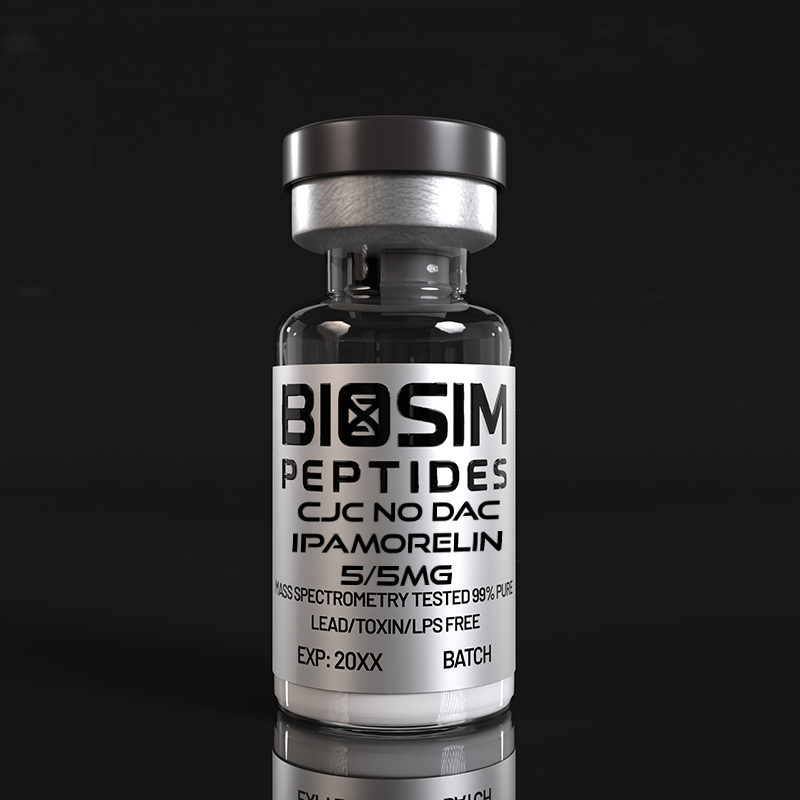
CJC-1295 No-DAC / Ipamorelin Blend 5/5mg: Research Overview
The CJC-1295 No-DAC / Ipamorelin Blend combines two complementary growth hormone (GH) secretagogues — 5 mg of CJC-1295 No-DAC (a modified GHRH(1-29) analog) and 5 mg of Ipamorelin (a selective ghrelin receptor agonist). This combination targets both arms of the GH axis: CJC-1295 agonizes the GHRH receptor (GHRH-R) on somatotrophs to increase GH pulse amplitude, while Ipamorelin activates the ghrelin receptor (GHS-R1a) to augment GH pulse frequency. Together, these peptides produce synergistic amplification of pulsatile GH secretion that exceeds the sum of individual effects. Supplied exclusively for in vitro laboratory research.
Molecular Background & Mechanism of Action
CJC-1295 No-DAC is a 29-amino acid GHRH analog with four substitutions (D-Ala², Gln⁸, Ala¹⁵, Leu²⁷) for enhanced proteolytic stability, while omitting the Drug Affinity Complex (DAC) moiety. This preserves a shorter half-life (~30-60 min) that produces physiological pulsatile GH release, avoiding the receptor desensitization associated with continuous GHRH-R stimulation by DAC-conjugated forms[1][2]. Ipamorelin (Aib-His-D-2-Nal-D-Phe-Lys-NH₂) is distinguished from earlier GHRP compounds by its minimal effect on prolactin, cortisol, and ACTH — making it the preferred selective GHS-R1a agonist for GH axis research[3][4].
Preclinical Evidence
The synergistic interaction between GHRH analogs and GHS-R1a agonists was first systematically characterized in perfused rat pituitary cells, where combined treatment produced GH responses 2-3 times greater than the sum of individual responses — a phenomenon attributed to cross-talk between cAMP and calcium signaling cascades[2][4]. Pharmacokinetic studies of CJC-1295 No-DAC demonstrate that the shorter half-life preserves the pulsatile architecture of GH secretion. Continuous GHRH-R stimulation by long-acting analogs rapidly induces receptor desensitization through GRK-mediated phosphorylation and β-arrestin recruitment; the No-DAC variant avoids this tachyphylaxis[1][5].
Ipamorelin’s selectivity profile has been confirmed across multiple preclinical models. Unlike GHRP-6, which elevates ACTH and cortisol, Ipamorelin at GH-releasing doses produces negligible changes in hypothalamic-pituitary-adrenal axis markers. This selectivity is attributed to Ipamorelin’s biased signaling at GHS-R1a — preferentially coupling to Gαq/11 over Gαi/o[3][6].
Research Applications
- GH Pulsatility Studies: Investigation of pulsatile GH secretion patterns using dual-receptor strategy in perifused pituitary cell systems.
- IGF-1 Axis Research: Quantification of IGF-1, IGFBP-3, and ALS responses to synergistic GH secretagogue stimulation.
- Receptor Desensitization Kinetics: Comparative analysis of GHRH-R tachyphylaxis under pulsatile vs. continuous stimulation.
- Metabolic Research: GH-dependent lipolysis, protein anabolism, and glucose homeostasis under controlled secretagogue protocols.
- Somatotroph Cell Biology: Second messenger cross-talk (cAMP/Ca²⁺/PKC) and exocytotic vesicle dynamics at the single-cell level.
- Combination Peptide Synergy: Pharmacological characterization of receptor-level synergism between GHRH analogs and ghrelin mimetics.
Comparative Context
| Combination | GHRH-R Agonist | GHS-R1a Agonist | Key Feature |
|---|---|---|---|
| CJC/Ipamorelin | CJC-1295 No-DAC | Ipamorelin | Pulsatile GH; selective GHS |
| Sermorelin/GHRP-2 | Sermorelin | GHRP-2 | Shorter half-life; less stable |
| CJC-DAC/MK-677 | CJC with DAC | Ibutamoren | Continuous GH; desensitization risk |
Safety & Laboratory Handling
Store lyophilized at -20°C. Reconstitute with sterile bacteriostatic water (not included). The blend is pre-mixed — do not attempt to separate. Reconstituted solutions: 2-8°C, use within 30 days. Avoid freeze-thaw cycles. PPE required. Lab research only.
References
- Teichman SL et al. (2006). “Prolonged stimulation of GH and IGF-I by CJC-1295.” J Clin Endocrinol Metab. PMID: 16352683.
- Sackmann-Sala L et al. (2009). “GHRH receptor signaling and GH release.” Endocr Rev. PMID: 19139536.
- Raun K et al. (1998). “Ipamorelin, the first selective growth hormone secretagogue.” Eur J Endocrinol. PMID: 9826111.
- Bowers CY et al. (1984). “New synthetic hexapeptide that specifically releases growth hormone.” Endocrinology. PMID: 6547387.
- Jette L et al. (2005). “hGRF(1-29)-albumin bioconjugates.” Endocrinology. PMID: 15746255.
- Johansen PB et al. (1999). “Ipamorelin induces longitudinal bone growth in rats.” Growth Horm IGF Res. PMID: 10502673.
- Broglio F et al. (2002). “Ghrelin: much more than a natural GH secretagogue.” J Endocrinol Invest. PMID: 12508946.
- Kojima M et al. (1999). “Ghrelin is a growth-hormone-releasing acylated peptide from stomach.” Nature. PMID: 10604470.
⚠ Research Use Only: Sold exclusively for in vitro laboratory research. Not FDA-evaluated for human use.

Reviews
There are no reviews yet.