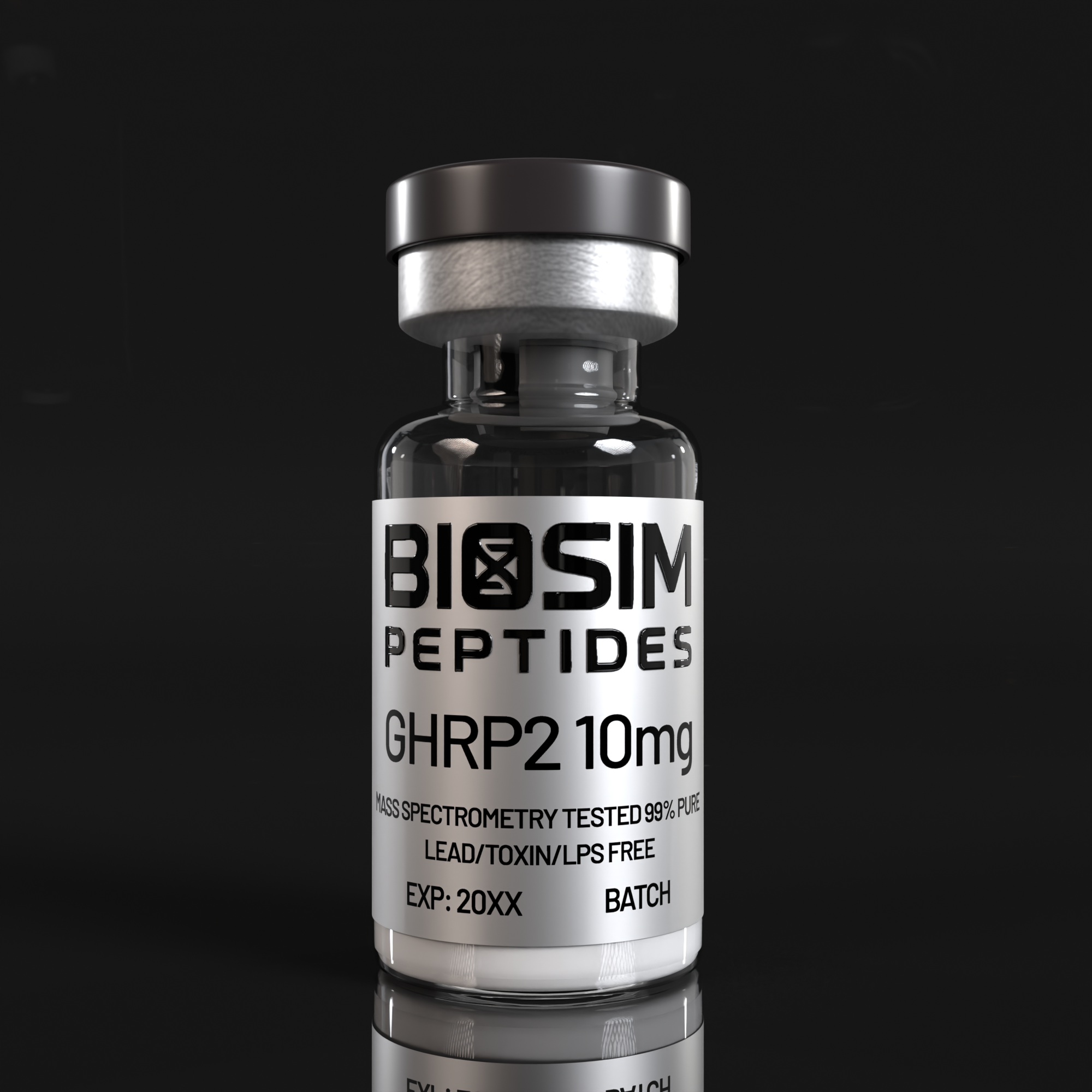
GHRP-2 10mg: Research Overview
Growth Hormone Releasing Peptide-2 (GHRP-2), also known as pralmorelin or KP-102, is a synthetic hexapeptide (D-Ala-D-β-Nal-Ala-Trp-D-Phe-Lys-NH₂) and a potent agonist of the ghrelin receptor (growth hormone secretagogue receptor type 1a, GHS-R1a). Originally developed through structure-activity optimization of met-enkephalin derivatives by Bowers and colleagues, GHRP-2 has emerged as one of the most extensively characterized synthetic growth hormone secretagogues in preclinical research. Its ability to robustly stimulate growth hormone (GH) release from anterior pituitary somatotrophs — both directly and through synergistic hypothalamic pathways — has made it a valuable tool for investigating the ghrelin-GHS-R1a axis, IGF-1 physiology, and metabolic regulation. GHRP-2 supplied by BioSim Peptides is ≥98% pure (lyophilized, 10mg) and is intended exclusively for in vitro laboratory research use. It has not been evaluated by the FDA for human use and is not a dietary supplement, drug, or therapeutic agent.
Molecular Background & Mechanism of Action
GHRP-2 exerts its biological effects through high-affinity binding to the GHS-R1a receptor, a Gαq/11-coupled seven-transmembrane receptor primarily expressed in the anterior pituitary gland and hypothalamic arcuate nucleus[1]. Upon ligand binding, GHS-R1a activates phospholipase C (PLC), which hydrolyzes phosphatidylinositol 4,5-bisphosphate (PIP₂) to generate inositol trisphosphate (IP₃) and diacylglycerol (DAG). IP₃ mobilizes intracellular Ca²⁺ stores from the endoplasmic reticulum, and the resultant calcium influx triggers the exocytosis of growth hormone-containing secretory granules from somatotroph cells[2]. Critically, GHRP-2 also acts at the hypothalamic level to stimulate growth hormone-releasing hormone (GHRH) neurons and functionally antagonize somatostatinergic tone, thereby amplifying endogenous GH pulsatility beyond what either pathway alone could achieve[3].
Unlike endogenous ghrelin, GHRP-2 lacks the n-octanoyl modification at Ser³ and therefore does not require ghrelin O-acyltransferase (GOAT)-mediated acylation for receptor activation. This structural independence confers greater stability and consistent pharmacodynamics in experimental settings. The peptide also engages convergent signaling with the GHRH receptor at the level of adenylyl cyclase/cyclic AMP, producing synergistic enhancement of GH secretion when both receptors are co-activated — a property that distinguishes it from earlier-generation secretagogues[2].
Preclinical & Clinical Evidence
The orexigenic and metabolic effects of GHRP-2 were demonstrated in a landmark controlled study by Laferrère and colleagues, who showed that intravenous administration of GHRP-2 significantly increased ad libitum food intake in healthy male volunteers, mirroring the acute hyperphagic effects of acylated ghrelin and confirming functional GHS-R1a agonism in humans[1]. This study established that GHRP-2 recapitulates the key appetite-regulating properties of the endogenous ghrelin system, making it a relevant probe for feeding behavior research.
In the context of muscle wasting and catabolic stress, Sheriff et al. demonstrated that GHRP-2 administration in a rat burn-injury model significantly attenuated the expression of the skeletal muscle-specific ubiquitin ligases MuRF-1 and MAFbx — key regulators of proteasome-mediated muscle proteolysis — suggesting a potential anti-catabolic mechanism mediated through GHS-R1a signaling[3]. This aligns with earlier work by Alba et al., who showed that long-term GHRP-2 treatment in GHRH knockout (GHRH−/−) mice partially rescued growth deficits and improved body composition parameters independent of the GHRH pathway[2]. Additionally, Zeng and colleagues demonstrated that GHRP-2 produces antinociceptive effects at the supraspinal level via opioid receptor cross-talk in murine models, implicating GHS-R1a signaling in central pain modulation pathways[6].
More recent clinical investigations have further expanded the research utility of GHRP-2. Kinoshita and colleagues established the GHRP-2 stimulation test as a clinically useful diagnostic tool for assessing hypothalamic-pituitary axis integrity, demonstrating that the GH response to GHRP-2 challenge reliably discriminates between hypothalamic and pituitary etiologies of GH deficiency[7]. A subsequent 2024 study in adolescents confirmed that GHRP-2 elicits robust, reproducible GH responses across pubertal stages, supporting its utility as a standardized provocative agent in developmental endocrinology research[8]. Additionally, a 2015 case report documented that 12-month intranasal GHRP-2 administration in a patient with severe anorexia nervosa improved body weight and ameliorated hypoglycemic episodes, highlighting the peptide’s potential relevance to body composition and metabolic research[5].
Research Applications
- GH-IGF-1 Axis Investigation: GHRP-2 serves as a selective probe for dissecting GHS-R1a-mediated GH release, independent of GHRH receptor activation. Researchers use it to study pulsatile GH secretion patterns, somatotroph responsiveness, and downstream IGF-1 dynamics in cell culture and tissue models[7][8].
- Muscle Catabolism & Body Composition Research: Evidence from burn-injury and GHRH-knockout models supports the investigation of GHRP-2 in muscle-sparing pathways. The peptide’s demonstrated attenuation of MuRF-1/MAFbx expression makes it relevant for studies examining ubiquitin-proteasome regulation in skeletal muscle[2][3].
- Appetite & Feeding Behavior Studies: As a ghrelin mimetic, GHRP-2 is employed in preclinical feeding behavior models to interrogate hypothalamic appetite circuits, including NPY/AgRP and POMC neuronal populations in the arcuate nucleus[1].
- Anti-Inflammatory & Cellular Protection: Recent work demonstrated GHRP-2 attenuation of PKC-induced inflammatory signaling in human ovarian granulosa cells, suggesting potential applications in studies of inflammation and cellular stress responses[4].
- Neuroendocrine Diagnostic Research: The GHRP-2 provocation test has been validated for research into hypothalamic-pituitary axis function, providing a standardized stimulus for GH reserve assessment in experimental models of pituitary dysfunction[7][8].
Comparative Context: GHRP-2 vs. GHRP-6 vs. Ipamorelin
GHRP-2 belongs to the broader family of synthetic GHS-R1a agonists, each possessing distinct pharmacological profiles. GHRP-2 is distinguished by its superior potency for GH release, while GHRP-6 exhibits a more pronounced appetite-stimulating effect. Ipamorelin, a pentapeptide, offers greater receptor selectivity with minimal off-target effects on prolactin or cortisol secretion at standard research concentrations. The table below summarizes key comparative features relevant to experimental design.
| Compound | Primary Target | GH Release Potency | Appetite Stimulation | Cortisol/Prolactin Effects | Selectivity |
|---|---|---|---|---|---|
| GHRP-2 | GHS-R1a | Very High (+++) | Moderate (++) | Mild elevation at high doses | High |
| GHRP-6 | GHS-R1a | High (++) | Pronounced (+++) | Mild elevation at high doses | Moderate |
| Ipamorelin | GHS-R1a (selective) | Moderate-High (++) | Minimal (+) | Negligible | Very High |
Safety & Laboratory Handling
Store lyophilized GHRP-2 at -20°C, protected from light and moisture. Prior to reconstitution, allow the vial to reach ambient temperature briefly to minimize condensation. Reconstitute with sterile bacteriostatic water (0.9% benzyl alcohol; not included) to the desired concentration. Do not use saline or other buffers unless specifically validated in your protocol, as ionic strength may affect peptide solubility. Reconstituted solutions should be stored at 2–8°C and used within 30 days. Aliquot and freeze at -80°C for longer-term storage; avoid repeated freeze-thaw cycles, which can promote aggregation and loss of bioactivity. Use appropriate personal protective equipment (PPE) including nitrile gloves, laboratory coat, and safety goggles. Handle in a laminar flow hood or biosafety cabinet using aseptic technique. For laboratory research use only — not for diagnostic, therapeutic, veterinary, or any clinical application. Not for human consumption.
References
- Laferrère B, Abraham C, Russell CD, et al. “Growth hormone releasing peptide-2 (GHRP-2), like ghrelin, increases food intake in healthy men.” J Clin Endocrinol Metab. 2005;90(2):611-614. PMID: 15699539.
- Alba M, Fintini D, Bowers CY, et al. “Effects of long-term treatment with growth hormone-releasing peptide-2 in the GHRH knockout mouse.” Am J Physiol Endocrinol Metab. 2005;289(5):E762-E767. PMID: 15985453.
- Sheriff S, Joshi R, Friend LA, et al. “Ghrelin receptor agonist, GHRP-2, attenuates burn injury-induced MuRF-1 and MAFbx expression and muscle proteolysis in rats.” Peptides. 2009;30(10):1909-1913. PMID: 19577604.
- Chao YN, Sun D, Peng YC, et al. “Growth Hormone Releasing Peptide-2 Attenuation of Protein Kinase C-Induced Inflammation in Human Ovarian Granulosa Cells.” Int J Mol Sci. 2016;17(8):1351. PMID: 27548147.
- Haruta I, Fuku Y, Kinoshita K, et al. “One-year intranasal application of growth hormone releasing peptide-2 improves body weight and hypoglycemia in a severely emaciated anorexia nervosa patient.” J Cachexia Sarcopenia Muscle. 2015;6(3):237-241. PMID: 26401470.
- Zeng P, Li S, Zheng YH, et al. “Ghrelin receptor agonist, GHRP-2, produces antinociceptive effects at the supraspinal level via the opioid receptor in mice.” Peptides. 2014;55:136-143. PMID: 24607724.
- Suzuki S, Ruike Y, Ishiwata K, et al. “Clinical Usefulness of the Growth Hormone-Releasing Peptide-2 Test for Hypothalamic-Pituitary Disorder.” J Endocr Soc. 2022;6(8):bvac101. PMID: 35795807.
- Onuki T, Hiroaki T, Sawano K, et al. “Robust growth hormone responses to GH-releasing peptide 2 in adolescents.” J Pediatr Endocrinol Metab. 2024;37(7):605-612. PMID: 38958228.
⚠ Research Use Only: This product is sold exclusively for in vitro laboratory research. It has not been evaluated by the FDA for human use and is not intended for diagnostic, therapeutic, or any clinical application. Statements regarding biological mechanisms describe preclinical and clinical research findings and do not constitute claims about product efficacy for any purpose in humans.

Reviews
There are no reviews yet.