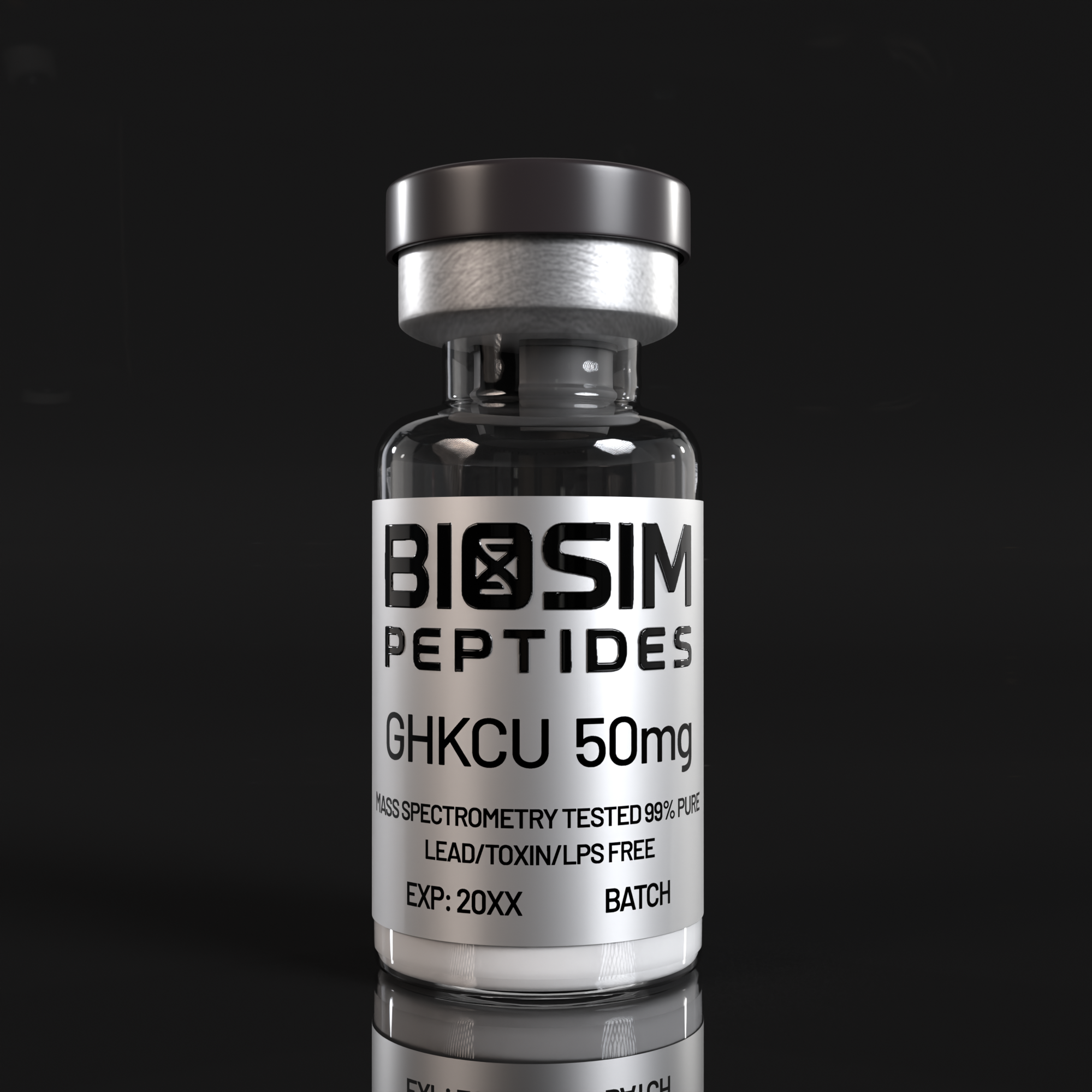
GHK-Cu 50mg — Research-Grade Copper Tripeptide from BioSim Peptides
GHK-Cu (glycyl-L-histidyl-L-lysine:copper(II)) is a naturally occurring copper-binding tripeptide that has become one of the most extensively studied small peptides in regenerative biology, dermatological research, and gene-expression science. This product page supplies GHK-Cu 50mg as a lyophilized, research-grade reagent intended exclusively for in-vitro laboratory investigation. Each vial is HPLC-verified at greater than 98% purity, mass-spectrometry confirmed, and shipped with a batch-specific Certificate of Analysis. This page summarizes the published research landscape around the GHK-Cu peptide so that investigators sourcing copper peptide GHK-Cu from BioSim Peptides have a single, citation-anchored reference for experimental design.
Across more than five decades of peer-reviewed work, GHK-Cu has been investigated for its roles in extracellular-matrix remodeling, modulation of inflammatory and antioxidant pathways, hair-follicle biology, broad-scale gene-expression reprogramming, and copper homeostasis. Nothing on this page should be construed as a medical claim — every observation discussed below comes from cell-culture systems, biochemical assays, or animal models, and the material itself is sold strictly for research use only.
What Is GHK-Cu? A Molecular Overview
GHK-Cu is the copper(II) complex of the tripeptide glycyl-histidyl-lysine (Gly-His-Lys, often abbreviated GHK). The free GHK tripeptide has a molecular weight of 340.4 Da; coordinated with a divalent copper ion it forms a tightly bound, square-planar complex with a characteristic affinity that allows it to exchange copper with serum albumin and other physiological carriers at near-equimolar concentrations. The histidine imidazole nitrogen, the glycyl amino-terminus, and the deprotonated amide nitrogen of the histidyl peptide bond together with one carboxylate oxygen form the four-coordinate Cu(II) chelation site that defines the molecule’s redox-controlled bioactivity (Pickart et al., 2015, BioMed Research International, PMID: 26236730).
Because copper is an obligate cofactor for lysyl oxidase, superoxide dismutase, cytochrome c oxidase, and many other enzymes central to connective-tissue assembly and redox balance, the GHK scaffold is widely understood in the literature as a copper-delivery vehicle whose biological signature reflects both the peptide moiety and the trafficked copper ion. This dual character — peptide signal plus controlled copper transfer — underlies most of the experimental phenomena attributed to copper peptide GHK-Cu.
Discovery and Historical Background
The GHK sequence was first isolated in 1973 by Loren Pickart, who observed that a low-molecular-weight factor in human plasma could restore a more youthful phenotype to aged hepatocytes in culture. The active species was subsequently characterized as the tripeptide Gly-His-Lys, and its physiological form as a copper(II) chelate — GHK-Cu. Plasma concentrations of GHK in humans decline substantially with age, dropping from roughly 200 ng/mL in the third decade of life to less than 80 ng/mL by the seventh, a pharmacokinetic observation that motivated decades of subsequent investigation into the peptide’s role in tissue maintenance (Pickart et al., 2012, Oxidative Medicine and Cellular Longevity, PMID: 22666519).
From the 1980s onward, GHK-Cu research expanded from hepatocyte and fibroblast models into wound-healing assays, dermal biology, hair follicle work, and most recently into transcriptomic and behavioral studies. The peptide is one of the few small molecules with a continuous record of publication spanning more than fifty years, and the depth of that record is part of why GHK-Cu remains a reference compound for researchers investigating copper-peptide chemistry and tissue-repair biology.
Molecular Structure and Proposed Mechanisms
Structurally, the GHK-Cu peptide is compact, conformationally constrained by the Cu(II) chelation geometry, and small enough to traverse some epithelial barriers when formulated appropriately. Published mechanistic work groups its activity into several non-exclusive categories:
- Copper trafficking: GHK-Cu donates Cu(II) to copper-requiring enzymes including lysyl oxidase, which is essential for cross-linking collagen and elastin fibers in the extracellular matrix.
- Redox modulation: The complex has been shown to suppress reactive oxygen species generation and to interact directly with antioxidant enzymes such as peroxiredoxin 6, which has emerged as a specific binding partner in pulmonary fibrosis models (Zhang et al., 2024, Redox Biology, PMID: 38879894).
- Gene-expression reprogramming: Whole-genome microarray work has identified more than four thousand human genes whose expression is shifted toward youthful or pro-regenerative states by GHK exposure, including transcripts involved in DNA repair, antioxidant defense, and matrix remodeling (Pickart et al., 2017, Brain Sciences, PMID: 28212278).
- Signaling-pathway engagement: Multiple groups have reported activation of SIRT1, modulation of NF-κB signaling, and altered TGF-β responses following GHK-Cu exposure in epithelial and connective-tissue models (Park et al., 2023, Biomedicine & Pharmacotherapy, PMID: 37257226).
Areas of GHK-Cu Research Investigation
Skin Models and Wound-Healing Research
The largest body of GHK-Cu literature concerns dermal biology. In cultured human fibroblasts and in animal wound models, the copper peptide GHK-Cu has been associated with increased proliferation of dermal fibroblasts, enhanced deposition of collagen types I and III, upregulation of glycosaminoglycan synthesis, and accelerated closure of full-thickness wounds. A 2022 study constructed RADA16 self-assembling nanofiber hydrogels functionalized with the copper tripeptide and reported improved healing kinetics in a diabetic wound model, illustrating one of several biomaterial strategies that use GHK-Cu as the bioactive component (Dou et al., 2022, Macromolecular Bioscience, PMID: 35598070).
Topical delivery has also been a major research focus. Encapsulation of GHK-Cu in liposomes, transferosomes, and ionic-liquid microemulsions has been investigated to address the molecule’s hydrophilicity and the practical challenges of getting an intact copper complex across the stratum corneum in skin-permeation assays (Dragicevic et al., 2025, Molecules, PMID: 39795193).
Collagen and Extracellular-Matrix Synthesis
GHK-Cu research has repeatedly demonstrated upregulation of structural ECM components in fibroblast cultures and dermal explants, including type I collagen, elastin, decorin, and several proteoglycans, with parallel induction of metalloproteinases and their inhibitors that together remodel rather than merely accumulate matrix. The same studies report increased expression of integrin receptors that anchor fibroblasts to the matrix, linking the molecular signal to higher-order tissue architecture (Pickart, 2008, Journal of Biomaterials Science, Polymer Edition, PMID: 18644225).
Anti-Inflammatory and Antioxidant Pathways
In silicosis and ovalbumin-induced airway-remodeling models, researchers have observed that the GHK-Cu tripeptide attenuates fibrotic and inflammatory readouts. The pulmonary work identified peroxiredoxin 6 as a direct molecular target through which the peptide influences redox-balanced signaling (Zhang et al., 2024, Redox Biology, PMID: 38879894), while the airway study attributed reduced remodeling to SIRT1 activation in epithelial cells (Park et al., 2023, Biomedicine & Pharmacotherapy, PMID: 37257226). These reports extend the historical dermal focus of GHK-Cu research into systemic connective-tissue biology.
Hair Follicle Research
Cultured human dermal papilla cells exposed to GHK-Cu have shown enlargement of follicle structures and altered expression of growth factors associated with the anagen phase of the hair cycle. The mechanism is generally interpreted as a combination of improved local microcirculation in animal models, copper donation to enzymes involved in hair-shaft protein cross-linking, and modulation of the same fibroblast pathways implicated in dermal repair (Pickart et al., 2015, BioMed Research International, PMID: 26236730).
Gene-Expression Modulation
One of the most striking features of GHK-Cu in the contemporary literature is the breadth of its transcriptional footprint. Microarray analyses of human cell lines exposed to physiological concentrations of GHK have identified shifts in expression for thousands of genes, with disproportionate effects on pathways governing DNA repair, antioxidant defense, ubiquitin-proteasome function, and integrin signaling. The 2017 analysis specifically catalogued GHK-responsive transcripts relevant to nervous-system function and cognitive decline, finding suppression of genes associated with neuroinflammation and induction of those associated with neuronal plasticity (Pickart et al., 2017, Brain Sciences, PMID: 28212278).
Neurological and Cognitive Research
Beyond the transcriptomic work, more recent investigations have begun to test the GHK peptide directly in neurodegenerative models, with preliminary observations including reduced amyloid pathology and improved behavioral readouts in transgenic Alzheimer’s-disease mice. These reports are early-stage and limited to animal systems but illustrate why GHK-Cu has remained a peptide of interest beyond its original dermal context (Pickart et al., 2012, Oxidative Medicine and Cellular Longevity, PMID: 22666519).
Longevity and Aging Models
Invertebrate longevity systems are increasingly used to characterize the upstream targets of GHK-Cu. A 2026 study in Caenorhabditis elegans reported that GHK-Cu extended healthspan and lifespan markers through coordinated regulation of mitochondrial function and activation of the DAF-16/SKN-1 stress-response axis, providing one of the cleanest mechanistic links between the peptide and conserved aging pathways (Liu et al., 2026, Biogerontology, PMID: 42084774).
Reconstitution, Handling, and Storage
The GHK-Cu 50mg vial ships as a sterile lyophilized powder in a sealed vial under inert headspace. The following lab-handling parameters are provided for in-vitro research workflows only; they are not human-use instructions.
- Long-term storage: Lyophilized GHK-Cu is most stable at −20°C protected from light and moisture. Stored under these conditions, peptide integrity is generally maintained for 24 months or longer when the vial remains sealed.
- Reconstitution: For laboratory assays, bacteriostatic water or sterile-filtered deionized water is commonly used as the reconstitution solvent. The copper complex is a deep blue-violet solution upon dissolution, a visual hallmark of intact Cu(II) chelation.
- Working solutions: After reconstitution, aliquots are typically stored at 2–8°C and used within the working window described in the relevant published protocol. Avoid repeated freeze-thaw cycles, which can compromise both the peptide backbone and the chelation state.
- Compatibility notes: The Cu(II) center is sensitive to strong reductants and to chelators with higher copper affinity (e.g., EDTA, DTPA). Buffer choice should account for this when designing experiments around the copper peptide GHK-Cu.
Purity, Quality Control, and Certificate of Analysis
Every batch of research-grade GHK-Cu is manufactured to consistent specifications and verified before release:
- Purity: >98% by reverse-phase HPLC, integrated at 220 nm.
- Identity: Confirmed by ESI mass spectrometry against the theoretical mass of the GHK-Cu complex.
- Appearance: Blue to blue-violet lyophilized powder, free of visible particulates.
- Packaging: 50mg net peptide per sealed glass vial, lot-numbered and matched to the Certificate of Analysis.
- Documentation: A batch-specific COA accompanies every shipment and is available on request for any lot in inventory.
This testing regime exists because reproducibility in peptide research depends on knowing exactly what is in the vial. Without HPLC and mass-spec confirmation of both the GHK backbone and the bound copper, assay results cannot be cleanly interpreted against the published literature.
Why Researchers Choose BioSim Peptides for GHK-Cu
Investigators seeking to buy GHK-Cu for in-vitro work select BioSim Peptides for several reasons rooted in the practical requirements of running a reproducible research program:
- USA-based shipping and inventory. Orders are packed and dispatched from a domestic facility with same-day shipping cutoffs on business days, minimizing cold-chain exposure and transit ambiguity.
- Lot-traceable quality control. Every order of GHK-Cu 50mg includes — or has available on request — a batch-specific Certificate of Analysis with HPLC and mass-spectrometry data.
- Specialist customer support. Technical questions about handling, reconstitution, or assay compatibility for the GHK-Cu peptide are answered by staff who work with these molecules daily.
- Consistent supply. Long-running projects depend on receiving the same molecule, manufactured to the same specification, across multiple orders. We maintain GHK-Cu specifications across lots so that experimental data remain comparable.
- Research-grade focus. The catalog is built for laboratory investigators, not consumer markets, which keeps documentation, packaging, and labeling appropriate for institutional research environments.
Common Terms in GHK-Cu Research
The GHK-Cu literature spans biochemistry, dermatology, materials science, and gerontology, and several synonyms appear across these fields. Researchers searching the published record may encounter the following terms used interchangeably with GHK-Cu peptide:
- Copper peptide or copper tripeptide-1 — the common cosmetics-industry name for the same molecular entity.
- Glycyl-L-histidyl-L-lysine:copper(II) — the full IUPAC-style name used in chemistry journals.
- GHK-Cu(II) complex — emphasizing the oxidation state of the bound copper.
- Prezatide copper acetate — an older clinical-development name for a GHK-Cu salt form.
Awareness of these synonyms is useful when conducting database searches and ensures comprehensive coverage of the GHK-Cu research literature.
Important Research Disclaimer
The GHK-Cu 50mg product offered by BioSim Peptides is supplied solely for in-vitro laboratory research and analytical reference purposes. It is not a drug, dietary supplement, food, cosmetic, or medical device. It is not intended to diagnose, treat, cure, mitigate, or prevent any disease or condition in humans or in animals, and no representation is made that it is safe or effective for any such use. All references on this page to biological activity describe published observations in cell-culture systems, biochemical assays, or animal models, and should not be interpreted as endorsements of, or recommendations for, human or veterinary application. Purchasers represent that they are qualified researchers or institutions and accept full responsibility for compliance with all applicable federal, state, and local laws, institutional review requirements, biosafety regulations, and standard laboratory practices governing the receipt, handling, storage, and disposal of research peptides.
For research use only. Not for human or animal consumption.
Frequently Asked Questions about GHK-Cu
What is GHK-Cu?
GHK-Cu is a research peptide supplied by BioSim Peptides for in-vitro and laboratory use only. Each vial is lyophilized, lab-tested, and accompanied by a Certificate of Analysis (COA) verifying identity and purity above 98% by HPLC.
Is the GHK-Cu from BioSim Peptides third-party tested?
Yes. Every lot of GHK-Cu 50mg is independently tested by HPLC and mass spectrometry. The COA for the current batch is available on request and packaged with every order.
How should GHK-Cu be stored?
Lyophilized GHK-Cu should be stored at -20°C for long-term stability. After reconstitution with bacteriostatic water it is typically stored at 2-8°C and used within the timeframe described in the published literature for the peptide.
How fast does BioSim Peptides ship?
Orders placed before 2 PM ET ship same business day from our USA facility via tracked carriers. Most domestic orders arrive in 2-4 business days.
Is GHK-Cu approved for human use?
No. GHK-Cu is supplied for in-vitro laboratory research only. It is not a drug, dietary supplement, cosmetic, or food, and is not intended for diagnosis, treatment, cure, or prevention of any disease in humans or animals.

Reviews
There are no reviews yet.