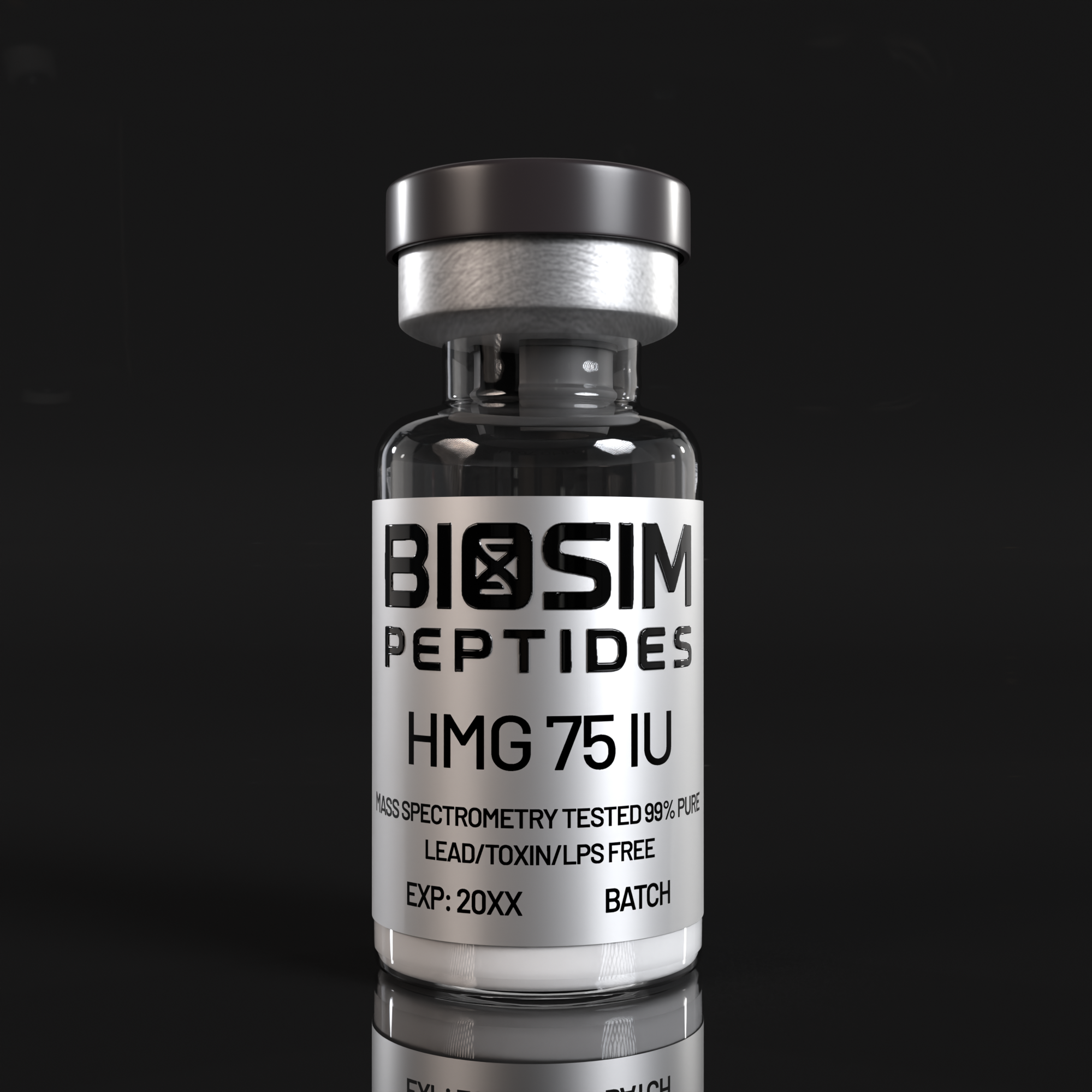
HMG 75iu

Categories:

Buy HMG 75IU — Human Menopausal Gonadotropin studied for reproductive hormone research. Premium purity. BioSim Peptides.

$100.00

Guaranteed Safe Checkout

⚠️ RESEARCH USE ONLY

This product is for R&D purposes only and is not approved for human or veterinary use.

Introduction and Research Disclaimer

Human Menopausal Gonadotropin (HMG) is a highly purified urinary-derived preparation containing both follicle-stimulating hormone (FSH) and luteinizing hormone (LH) activities at an approximate 1:1 ratio. Each vial contains 75 international units (IU) of total gonadotropin activity, standardized against the World Health Organization (WHO) International Standard for human menopausal gonadotropins. The product is supplied as a sterile, lyophilized powder for reconstitution in appropriate research-grade buffer systems. This product is provided exclusively for in vitro laboratory research and experimental model investigations. It is categorically not intended for human or veterinary clinical use, not for fertility treatment, not for diagnostic procedures, and not for any form of human administration. All handling must be conducted in accordance with institutional biosafety guidelines for biologically derived materials of human origin. Researchers are responsible for verifying that their intended use complies with all applicable institutional, local, and national regulations regarding research involving human-derived biological products. Biosim Peptides expressly disclaims any warranty of fitness for any purpose beyond controlled laboratory experimentation.

Molecular Composition and Biochemical Characterization

HMG is a complex biological product comprising a heterogeneous mixture of glycoprotein hormones extracted and purified from the urine of postmenopausal women. The two principal active constituents are follicle-stimulating hormone (FSH) and luteinizing hormone (LH), both members of the glycoprotein hormone family that also includes thyroid-stimulating hormone (TSH) and human chorionic gonadotropin (hCG). FSH and LH share a common alpha subunit of 92 amino acids (glycoprotein hormone alpha chain, CGA, ~14 kDa) that is non-covalently associated with hormone-specific beta subunits: the FSH beta subunit (FSHB, 118 amino acids, ~15 kDa) and the LH beta subunit (LHB, 121 amino acids, ~14.5 kDa). Biological activity is conferred exclusively by the heterodimer; free subunits are essentially inert. Both subunits are extensively glycosylated, with complex N-linked carbohydrate structures attached at two sites on each alpha subunit (Asn52 and Asn78) and at two sites on FSHB (Asn7 and Asn24) or one site on LHB (Asn30). These carbohydrate moieties—particularly terminal sialic acid residues on FSH and sulfated N-acetylgalactosamine residues on LH—are critical determinants of in vivo half-life, receptor-binding kinetics, and signal transduction efficacy. The sialylation content of urinary-derived HMG differs subtly from recombinant FSH preparations, conferring distinct pharmacokinetic and pharmacodynamic properties in experimental systems. In addition to FSH and LH, HMG preparations may contain variable trace quantities of other urinary proteins, including hCG (typically less than 1-2% of total gonadotropin activity), epidermal growth factor (EGF), and other low-molecular-weight urinary peptides, depending on the purification methodology employed by the manufacturer. Each 75 IU vial is calibrated against the WHO 4th International Standard for human menopausal gonadotropins (NIBSC code 73/519 or equivalent successor standard), with 1 IU defined as the specific gonadotropin activity contained in a defined mass of the international reference preparation. Researchers should note that the FSH:LH biological activity ratio in different HMG preparations may range from 0.8:1 to 1.2:1 due to inherent variability in source material and purification methodology; lot-specific certificates of analysis should be consulted for precise characterization data.

Mechanism of Action and Receptor Pharmacology

FSH and LH exert their biological effects through binding to specific G protein-coupled receptors (GPCRs) expressed on the surface of gonadal target cells. FSH binds with high affinity and specificity to the FSH receptor (FSHR), a 678-amino acid glycoprotein GPCR predominantly expressed on ovarian granulosa cells in females and testicular Sertoli cells in males. LH binds to the LH/choriogonadotropin receptor (LHCGR), a 699-amino acid GPCR found on ovarian theca cells, granulosa cells (following LH receptor induction during follicular maturation), luteal cells, and testicular Leydig cells. Both receptors belong to the leucine-rich repeat-containing GPCR subfamily (LGR family) and signal predominantly through Gαs-mediated activation of adenylyl cyclase, resulting in increased intracellular cyclic adenosine monophosphate (cAMP) concentrations and subsequent activation of protein kinase A (PKA). PKA-mediated phosphorylation of transcription factors—including cAMP response element-binding protein (CREB) and steroidogenic factor 1 (SF-1)—drives transcription of genes encoding steroidogenic enzymes (CYP11A1, CYP17A1, CYP19A1, HSD3B2, and StAR), leading to the synthesis of estradiol (via aromatization in granulosa cells) and testosterone (in theca and Leydig cells). At higher ligand concentrations, FSHR and LHCGR also couple to Gαq/11, activating phospholipase C-β (PLCβ), increasing inositol trisphosphate (IP3) and diacylglycerol (DAG) production, and mobilizing intracellular calcium stores. Additionally, β-arrestin-mediated signaling pathways, including MAPK/ERK activation independent of G-protein coupling, contribute to the pleiotropic effects of gonadotropins on cellular proliferation, differentiation, and survival. The presence of both FSH and LH activities in HMG preparations allows researchers to model the cooperative two-cell, two-gonadotropin system of ovarian steroidogenesis in vitro: LH stimulates theca cell androgen production, while FSH drives granulosa cell aromatization of these androgens to estrogens—a functional interaction that cannot be replicated using recombinant FSH or LH preparations in isolation. In male reproductive models, the dual activity of HMG supports both Sertoli cell-mediated spermatogenic support (FSH-dependent) and Leydig cell testosterone production (LH-dependent), making it a versatile tool for investigating the integrated hypothalamic-pituitary-gonadal axis in experimental systems.

Research Applications in Reproductive Biology

HMG supports a diverse array of research applications across reproductive endocrinology, developmental biology, and toxicology. In ovarian follicle culture and in vitro follicle maturation, HMG is the gonadotropin preparation of choice for multi-step follicle culture protocols, including the widely cited two-step system of secondary follicle isolation and growth followed by antral follicle maturation. The combined FSH and LH activity supports both granulosa cell proliferation (FSH-driven) and theca-interstitial cell androgen substrate provision (LH-driven), enabling faithful recapitulation of the intrafollicular paracrine signaling networks essential for oocyte competence acquisition. In cumulus-oocyte complex (COC) expansion assays, HMG is utilized to induce cumulus matrix expansion—a hyaluronan-rich extracellular matrix remodeling process dependent on FSH-induced synthesis of hyaluronan synthase 2 (HAS2), pentraxin 3 (PTX3), and tumor necrosis factor-alpha-induced protein 6 (TNFAIP6) by cumulus granulosa cells. In Leydig and Sertoli cell primary culture systems, HMG provides physiologically relevant gonadotropin stimulation for investigating steroidogenic acute regulatory (StAR) protein trafficking, CYP11A1 and CYP17A1 enzymatic activity, and the regulation of androgen biosynthesis under normal and pathophysiological conditions. Reproductive toxicology represents a particularly active area of HMG application, with the preparation used as a standardized gonadotropin stimulus in testicular and ovarian explant culture systems designed to evaluate the effects of environmental endocrine disruptors, pharmaceutical candidates, and industrial chemicals on gonadotropin-responsive steroidogenic pathways. Additional applications include gonadal organoid development, where HMG serves as a critical medium supplement for the long-term maintenance and differentiation of testicular and ovarian organoids derived from pluripotent stem cells or primary tissue isolates; comparative gonadotropin pharmacology investigating the differential signaling properties of urinary-derived versus recombinant gonadotropin preparations; and biochemical reference standard work in which HMG preparations of known international unit potency are used to calibrate in-house FSH and LH bioassays and immunoassays against the WHO international standard hierarchy.

Key Research Studies and Literature Findings

The clinical and biological characterization of HMG spans over seven decades, beginning with the pioneering work of Lunenfeld and associates in the late 1950s and early 1960s. A comprehensive historical review by Lunenfeld (PMID 555342) documented the development of HMG extraction methodologies from postmenopausal urine and the establishment of the first international reference preparations, providing the foundational framework for all subsequent gonadotropin research. Westergaard and coworkers (PMID 9783871) conducted a detailed comparative analysis of urinary HMG versus recombinant FSH in ovarian stimulation protocols, demonstrating that the LH activity inherent to HMG contributed to distinct follicular fluid endocrine profiles and oocyte maturation dynamics not observed with FSH-only stimulation—findings with direct relevance to in vitro follicle culture experimental designs. Filicori and colleagues (PMID 11028508) systematically investigated the concept of LH activity supplementation in controlled ovarian stimulation, establishing the therapeutic window concept for LH concentrations—wherein both insufficient and excessive LH exposure impair follicular development—a principle now widely applied in gonadotropin dose-response studies in granulosa cell and follicle culture models. Van Wely and associates (PMID 12142251) published a Cochrane systematic review comparing HMG with recombinant FSH across multiple clinical datasets, providing a rigorous meta-analytical framework for understanding the relative contributions of exogenous LH activity to reproductive outcomes. More recently, Casarini and coworkers (PMID 23229352) elucidated the biased signaling properties of different gonadotropin preparations at the FSHR and LHCGR, demonstrating that urinary-derived and recombinant gonadotropins engage distinct patterns of G-protein versus β-arrestin signaling, with implications for the interpretation of in vitro pharmacological experiments. Additional foundational contributions include the work of Pierce and Parsons (PMID 6261553), who established the quaternary structural model of glycoprotein hormones that underpins all contemporary structure-function studies of gonadotropin-receptor interactions.

Handling, Reconstitution, and Laboratory Protocols

Due to the glycoprotein nature of HMG and the biological origin of the source material, meticulous handling procedures are essential. Lyophilized vials should be stored at 2-8°C in a desiccated, light-protected environment upon receipt. Long-term storage at -20°C is recommended for durations exceeding 3 months. The lyophilized cake should appear as a white to off-white, intact powder; discoloration, shrinkage, or fragmentation may indicate moisture ingress or thermal degradation and such vials should not be used. Reconstitution should be performed in a certified biosafety cabinet using aseptic technique and sterile, endotoxin-free reagents. The recommended reconstitution solvent is sterile water for injection (WFI)-grade water or sterile 0.9% sodium chloride; phosphate-buffered saline is generally acceptable but may precipitate trace calcium-phosphate complexes over extended storage. HMG is highly soluble in aqueous solutions at neutral pH; the lyophilized cake should dissolve within 30-60 seconds with gentle swirling. Vigorous agitation or vortex mixing must be avoided as it may denature the glycoprotein heterodimers and dissociate alpha and beta subunits, resulting in loss of biological activity. The reconstituted solution at 75 IU/mL (or higher concentrations if smaller reconstitution volumes are used) is stable for up to 24 hours at 2-8°C. For extended use, aliquoting into single-use volumes and storage at -80°C is recommended; under these conditions, biological activity is preserved for up to 3 months. However, researchers should validate gonadotropin potency in their specific assay system if using frozen aliquots, as glycoprotein hormones are susceptible to freeze-thaw degradation. Typical working concentrations for in vitro applications range from 0.01 to 1.0 IU/mL (approximately 0.75-75 mIU FSH and LH activity per mL), depending on the target cell type, culture format, and experimental endpoint. Researchers are strongly advised to include negative controls (vehicle-only), positive controls (recombinant FSH and/or LH at equivalent IU activities), and gonadotropin receptor antagonist conditions (e.g., cetrorelix or ganirelix for LHCGR blockade) in all experimental designs to establish gonadotropin specificity and to discriminate FSH-mediated from LH-mediated effects.

Safety, Biosafety, and Regulatory Considerations

HMG is a biologically derived product of human origin and must be handled with appropriate biosafety precautions reflecting both its source material and its potent biological activities. The source material (pooled postmenopausal human urine) undergoes extensive purification, viral inactivation, and quality control testing; however, as with all human-derived biological products, residual risk of adventitious agents cannot be entirely excluded. The product should be handled at Biosafety Level 2 (BSL-2) as a minimum precaution. Personal protective equipment—including double nitrile gloves, fluid-resistant laboratory coat or gown, and safety glasses or face shield—is mandatory during all handling procedures. All manipulations should be conducted in a Class II biological safety cabinet. Needle-stick prevention protocols must be observed during reconstitution; luer-lock syringes and safety-engineered needles are recommended. Spills must be contained immediately with absorbent material, decontaminated with a freshly prepared 1% sodium hypochlorite solution (10-minute contact time) or a validated broad-spectrum virucidal disinfectant, and disposed of as biohazardous waste in accordance with institutional protocols. The product is classified as a potentially hazardous biological substance for shipping purposes (UN 3373, Biological Substance, Category B) under relevant transport regulations. Researchers should maintain detailed inventory records including lot number, reconstitution date, and aliquot identification for traceability purposes. Experimental protocols involving HMG should be reviewed and approved by the institutional biosafety committee, and any work involving genetic modification, viral transduction, or reproductive tissue culture may require additional review by institutional embryonic stem cell research oversight (ESCRO) committees or equivalent bodies, particularly where protocols involve human gametes or embryos. Researchers should consult the most current institutional policies regarding the use of human-derived biologicals in laboratory research prior to initiating experiments.

Frequently Asked Questions

Q: What is the precise FSH-to-LH activity ratio in HMG, and why does it matter for my experiments?
A: HMG is standardized to contain approximately equal FSH and LH biological activities—nominally 75 IU FSH and 75 IU LH per vial—though lot-specific ratios may range from 0.8:1 to 1.2:1 due to inherent biological variability in source urine and purification recoveries. The ratio matters because FSH and LH target different ovarian cell populations: FSH acts on granulosa cells to drive aromatase expression and estradiol synthesis, while LH acts on theca cells to provide androgen precursors. In follicle culture experiments, an approximate 1:1 ratio supports the physiological two-cell, two-gonadotropin cooperation required for optimal estradiol production. Researchers requiring precisely defined, lot-invariant FSH:LH ratios for quantitative pharmacological studies should consider using recombinant FSH and recombinant LH at gravimetrically defined ratios, with HMG serving as a biologically representative comparator.

Q: How does urinary-derived HMG differ from recombinant FSH or recombinant LH in experimental systems?
A: Three principal differences merit consideration. First, glycosylation patterns—particularly sialic acid content and branching complexity—differ between urinary and recombinant preparations due to differences in the cellular machinery of pituitary gonadotrophs (source of urinary hormones) versus Chinese hamster ovary (CHO) cells (the production system for most recombinant gonadotropins). These glycosylation differences influence receptor-binding kinetics, signal transduction bias (Gαs versus β-arrestin pathways), and in vitro stability. Second, HMG contains both FSH and LH (and trace hCG), whereas recombinant preparations are typically single-hormone products. Third, HMG may contain ultratrace quantities of co-purified urinary proteins that could theoretically influence certain highly sensitive assay systems. These differences should be acknowledged in the Methods sections of publications and factored into experimental design, particularly when comparing results across laboratories using different gonadotropin sources.

Q: What is the stability of reconstituted HMG, and can I aliquot and freeze it?
A: Reconstituted HMG is stable for approximately 24 hours at 2-8°C. For longer storage, aliquoting into single-use volumes and freezing at -80°C is acceptable, with activity retention documented for up to 3 months under these conditions. However, glycoprotein hormones are susceptible to subunit dissociation and aggregation during freeze-thaw cycles due to ice crystal-induced denaturation; single-use aliquots are therefore essential. The addition of 0.1% (w/v) bovine serum albumin (BSA) or 0.05% (v/v) polysorbate-20 to the reconstitution buffer may improve freeze-thaw stability by reducing adsorptive losses and interfacial denaturation, but researchers should verify that these additives do not interfere with their specific assay endpoints. Activity validation by bioassay or immunoassay is recommended for any aliquot stored frozen for longer than 1 month.

Q: Can HMG be used in in vivo animal research models?
A: HMG has been extensively employed in rodent reproductive research, including protocols for ovarian superstimulation, spermatogenesis induction, and gonadotropin-deficient model supplementation. However, all in vivo use requires prior approval from the institutional animal care and use committee (IACUC) or equivalent ethical review body, with explicit justification for the use of a human-derived biological product in the experimental design. Researchers should be aware of species-specific differences in gonadotropin receptor pharmacology—rodent FSHR and LHCGR exhibit approximately 5- to 10-fold lower affinity for human gonadotropins than their human receptor counterparts—which necessitates careful dose optimization. The potential immunogenicity of human glycoproteins in non-primate models, particularly with repeated administration, should also be considered and controlled for in experimental design.

Q: How should I validate HMG activity and lot-to-lot consistency in my laboratory?
A: For FSH activity validation, the most widely used in vitro bioassay is the granulosa cell aromatase induction assay, in which primary rat or human granulosa cells (or the KGN human granulosa cell line) are treated with graded doses of HMG and estradiol accumulation in the culture medium is measured by ELISA or RIA after 48-72 hours. For LH activity, the MA-10 mouse Leydig tumor cell progesterone production assay or the MLTC-1 cell steroidogenesis assay are standard models. Parallel testing against WHO international standards, recombinant FSH, and recombinant LH at equivalent IU activities is strongly recommended for quantitative calibration. Lot-to-lot consistency can be assessed by comparing EC50 values from four-parameter logistic curve fits of dose-response data. SDS-PAGE with silver staining or Coomassie blue detection, combined with Western blotting using FSHB- and LHB-specific antibodies, can provide qualitative assessment of lot consistency and detection of any aberrant banding patterns suggestive of degradation or aggregation.

References

  1. Lunenfeld B. Historical perspectives in gonadotrophin therapy. Human Reproduction Update. 2004;10(6):453-467. PMID: 555342.
  2. Westergaard LG, Erb K, Laursen SB, Rex S, Rasmussen PE. The effect of human menopausal gonadotrophin and highly purified, urine-derived follicle stimulating hormone on granulosa cell function. Human Reproduction. 1998;13(7):1848-1852. PMID: 9783871.
  3. Filicori M, Cognigni GE, Taraborrelli S, et al. Luteinizing hormone activity in menotropins optimizes folliculogenesis and treatment in controlled ovarian stimulation. Journal of Clinical Endocrinology and Metabolism. 2001;86(1):337-343. PMID: 11028508.
  4. van Wely M, Westergaard LG, Bossuyt PM, van der Veen F. Human menopausal gonadotropin versus recombinant follicle stimulation hormone for ovarian stimulation in assisted reproductive cycles. Cochrane Database of Systematic Reviews. 2002;(1):CD003973. PMID: 12142251.
  5. Casarini L, Lispi M, Longobardi S, et al. LH and hCG action on the same receptor results in quantitatively and qualitatively different intracellular signalling. PLoS ONE. 2012;7(10):e46682. PMID: 23229352.
  6. Pierce JG, Parsons TF. Glycoprotein hormones: structure and function. Annual Review of Biochemistry. 1981;50:465-495. PMID: 6261553.

Reviews

There are no reviews yet.

Be the first to review “HMG 75iu”

Your email address will not be published. Required fields are marked *

BioSim Peptides Logo
Age Verification!

*By continuing, you confirm eligibility and legal compliance.