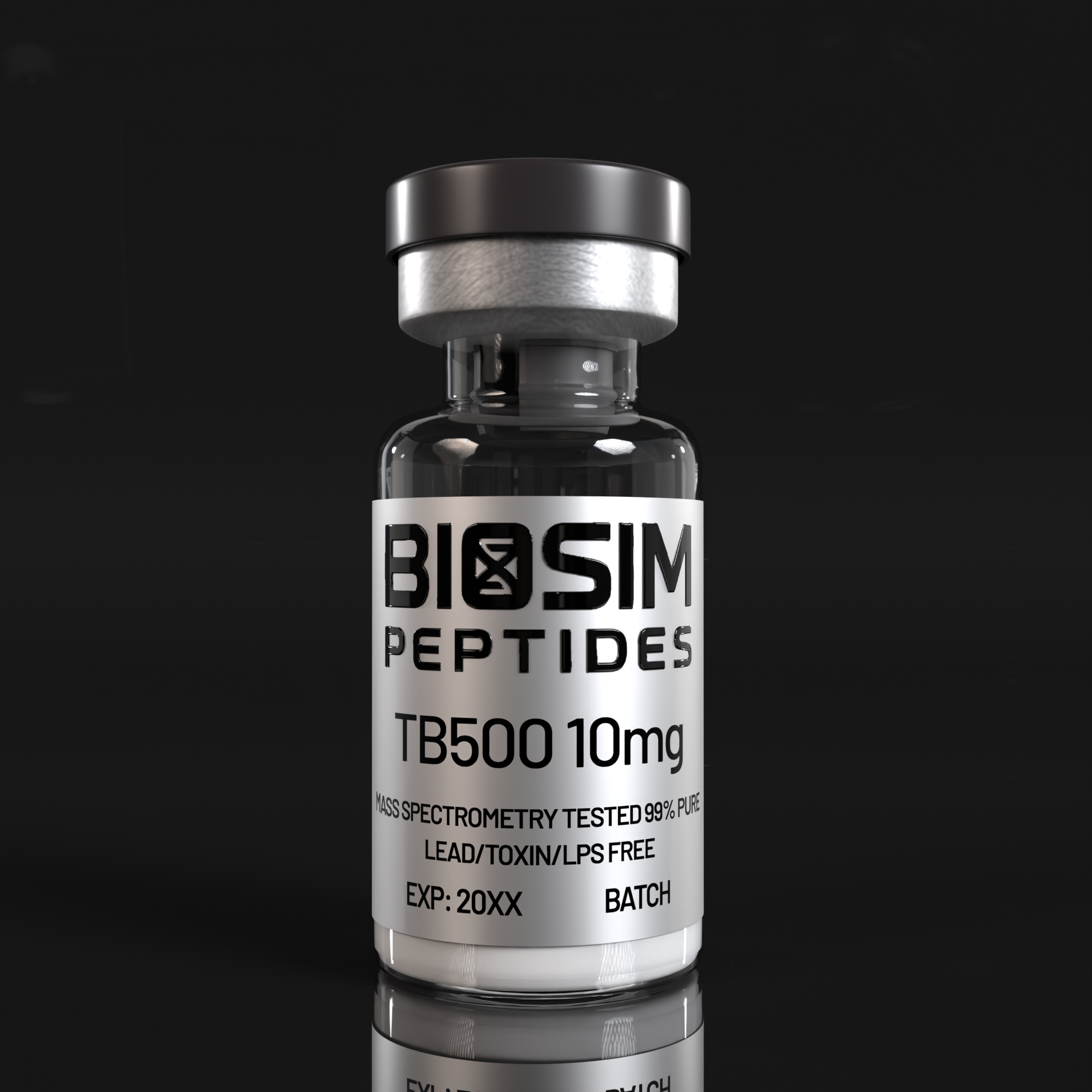
TB-500 is a synthetic peptide fragment corresponding to the active region of thymosin beta-4 (Tβ4), a 43-amino acid actin-sequestering polypeptide widely studied in tissue regeneration, angiogenesis, and inflammatory pathway research. BioSim Peptides supplies TB-500 10mg as a high-purity lyophilized powder intended strictly for in-vitro laboratory research use. This product is not a drug, supplement, or therapeutic agent.
What is TB-500?
TB-500 is a synthetic peptide whose sequence corresponds to amino acids 17–23 of the parent thymosin beta-4 molecule, the short hydrophilic region (LKKTETQ) identified in the literature as an actin-binding active site (Esposito et al., 2012). Thymosin beta-4 itself was originally isolated from calf thymus in the 1980s and is now recognized as one of the most abundant intracellular proteins in mammalian tissues, where it functions as the principal G-actin sequestering peptide.
The parent peptide belongs to the beta-thymosin family — small, highly conserved, acidic polypeptides characterized by an unstructured conformation in solution that becomes ordered upon binding to monomeric actin (Hannappel, 2007). TB-500 retains many of the regenerative and migratory bioactivities associated with full-length Tβ4 despite its smaller size, which has made it a useful tool compound for dissecting actin dynamics and cell-motility pathways in preclinical models.
Because the short fragment is detectable in equine and other animal sports doping screens, considerable analytical chemistry work has been performed to characterize TB-500 by mass spectrometry and to distinguish it from endogenous Tβ4 (Ho et al., 2012). In a laboratory research setting, TB-500 is commonly referred to as a “thymosin beta-4 fragment”, “Tβ4 fragment 17-23”, or by its acetylated N-terminal designation in synthesis literature.
Mechanism of Action in Research Models
The defining molecular activity of thymosin beta-4 and its fragment TB-500 is the binding and sequestration of G-actin monomers. By forming a 1:1 complex with monomeric actin, Tβ4 establishes a reserve pool of unpolymerized actin that can be rapidly mobilized for filament assembly during cell migration, cytokinesis, and wound closure (Bubb, 2003). Studies have characterized this interaction through NMR and crystallographic approaches, mapping the contact surface to the central region of the peptide retained within TB-500.
Beyond actin regulation, research suggests Tβ4 modulates a number of downstream signaling cascades relevant to tissue remodeling. Published literature describes upregulation of laminin-5, increased endothelial cell migration and tubule formation in angiogenesis assays, and modulation of the AKT survival pathway in cardiomyocytes (Goldstein et al., 2012). Investigations in cardiac injury models have linked Tβ4 exposure to activation of epicardial progenitor cells and altered expression of integrin-linked kinase (Pipes & Patrick, 2016).
Additional preclinical data indicates anti-inflammatory effects, with reductions in pro-inflammatory chemokine production and neutrophil infiltration observed in injury models (Sosne et al., 2002). Although the loss-of-function picture is more nuanced — for example, conditional cardiac knockouts of Tβ4 in mice did not impair baseline development (Banerjee et al., 2012) — exogenous administration of Tβ4 and TB-500 continues to generate measurable phenotypic effects across diverse research systems.
Mechanistic studies have also examined how the LKKTET motif retained in TB-500 interfaces with broader cellular machinery. Beyond binding actin, this central region has been implicated in interactions with cell-surface receptors and intracellular signaling intermediates that govern migration and survival. Reports of receptor-independent effects, alongside putative engagement of pathways such as PINCH/ILK and Notch signaling, illustrate why TB-500 continues to serve as a versatile tool fragment for hypothesis generation in regenerative biology research (Goldstein et al., 2012). Researchers should note that the in-vitro literature uses a wide range of model systems and concentration ranges, and direct translation between studies requires careful attention to experimental design.
Key Areas of Scientific Research
Tissue Repair and Wound Healing Research
TB-500 and full-length Tβ4 have been investigated extensively in epithelial and dermal injury models. In corneal wound assays, topical Tβ4 accelerated re-epithelialization and reduced inflammatory cell infiltration in rodent eyes (Sosne et al., 2002). Reviews of the broader Tβ4 literature describe consistent effects on keratinocyte and fibroblast migration in scratch-wound assays, positioning the peptide as a useful probe of actin-dependent repair processes (Goldstein et al., 2012).
Cardiovascular and Ischemia Research
Cardiac ischemia–reperfusion models have been a major focus for thymosin beta-4 research. Studies describe improved cardiomyocyte survival, reduced infarct size, and reactivation of the embryonic epicardium when Tβ4 is administered in murine myocardial-infarction models (Pipes & Patrick, 2016). These observations have prompted continued investigation of TB-500 as a structurally simpler analog for dissecting which features of Tβ4 are responsible for cardioprotective signaling in vitro.
Angiogenesis and Endothelial Biology
Endothelial-cell tube-formation, aortic-ring sprouting, and chick chorioallantoic membrane assays have all been used to characterize the pro-angiogenic profile of Tβ4-class peptides. Published data demonstrate increased endothelial migration and capillary-like network formation in vitro, with associated upregulation of vascular endothelial growth factor signaling components (Goldstein et al., 2012).
Inflammatory Pathway Studies
Research suggests Tβ4 and TB-500 attenuate NF-κB activation and reduce inflammatory cytokine release in macrophage and corneal epithelial systems (Sosne et al., 2002). These findings are routinely cross-referenced in laboratory investigations of crosstalk between cytoskeletal dynamics and innate immune signaling.
Neural and Neurological Injury Research
Beta-thymosin biology extends into the central and peripheral nervous system. In published preclinical models of traumatic brain injury and ischemic stroke, exogenous Tβ4 has been associated with increased oligodendrocyte progenitor recruitment, axonal sprouting, and functional recovery markers (Goldstein et al., 2012). TB-500, as the active fragment, has been used by laboratories investigating which subdomains of Tβ4 mediate these effects in vitro, particularly within cultured neural progenitor and Schwann cell systems.
Hair Follicle and Skin Research
Research literature on Tβ4 describes stimulation of hair follicle stem cell migration and elongation of the anagen growth phase in murine models (Goldstein et al., 2012). These observations have prompted basic-research investigations of follicular cytoskeletal dynamics and dermal papilla cell behavior, where TB-500 serves as a useful tool fragment because of its smaller size and synthetic accessibility relative to full-length Tβ4.
Actin Sequestration Biochemistry
At a purely biochemical level, TB-500 and other Tβ4-derived fragments are used to dissect the thermodynamics of G-actin binding. NMR and isothermal titration calorimetry studies have mapped the contact residues and characterized binding affinities in detail, providing a structural framework for understanding cytoskeletal sequestration (Bubb, 2003). This makes the peptide a routine reagent in in-vitro cytoskeleton research, independent of its regenerative phenotypes.
Published Research Highlights
- Esposito et al. (2012, Drug Testing and Analysis) described the synthesis and analytical characterization of the N-terminal acetylated 17–23 fragment of thymosin beta-4, providing the chemical framework used by most TB-500 suppliers.
- Ho et al. (2012, Journal of Chromatography A) developed an LC–MS workflow for detecting TB-500 in equine plasma, confirming its stability and detectability as a discrete synthetic entity.
- Goldstein et al. (2012, Expert Opinion on Biological Therapy) reviewed the multi-functional regenerative profile of thymosin beta-4 across wound, cardiac, and neural injury models.
- Sosne et al. (2002, Experimental Eye Research) reported that thymosin beta-4 promoted corneal re-epithelialization and decreased inflammation following alkali injury in vivo.
- Pipes and Patrick (2016, Vitamins and Hormones) summarized cardioprotective effects of Tβ4 in murine ischemia–reperfusion models.
- Banerjee et al. (2012, Circulation Research) demonstrated that cardiomyocyte-specific deletion of Tβ4 was tolerated in mice, refining mechanistic interpretation of exogenous-peptide studies.
- Hannappel (2007, Annals of the New York Academy of Sciences) reviewed the beta-thymosin family broadly, situating TB-500 within the structural biology of actin-sequestering peptides.
Research Context and Comparative Notes
TB-500 is commonly chosen as a laboratory tool fragment when investigators want to retain the central actin-binding activity of thymosin beta-4 without the complexity of producing the full 43-residue parent peptide. The published literature supports its utility for in-vitro cytoskeletal assays, migration experiments, and as a positive comparator in regenerative biology studies (Bubb, 2003; Goldstein et al., 2012).
Researchers should note that translation between TB-500 and full-length Tβ4 effects is not always direct. Some studies report differing potency or pathway engagement, reflecting the contribution of regions outside the LKKTET motif to certain Tβ4 activities. For this reason, TB-500 is most informative when paired with full-length Tβ4 in side-by-side experiments, or when used to probe specifically actin-related phenotypes. The peptide’s small size also makes it well suited to studies relying on precise mass-spectrometric detection and quantitation (Ho et al., 2012).
Stability, Storage, and Handling in Laboratory Settings
TB-500 is supplied as a lyophilized white powder. The literature and standard peptide-handling guidance recommend long-term storage of the lyophilized vial at −20 °C, protected from light and moisture. Under these conditions the peptide is generally reported to remain stable for extended periods.
For laboratory reconstitution, sterile bacteriostatic water or sterile water for injection is typically used in published protocols. Reconstituted solutions are best stored at 2–8 °C and used within a few weeks, consistent with general stability windows reported for small lyophilized peptides. Repeated freeze–thaw cycles should be avoided, and all handling should occur under aseptic technique in an appropriate biosafety environment. No dosing or administration is implied; all use is for in-vitro research only.
Product Specifications
- Product name: TB-500 10mg
- Sequence (Tβ4 17-23 active region, acetylated): Ac-LKKTETQ-OH
- Molecular formula (free acid): C₃₈H₆₈N₁₀O₁₃
- Approximate molecular weight: ~889 Da (synthetic acetylated fragment); full-length Tβ4 ~4,963 Da
- Purity: ≥98% by HPLC
- Presentation: Lyophilized white powder, single-use research vial
- Quantity: 10 mg per vial
- Certificate of Analysis: Included; HPLC and mass spectrometry data available on request
- Shipping: USA-based fulfillment
Why Researchers Choose BioSim Peptides
BioSim Peptides supplies research-grade TB-500 with verified identity and purity. Every batch is independently analyzed by reversed-phase HPLC and mass spectrometry, and certificates of analysis are made available to laboratory customers on request. We maintain a minimum purity specification of ≥98% across our peptide catalog.
Our facility is USA-based, with cold-chain-aware packaging, prompt domestic shipping, and responsive customer support for questions about specifications, handling, and documentation. Researchers working with thymosin beta-4 fragments often pair TB-500 with related regenerative peptides studied in the literature, such as BPC-157, when designing comparative in-vitro experiments.
References
- Esposito S, et al. Synthesis and characterization of the N-terminal acetylated 17-23 fragment of thymosin beta-4. Drug Testing and Analysis. 2012. PMID: 22962027.
- Ho EN, et al. Doping control analysis of TB-500, a synthetic version of an active region of thymosin β4, in equine urine and plasma by liquid chromatography–mass spectrometry. Journal of Chromatography A. 2012. PMID: 23084823.
- Goldstein AL, Hannappel E, Sosne G, Kleinman HK. Thymosin β4: a multi-functional regenerative peptide. Basic properties and clinical applications. Expert Opinion on Biological Therapy. 2012. PMID: 22074294.
- Hannappel E. Beta-thymosins. Annals of the New York Academy of Sciences. 2007. PMID: 17468232.
- Sosne G, et al. Thymosin beta 4 promotes corneal wound healing and decreases inflammation in vivo following alkali injury. Experimental Eye Research. 2002. PMID: 11950239.
- Bubb MR. Thymosin beta 4 interactions. Vitamins and Hormones. 2003. PMID: 12852258.
- Pipes GT, Patrick CW. Cardioprotection by thymosin beta 4. Vitamins and Hormones. 2016. PMID: 27450736.
- Banerjee I, et al. Thymosin beta 4 is dispensable for murine cardiac development and function. Circulation Research. 2012. PMID: 22158707.
This peptide is supplied by BioSim Peptides for in-vitro laboratory research use only. It is not a drug, supplement, cosmetic, or food product and is not intended for human or veterinary use, consumption, diagnosis, treatment, cure, or prevention of any disease. All research must comply with applicable institutional and regulatory guidelines.
Frequently Asked Questions about TB-500
What is TB-500?
TB-500 is a research peptide supplied by BioSim Peptides for in-vitro and laboratory use only. Each vial is lyophilized, lab-tested, and accompanied by a Certificate of Analysis (COA) verifying identity and purity above 98% by HPLC.
Is the TB-500 from BioSim Peptides third-party tested?
Yes. Every lot of TB-500 10mg is independently tested by HPLC and mass spectrometry. The COA for the current batch is available on request and packaged with every order.
How should TB-500 be stored?
Lyophilized TB-500 should be stored at -20°C for long-term stability. After reconstitution with bacteriostatic water it is typically stored at 2-8°C and used within the timeframe described in the published literature for the peptide.
How fast does BioSim Peptides ship?
Orders placed before 2 PM ET ship same business day from our USA facility via tracked carriers. Most domestic orders arrive in 2-4 business days.
Is TB-500 approved for human use?
No. TB-500 is supplied for in-vitro laboratory research only. It is not a drug, dietary supplement, cosmetic, or food, and is not intended for diagnosis, treatment, cure, or prevention of any disease in humans or animals.

Reviews
There are no reviews yet.