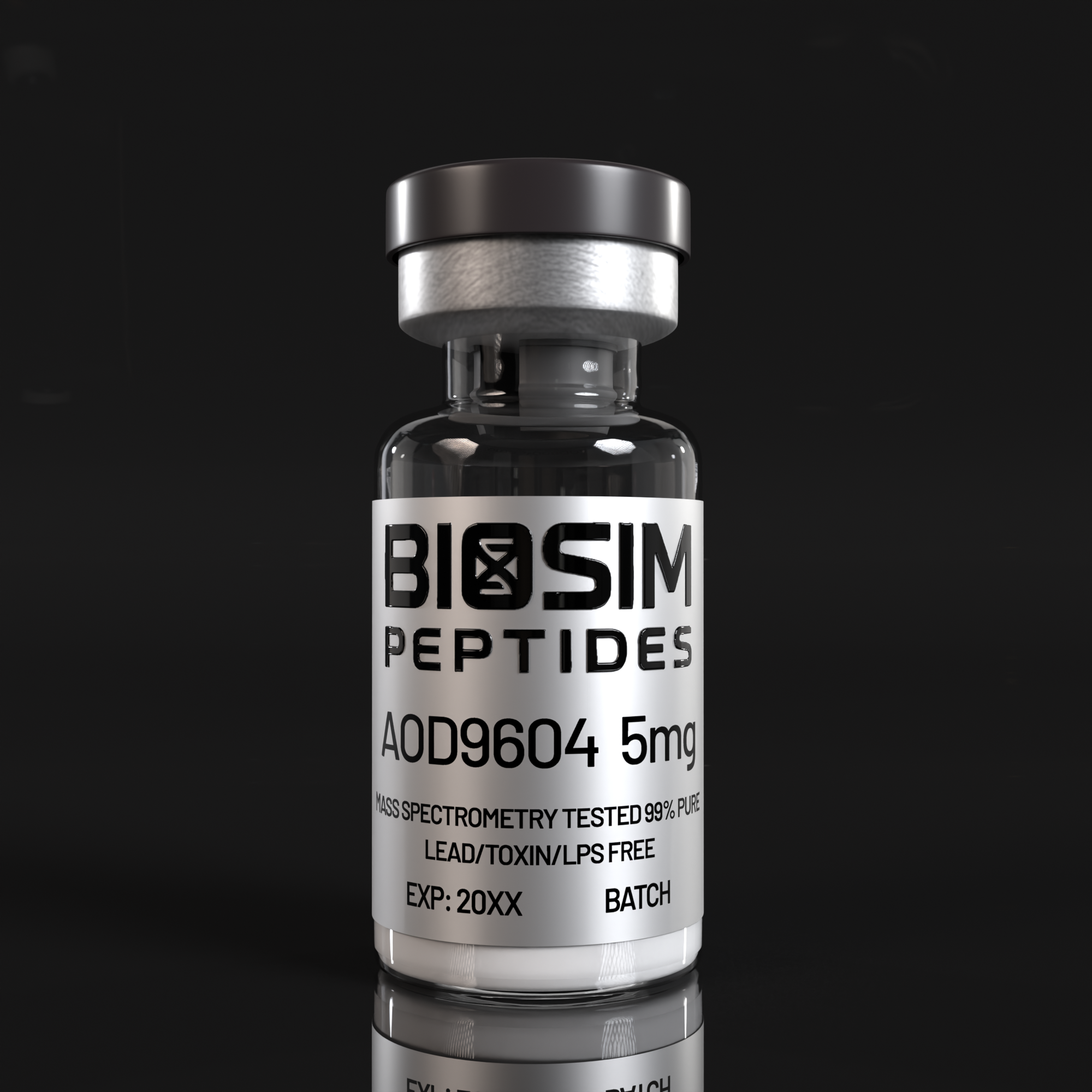
AOD-9604 5mg: Research Overview
AOD-9604 is a modified C-terminal fragment of human growth hormone (hGH) encompassing amino acid residues 177–191 with an additional N-terminal tyrosine residue, specifically designed for laboratory investigation of lipolytic and metabolic pathways. First developed by Professor Frank Ng at Monash University, this synthetic peptide retains the fat-metabolizing properties of the full-length hGH molecule while lacking the growth-promoting and diabetogenic effects associated with the intact hormone. AOD-9604 has been extensively characterized in preclinical models for its ability to stimulate lipolysis, enhance fat oxidation, and modulate adipose tissue metabolism, making it a valuable research tool for studying obesity, lipid metabolism, and metabolic disorders. This product is supplied as a lyophilized powder at 5mg per vial and is intended exclusively for in vitro laboratory research applications.
Molecular Background & Mechanism of Action
AOD-9604 (Tyr-hGH177-191) is derived from the C-terminal region of human growth hormone, a domain identified as the lipolytic core of the 191-amino acid hormone. The peptide has the following amino acid sequence: Tyr-Leu-Arg-Ile-Val-Gln-Cys-Arg-Ser-Val-Glu-Gly-Ser-Cys-Gly-Phe (the native cysteines at positions 182 and 189 form an intramolecular disulfide bond). The addition of the N-terminal tyrosine residue was a key modification that enhanced the stability and synthetic accessibility of the fragment while preserving its biological activity — specifically its capacity to stimulate lipolysis in adipose tissue without triggering the somatogenic effects mediated by the hGH receptor.[1][3]
Mechanistically, AOD-9604 acts through a pathway distinct from full-length hGH. Rather than binding the hGH receptor (GHR), AOD-9604 interacts with a putative receptor on adipocytes that triggers a signaling cascade involving the β3-adrenergic receptor (β3-AR) pathway. Preclinical studies in β3-AR knockout mice demonstrated that the lipolytic effects of AOD-9604 are dependent on functional β3-adrenergic signaling.[1] The peptide stimulates hormone-sensitive lipase (HSL) activity, promoting the hydrolysis of stored triglycerides into free fatty acids and glycerol. Additionally, AOD-9604 has been shown to increase fat oxidation rates independently of insulin signaling, differentiating its mechanism from agents that primarily affect glucose homeostasis.[4][5]
Preclinical & Clinical Evidence
The preclinical development of AOD-9604 is anchored in a body of work demonstrating its lipolytic efficacy across multiple animal models. In a landmark study published in Endocrinology, Heffernan and colleagues investigated chronic AOD-9604 administration in diet-induced obese mice and β3-AR knockout mice. The compound significantly reduced body weight and adipose tissue mass in wild-type obese mice, with effects comparable to full-length hGH. Critically, the lipolytic action was absent in β3-AR knockout animals, confirming that the β3-adrenergic pathway is essential for AOD-9604’s mechanism and that the peptide does not simply mimic intact hGH signaling.[1]
Complementary research published in the International Journal of Obesity demonstrated that chronic treatment with the modified C-terminal fragment (AOD-9604) increased fat oxidation and produced significant weight loss in obese mice, with the peptide showing a more favorable safety profile than full-length hGH — specifically, no adverse effects on glucose tolerance or insulin sensitivity were observed, contrasting sharply with the known diabetogenic properties of intact growth hormone.[2] In Zucker fatty rats, Ng and colleagues characterized the molecular and cellular actions of the hGH lipolytic domain (then designated AOD9401) and demonstrated that the peptide acts directly on adipocytes to stimulate lipolysis, providing the first detailed cellular mechanism for the fragment’s effects.[4]
Metabolic tracer studies documented in Hormone Research established the pharmacokinetic profile and metabolic fate of AOD-9604, demonstrating rapid tissue distribution and metabolic clearance consistent with a peptide of this size class.[3] Remarkably, oral administration studies published in the American Journal of Physiology showed that the synthetic fragment retained biological activity even when delivered orally — a property attributed to its small size and resistance to proteolytic degradation relative to the parent hormone.[5] More recently, analytical chemistry investigations have characterized AOD-9604’s detection profile and in vitro metabolism, documenting its stability in biological matrices and establishing mass spectrometry-based methods for identification.[6][7] An exploratory study also investigated AOD-9604’s potential in joint tissue research, examining intra-articular administration in an osteoarthritis model.[8]
Research Applications
- Lipolysis & Adipocyte Biology: AOD-9604 serves as a selective pharmacological probe for studying β3-adrenergic signaling in adipose tissue without the confounding effects of full hGH receptor activation. Researchers can employ this peptide to dissect the molecular mechanisms governing triglyceride hydrolysis, free fatty acid mobilization, and hormone-sensitive lipase regulation in adipocyte models.
- Obesity & Metabolic Disorder Modeling: As a tool for investigating anti-obesity mechanisms, AOD-9604 enables the study of fat-mass reduction pathways independent of caloric restriction, appetite modulation, or insulin sensitization. It is particularly useful in comparative studies alongside GLP-1 receptor agonists, amylin analogs, and other metabolic peptides.
- Fat Oxidation & Energy Expenditure Studies: The peptide’s capacity to increase fat oxidation without affecting glucose disposal makes it a valuable agent for investigating substrate utilization, respiratory exchange ratios, and mitochondrial fatty acid oxidation pathways in metabolic research.
- Growth Hormone Fragment Pharmacology: AOD-9604 provides a model system for studying how discrete domains of large peptide hormones can be isolated to retain specific biological functions while eliminating off-target effects — a concept relevant to rational peptide drug design and structure-function relationship analysis.
- Analytical Method Development: The peptide has been used as a reference standard in the development of liquid chromatography–mass spectrometry (LC-MS) and ion mobility spectrometry methods for detecting peptide-based compounds in complex biological matrices.[6]
Comparative Context
AOD-9604 occupies a unique niche among metabolic research peptides, distinguished by its origin as an hGH fragment and its selective lipolytic mechanism. Unlike full-length human growth hormone, which acts through the GHR to promote both lipolysis and IGF-1-mediated growth, AOD-9604 selectively targets adipose tissue lipolysis without elevating circulating IGF-1 levels or inducing insulin resistance. This contrasts with GLP-1 receptor agonists (such as semaglutide or liraglutide), which primarily act through appetite suppression and delayed gastric emptying, and with amylin analogs (such as cagrilintide), which target satiety pathways in the central nervous system. The compound also differs from β3-adrenergic agonists (e.g., CL-316,243) in that it appears to engage the β3-AR pathway indirectly rather than through direct receptor agonism, suggesting a distinct upstream signaling mechanism.[1][4]
| Compound | Target / Pathway | Key Property |
|---|---|---|
| AOD-9604 | β3-AR / HSL (adipose) | Selective lipolysis; no IGF-1 or glycemic effects |
| hGH (full-length) | GHR → IGF-1, lipolysis | Broad anabolic + lipolytic; diabetogenic |
| Semaglutide | GLP-1 receptor | Appetite suppression, insulinotropic |
| Cagrilintide | Amylin / CTR receptors | CNS satiety signaling, gastric emptying |
| CL-316,243 | β3-AR (direct agonist) | Direct β3-AR agonism; thermogenic |
Safety & Laboratory Handling
Store lyophilized AOD-9604 at -20°C protected from light and moisture. The lyophilized peptide is stable under these conditions for the duration indicated on the certificate of analysis. For reconstitution, use sterile bacteriostatic water or appropriate buffer compatible with your experimental system (not included). Reconstituted solutions should be stored at 2-8°C and used within 30 days. Avoid repeated freeze-thaw cycles, as these may compromise peptide integrity and biological activity. Use appropriate personal protective equipment including gloves and eye protection when handling. For laboratory research use only — not for diagnostic or therapeutic applications. This product has not been evaluated by the FDA for human use and is not intended for human or veterinary administration.
References
- Heffernan M, Summers RJ, Thorburn A, et al. (2001). “The effects of human GH and its lipolytic fragment (AOD9604) on lipid metabolism following chronic treatment in obese mice and β3-AR knock-out mice.” Endocrinology. PMID: 11713213.
- Heffernan MA, Thorburn AW, Fam B, et al. (2001). “Increase of fat oxidation and weight loss in obese mice caused by chronic treatment with human growth hormone or a modified C-terminal fragment.” International Journal of Obesity and Related Metabolic Disorders. PMID: 11673763.
- Ng FM, Sun J, Sharma L, et al. (2000). “Metabolic studies of a synthetic lipolytic domain (AOD9604) of human growth hormone.” Hormone Research. PMID: 11146367.
- Ng FM, Jiang WJ, Gianello R, et al. (2000). “Molecular and cellular actions of a structural domain of human growth hormone (AOD9401) on lipid metabolism in Zucker fatty rats.” Journal of Molecular Endocrinology. PMID: 11116208.
- Heffernan MA, Jiang WJ, Thorburn AW, et al. (2000). “Effects of oral administration of a synthetic fragment of human growth hormone on lipid metabolism.” American Journal of Physiology – Endocrinology and Metabolism. PMID: 10950816.
- Cox HD, Smeal SJ, Hughes CM, et al. (2015). “Detection and in vitro metabolism of AOD9604.” Drug Testing and Analysis. PMID: 25208511.
- Orlovius AK, Thomas A, Schänzer W, et al. (2013). “AOD-9604 does not influence the WADA hGH isoform immunoassay.” Drug Testing and Analysis. PMID: 24124033.
- Kwon DR, Park GY. (2015). “Effect of Intra-articular Injection of AOD9604 with or without Hyaluronic Acid in Rabbit Osteoarthritis Model.” Annals of Clinical and Laboratory Science. PMID: 26275694.
⚠ Research Use Only: This product is sold exclusively for in vitro laboratory research. It has not been evaluated by the FDA for human use and is not intended for diagnostic, therapeutic, or any clinical application.

Reviews
There are no reviews yet.