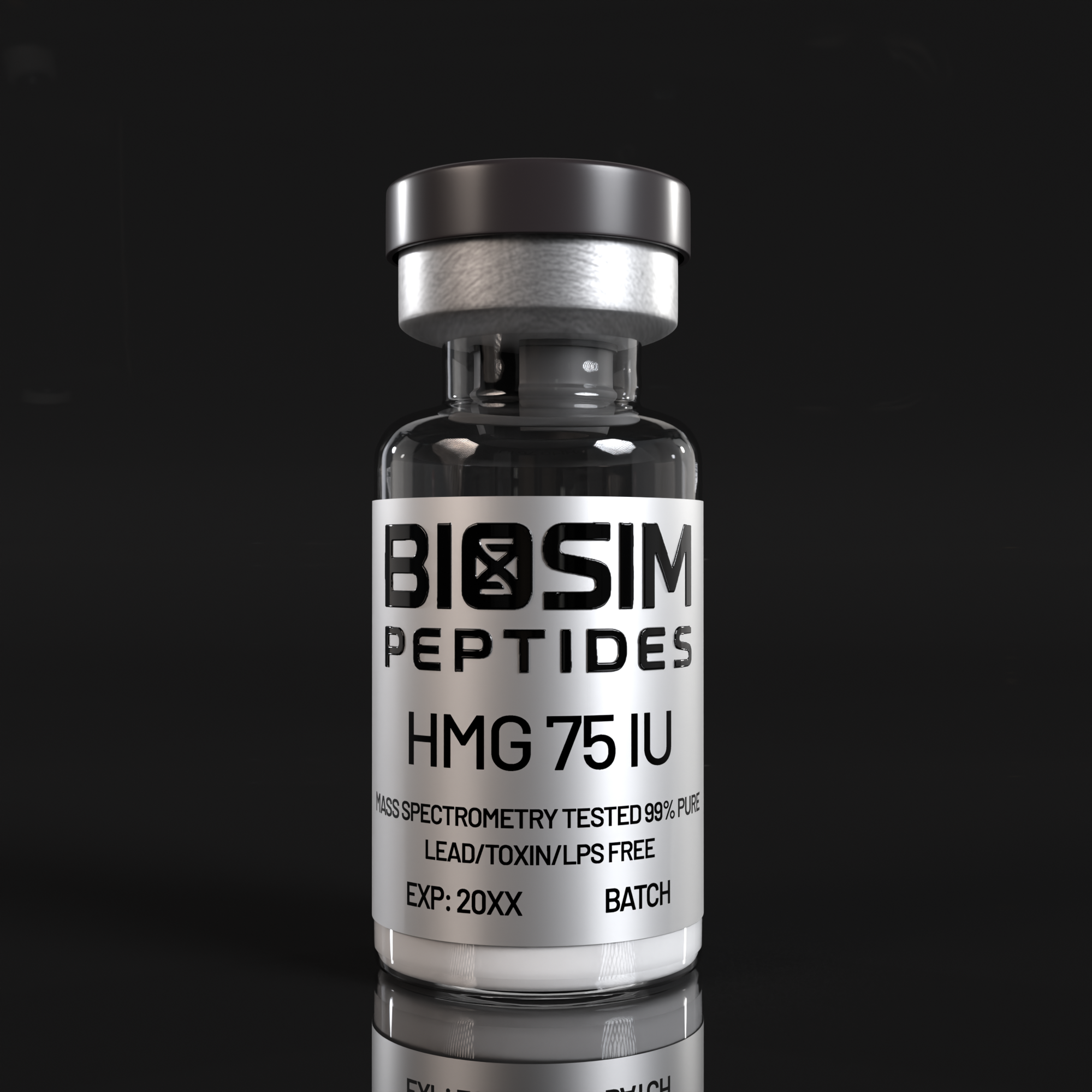
HMG 75iu: Research Overview
Human Menopausal Gonadotropin (HMG), also known as menotropin, is a highly purified urinary-derived gonadotropin preparation containing both follicle-stimulating hormone (FSH) and luteinizing hormone (LH) activity. Each vial of HMG 75iu provides 75 IU of FSH and 75 IU of LH activity, formulated for use in advanced reproductive endocrinology research. This product is intended exclusively for in vitro laboratory investigation of gonadotropin receptor signaling, folliculogenesis, steroidogenesis, and spermatogenesis pathways. It is not approved for human or veterinary therapeutic use.
Molecular Background & Mechanism of Action
HMG exerts its biological effects through selective binding to the FSH receptor (FSHR) and LH/choriogonadotropin receptor (LHCGR), both members of the G protein-coupled receptor (GPCR) superfamily. FSH binding to FSHR on ovarian granulosa cells activates the Gs-adenylyl cyclase-cAMP-PKA signaling cascade, driving aromatase expression and estradiol biosynthesis — a critical step in follicular maturation.[1] LH activity, mediated through LHCGR on theca cells and mature granulosa cells, stimulates androgen production via the same cAMP-PKA pathway and triggers the downstream events of ovulation and luteinization.[2]
Recent molecular pharmacology studies have revealed that different commercial HMG preparations exhibit distinct intracellular signaling fingerprints despite converging on similar long-term steroidogenic outcomes. Riccetti et al. (2017) demonstrated that heterogeneous hCG and hMG preparations differentially activate cAMP, ERK1/2, and β-arrestin recruitment pathways in granulosa cells, with varying potency and efficacy profiles at FSHR and LHCGR.[3] Subsequent work by Casarini et al. (2020) confirmed that two hMG preparations display divergent early signaling kinetics, including differences in cAMP accumulation and β-arrestin 2 recruitment, underscoring the importance of batch characterization in research settings.[4] The “two-cell, two-gonadotropin” model posits that LH-driven theca cell androgen production synergizes with FSH-driven granulosa cell aromatization — a cooperative mechanism that recombinant FSH alone cannot fully replicate.
Preclinical & Clinical Evidence
The therapeutic equivalence and clinical utility of HMG have been extensively characterized in randomized controlled trials. A landmark 2025 Cochrane network meta-analysis encompassing 162 randomized trials (33,000+ participants) evaluated controlled ovarian stimulation protocols and confirmed that HMG-containing regimens achieve comparable or superior live birth rates relative to recombinant FSH protocols in specific patient populations, while offering distinct pharmacodynamic advantages through endogenous LH activity supplementation.[5] A separate 2025 Cochrane systematic review focused on gonadotropins for ovulation induction in women with polycystic ovary syndrome (PCOS) concluded that HMG is among the most effective ovulation induction agents, with robust evidence supporting its use in clomiphene-resistant anovulatory infertility.[6]
In a prospective, assessor-blinded, randomized trial comparing highly purified human menotropin (HP-hMG) with recombinant FSH in high-responder IVF patients (n=1,059), Witz et al. (2020) reported that HP-hMG yielded comparable ongoing pregnancy rates while demonstrating a favorable safety profile — an important consideration for researchers investigating gonadotropin receptor pharmacology and downstream signaling networks in hyperstimulated ovarian models.[7] Santi et al. (2017) conducted a comprehensive review comparing FSH alone, FSH+LH, HMG, and FSH+hCG protocols on oocyte quality, finding that LH activity supplementation via HMG was associated with improvements in oocyte competence and endometrial receptivity markers.[8]
Beyond ovarian applications, HMG has demonstrated significant utility in male reproductive research. Studies in hypogonadotropic hypogonadism (HH) models have shown that combined FSH/LH therapy via HMG effectively restores spermatogenesis. Sahib et al. (2023) reported favorable management outcomes in HH males treated with gonadotropin regimens incorporating menotropin, with documented improvements in testicular volume, serum testosterone, and sperm parameters.[9] These findings position HMG as a valuable tool for investigators studying the gonadotropic regulation of spermatogenesis and Sertoli cell function.
Research Applications
- Ovarian Folliculogenesis Research: Investigate FSH-driven granulosa cell proliferation, differentiation, and aromatase induction in primary and immortalized granulosa cell lines.
- Gonadotropin Receptor Pharmacology: Characterize FSHR and LHCGR signaling kinetics, including cAMP accumulation, ERK1/2 phosphorylation, and β-arrestin recruitment profiles using different HMG preparations.
- Steroidogenesis Pathway Analysis: Study the two-cell, two-gonadotropin model of estradiol biosynthesis in theca-granulosa co-culture systems.
- Spermatogenesis Research: Examine FSH and LH contributions to Sertoli cell function, spermatogonial stem cell maintenance, and meiotic progression in testicular explant and organotypic culture models.
- Comparative Gonadotropin Studies: Assess the differential effects of urinary-derived HMG versus recombinant FSH/LH preparations on oocyte competence markers and endometrial receptivity gene expression profiles.
- Polycystic Ovary Syndrome (PCOS) Models: Employ HMG in in vitro PCOS research paradigms to study aberrant follicular steroidogenesis and insulin-gonadotropin signaling crosstalk.
Safety & Laboratory Handling
HMG 75iu lyophilized powder should be stored at -20°C in a desiccated environment, protected from light and moisture. Reconstitution should be performed using sterile bacteriostatic water (0.9% benzyl alcohol) or sterile water for injection under aseptic conditions. Following reconstitution, the solution should be stored at 2-8°C and used within 30 days. Avoid repeated freeze-thaw cycles, which may compromise peptide integrity and biological activity. Researchers should wear appropriate personal protective equipment (PPE), including laboratory gloves, eye protection, and a lab coat when handling this product. All work should be conducted in a certified biosafety cabinet or laminar flow hood. Dispose of unused material in accordance with institutional biosafety guidelines. This product is for laboratory research use only and is not intended for human or veterinary administration.
References
- Casarini L, Riccetti L, Paradiso E, et al. (2020). “Two human menopausal gonadotrophin (hMG) preparations display different early signaling in vitro.” Molecular Human Reproduction. PMID: 33084890.
- Ezcurra D, Humaidan P. (2014). “A review of luteinising hormone and human chorionic gonadotropin when used in assisted reproductive technology.” Reproductive Biology and Endocrinology. PMID: 25280580.
- Riccetti L, Klett D, Ayoub MA, et al. (2017). “Heterogeneous hCG and hMG commercial preparations result in different intracellular signalling but induce a similar long-term progesterone response in human granulosa cells.” Molecular Human Reproduction. PMID: 29044421.
- Casarini L, Riccetti L, Paradiso E, et al. (2020). “Two human menopausal gonadotrophin (hMG) preparations display different early signaling in vitro.” Molecular Human Reproduction. PMID: 33084890.
- Melo P, Eapen A, Chung Y, et al. (2025). “Controlled ovarian stimulation protocols for assisted reproduction: a network meta-analysis.” Cochrane Database of Systematic Reviews. PMID: 40590303.
- Weiss NS, Kostova EB, Mol BWJ, et al. (2025). “Gonadotropins for ovulation induction in women with polycystic ovary syndrome.” Cochrane Database of Systematic Reviews. PMID: 40193219.
- Witz CA, Daftary GS, Doody KJ, et al. (2020). “Randomized, assessor-blinded trial comparing highly purified human menotropin and recombinant follicle-stimulating hormone in high responders undergoing in vitro fertilization.” Fertility and Sterility. PMID: 32416978.
- Santi D, Casarini L, Alviggi C, et al. (2017). “Efficacy of Follicle-Stimulating Hormone (FSH) Alone, FSH + Luteinizing Hormone, Human Menopausal Gonadotropin or FSH + Human Chorionic Gonadotropin on Oocyte Quality in Assisted Reproductive Technologies.” Frontiers in Endocrinology. PMID: 28620352.
⚠ Research Use Only: This product is manufactured for in vitro laboratory research purposes only. It is not a drug, food, or dietary supplement and has not been evaluated by the FDA for safety or efficacy in humans. Not for human consumption, veterinary, or clinical therapeutic use. Researchers must comply with all institutional, local, and federal regulations governing the handling and use of research-grade peptides.

Reviews
There are no reviews yet.