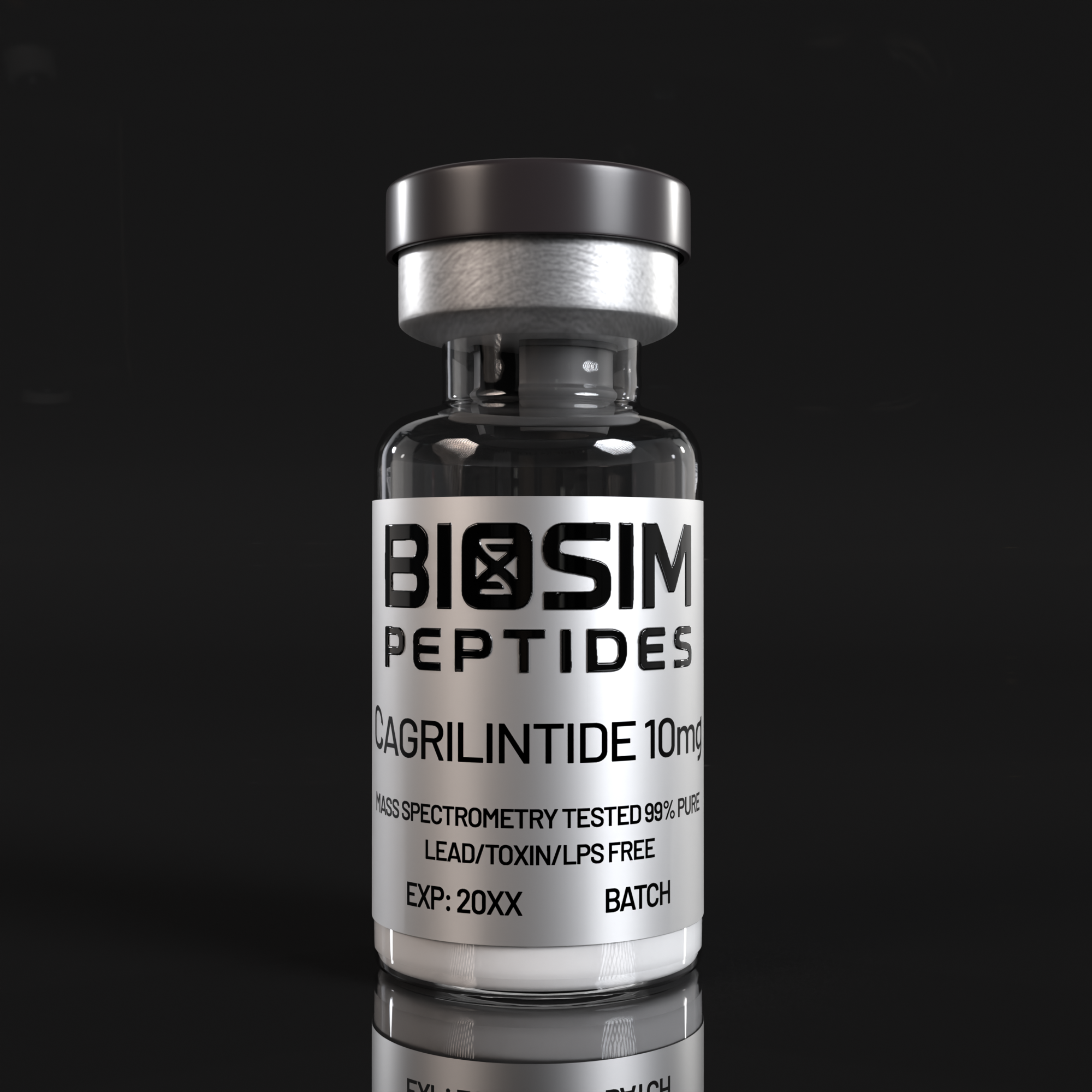
Cagrilintide 10mg: Research Overview
Cagrilintide is a long-acting, acylated amylin analog developed as a research tool for investigating metabolic regulation, appetite control, and energy homeostasis pathways. Originally designated AM833, cagrilintide was engineered to mimic the physiological actions of the endogenous pancreatic hormone amylin — a 37-amino acid peptide co-secreted with insulin from pancreatic β-cells that contributes to postprandial glucose control and satiety signaling. Through structural modifications, including fatty acid acylation to promote reversible albumin binding, cagrilintide achieves an extended pharmacokinetic half-life suitable for once-weekly administration in preclinical models. It has attracted significant research attention for its dual action at amylin and calcitonin receptors and its emerging role in combination therapy investigations with GLP-1 receptor agonists. This product is supplied as a lyophilized powder at 10mg per vial and is intended exclusively for in vitro and authorized preclinical laboratory research applications.
Molecular Background & Mechanism of Action
Cagrilintide is a synthetic peptide analog of human amylin (islet amyloid polypeptide, IAPP) engineered with key amino acid substitutions to enhance stability, receptor selectivity, and pharmacokinetic profile. Like native amylin, cagrilintide acts as an agonist at amylin receptors (AMY receptors), which are heterodimeric complexes composed of the calcitonin receptor (CTR) paired with one of three receptor activity-modifying proteins (RAMP1, RAMP2, or RAMP3). Comprehensive pharmacological profiling has demonstrated that cagrilintide (AM833) is a potent agonist at multiple calcitonin family G protein-coupled receptors, with particularly high affinity for the AMY1 receptor subtype (CTR/RAMP1), which is densely expressed in the area postrema and nucleus of the solitary tract — key regions of the dorsal vagal complex involved in appetite regulation and energy balance.[1][2]
A landmark cross-species neuroanatomical study published in Nature Metabolism in 2026 mapped the neural substrates of cagrilintide action across rodent and primate models, revealing that the peptide engages discrete neuronal populations in the dorsal vagal complex that are distinct from those targeted by GLP-1 receptor agonists. This study identified prolactin-releasing hormone (PrRP) neurons as critical mediators of cagrilintide’s effects on feeding behavior and body weight, establishing a mechanistic framework for understanding how this amylin analog promotes negative energy balance through central nervous system signaling.[3] The long-acting pharmacokinetic profile is achieved through reversible, non-covalent binding to serum albumin via a conjugated fatty acid moiety, which slows renal clearance and extends the elimination half-life to approximately 7-8 days — enabling sustained receptor engagement with once-weekly dosing regimens in research models.[1][4]
Preclinical & Clinical Evidence
The pharmacological characterization of cagrilintide began with detailed in vitro receptor profiling. Fletcher and colleagues (2021) published the first comprehensive pharmacological analysis of AM833 (cagrilintide) in the Journal of Pharmacology and Experimental Therapeutics, comparing its signaling properties at calcitonin family receptors with those of six other selective and non-selective agonists, including native human amylin, pramlintide, salmon calcitonin, and the dual amylin-calcitonin receptor agonist KBP-042. This study established cagrilintide as a potent agonist at AMY receptors with a signaling profile well-suited for sustained metabolic effects.[1]
The REIMAGINE clinical trial program has significantly expanded the evidence base for cagrilintide. The REIMAGINE 2 trial — a double-blind, randomized, controlled phase 3 study published in The Lancet Diabetes & Endocrinology — compared cagrilintide-semaglutide (CagriSema) against semaglutide alone and cagrilintide alone in individuals with type 2 diabetes. This trial demonstrated that the combination produced superior glycemic control and body weight reduction compared to either monotherapy, providing compelling evidence for complementary mechanisms of action between amylin receptor and GLP-1 receptor agonism.[5] A systematic review and meta-analysis by Rao and colleagues examined all available evidence on cagrilintide and CagriSema for weight reduction and metabolic risk modification in overweight or obesity, confirming significant efficacy signals across multiple study populations.[6]
Pharmacokinetic investigations have established that cagrilintide can be safely administered to research subjects with renal or hepatic impairment without clinically meaningful alterations in drug exposure, safety, or tolerability profiles.[4] This broad applicability reinforces cagrilintide’s utility as a versatile research compound for metabolic studies across diverse model systems. A comprehensive systematic review, meta-analysis, and meta-regression by Ahmed and colleagues confirmed the efficacy and safety of both cagrilintide monotherapy and CagriSema combination therapy as anti-obesity interventions, with dose-response relationships characterized across multiple trial populations.[7] The neural mechanism was definitively established through cross-species mapping of cagrilintide-responsive circuits in the dorsal vagal complex, demonstrating conserved PrRP neuron engagement from rodents to primates.[3] A detailed review by Bailey and colleagues positioned long-acting amylin-related peptides, including cagrilintide, as transformative therapies for obesity and type 2 diabetes research, highlighting their unique mechanistic niche alongside incretin-based approaches.[8]
Research Applications
- Appetite Regulation & Satiety Pathway Research: Cagrilintide is a powerful pharmacological probe for investigating amylin-mediated satiety signaling. Researchers can study how activation of AMY receptors in the area postrema and nucleus of the solitary tract modulates feeding behavior, gastric emptying, and meal termination in preclinical models.
- Combination Metabolic Therapy Investigation: The synergy between amylin receptor agonism (cagrilintide) and GLP-1 receptor agonism (semaglutide) provides a rich experimental paradigm for studying multi-receptor approaches to metabolic regulation. The REIMAGINE trial data supports investigation of complementary mechanisms involving appetite suppression, delayed gastric emptying, and energy expenditure modulation.[5][7]
- Dorsal Vagal Complex Neurocircuitry: Cagrilintide’s well-characterized neural target engagement profile makes it an ideal tool for mapping brainstem circuits involved in energy homeostasis. The identification of PrRP neurons as key mediators opens new avenues for investigating how peripheral metabolic signals are integrated by hindbrain nuclei.[3]
- Body Weight & Adiposity Regulation Studies: As a long-acting agent with sustained receptor engagement, cagrilintide is well-suited for chronic dosing studies examining body weight trajectories, body composition changes, and metabolic adaptation in diet-induced obesity models.
- Comparative Endocrinology of Amylin Family Peptides: Researchers can use cagrilintide alongside native amylin, pramlintide, salmon calcitonin, and related peptides to compare receptor selectivity, signaling bias, and metabolic outcomes across the calcitonin peptide family.[1][8]
Comparative Context
Cagrilintide occupies a distinct position within the metabolic peptide research landscape. While GLP-1 receptor agonists (semaglutide, liraglutide, tirzepatide) primarily target incretin pathways to enhance insulin secretion and suppress appetite, cagrilintide engages the amylin/calcitonin receptor system to promote satiety through a complementary mechanism. Native amylin has a short plasma half-life (~13 minutes), limiting its utility as a research tool; cagrilintide overcomes this through structural modifications that extend its half-life to approximately 7 days. Pramlintide, the only other clinically characterized amylin analog, requires multiple daily injections due to its shorter duration of action. Importantly, cagrilintide and semaglutide appear to engage distinct neuronal populations in the dorsal vagal complex — a mechanistic observation that explains their additive effects in combination studies.[2][3][5]
| Compound | Target / Pathway | Key Property |
|---|---|---|
| Cagrilintide | AMY1–AMY3 receptors (DVC) | ~7-day half-life; CNS satiety; gastric emptying delay |
| Native Amylin | AMY receptors | ~13-minute half-life; co-secreted with insulin |
| Pramlintide | AMY receptors | Synthetic amylin analog; t.i.d. dosing |
| Semaglutide | GLP-1 receptor | Incretin pathway; distinct DVC neuronal targets |
| Tirzepatide | GIP/GLP-1 dual agonist | Dual incretin agonism; no amylin component |
| Salmon Calcitonin | CTR (high affinity) | Ancestral amylin receptor agonist; shorter t½ |
Safety & Laboratory Handling
Store lyophilized cagrilintide at -20°C protected from light and moisture. The lyophilized peptide is stable under these conditions for the duration indicated on the certificate of analysis. For reconstitution, use sterile bacteriostatic water or an appropriate buffer system compatible with your experimental protocol (not included). Reconstituted solutions should be stored at 2-8°C and used within 30 days. Avoid repeated freeze-thaw cycles, as these may compromise peptide integrity, aggregation state, and biological activity. Use appropriate personal protective equipment including gloves and eye protection when handling. For laboratory research use only — not for diagnostic or therapeutic applications. This product has not been evaluated by the FDA for human use and is not intended for human or veterinary administration.
References
- Fletcher MM, Keov P, Truong TT, et al. (2021). “AM833 Is a Novel Agonist of Calcitonin Family G Protein-Coupled Receptors: Pharmacological Comparison with Six Selective and Nonselective Agonists.” Journal of Pharmacology and Experimental Therapeutics. PMID: 33727283.
- Dehestani B, Stratford NR, le Roux CW. (2021). “Amylin as a Future Obesity Treatment.” Journal of Obesity & Metabolic Syndrome. PMID: 34929674.
- Ludwig MQ, Coester B, Gordian D, et al. (2026). “A cross-species atlas of the dorsal vagal complex reveals neural mediators of the effects of cagrilintide on energy balance.” Nature Metabolism. PMID: 42260119.
- Nielsen MJF, Becker NP, Duus HHH, et al. (2026). “Renal or Hepatic Impairment Does Not Affect Pharmacokinetics, Safety, or Tolerability of Subcutaneous Cagrilintide.” Clinical Pharmacokinetics. PMID: 42228334.
- Buse JB, Bajaj HS, Dalskov SM, et al. (2026). “Cagrilintide-semaglutide (CagriSema) versus semaglutide or cagrilintide in people with type 2 diabetes (REIMAGINE 2): a double-blind, randomised, controlled, phase 3 study.” The Lancet Diabetes & Endocrinology. PMID: 42251859.
- Rao H, Kumar S, Ali SME, et al. (2026). “Cagrilintide and CagriSema for weight reduction and metabolic risk modification in overweight or obesity: a systematic review and meta-analysis.” Journal of Diabetes & Metabolic Disorders. PMID: 42180166.
- Ahmed M, Hassan M, Tahir M, et al. (2026). “Efficacy and Safety of Cagrilintide and Cagrisema Versus Semaglutide as Anti-Obesity Medications: A Systematic Review, Meta-Analysis and Meta-Regression.” Diabetes, Obesity and Metabolism. PMID: 41834765.
- Bailey CJ, Flatt PR, Conlon JM. (2026). “Long-acting amylin-related peptides as therapies for obesity and type 2 diabetes.” Peptides. PMID: 41747885.
⚠ Research Use Only: This product is sold exclusively for in vitro laboratory research. It has not been evaluated by the FDA for human use and is not intended for diagnostic, therapeutic, or any clinical application.

Reviews
There are no reviews yet.