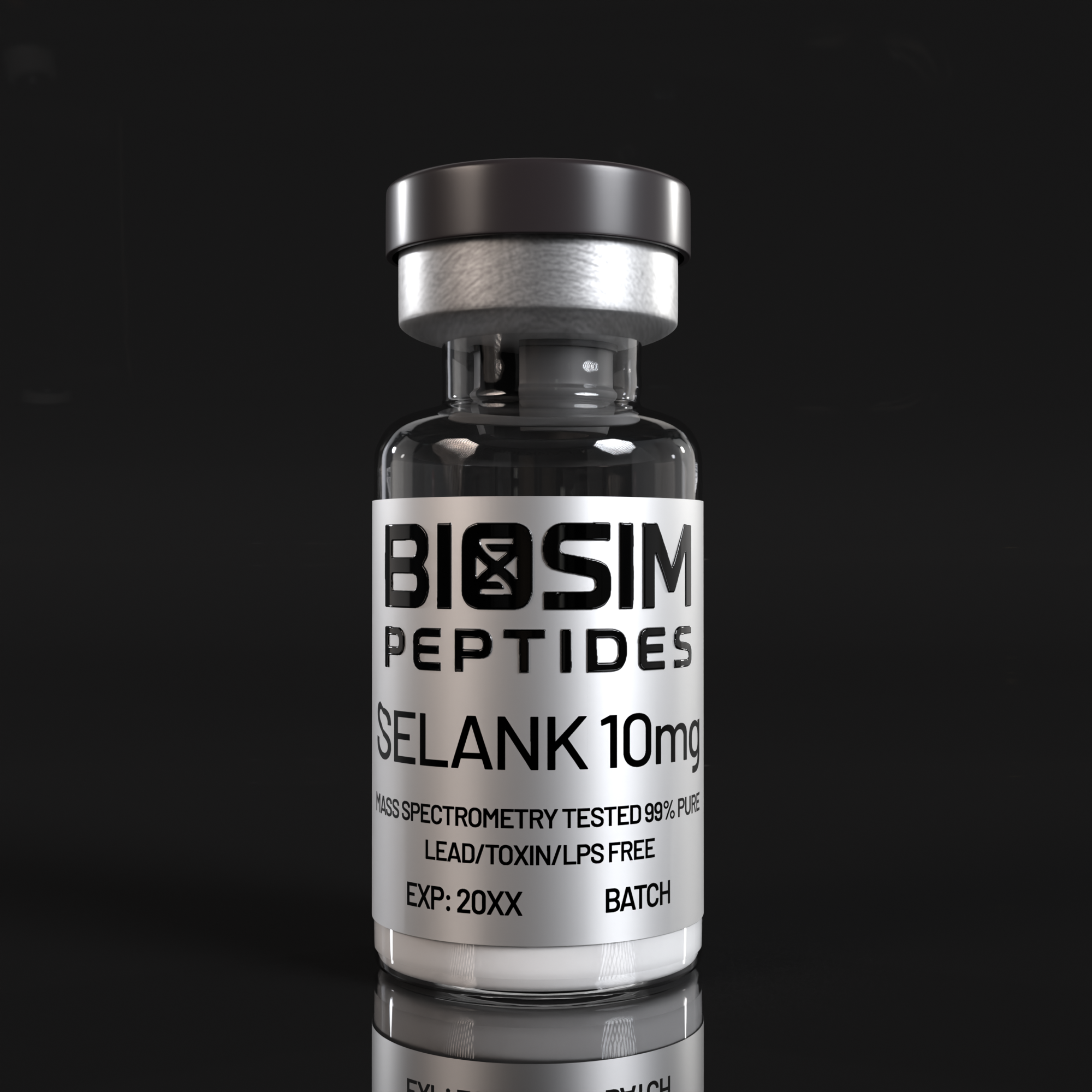
Selank 10mg

Categories:

Buy Selank 10MG — an anxiolytic research peptide studied for cognitive and immune-modulating properties. High purity. BioSim Peptides.

$50.00

Guaranteed Safe Checkout

⚠️ RESEARCH USE ONLY

This product is for R&D purposes only and is not approved for human or veterinary use.

Research Disclaimer & Introduction

FOR RESEARCH USE ONLY. NOT FOR HUMAN OR VETERINARY USE. Selank is a synthetic heptapeptide supplied as a lyophilized powder for laboratory investigation. This product is intended exclusively for qualified researchers conducting in vitro or in vivo studies in approved laboratory settings. Biosim Peptides does not condone or authorize any use of this compound outside of controlled research environments. By purchasing this product, the researcher certifies that they are qualified to handle research peptides and will comply with all applicable laws, regulations, and institutional guidelines.

Selank (Thr-Lys-Pro-Arg-Pro-Gly-Pro) is a synthetic analog of the endogenous immunomodulatory peptide tuftsin, which is a natural tetrapeptide fragment (Thr-Lys-Pro-Arg) derived from the Fc domain of immunoglobulin G. Developed at the Institute of Molecular Genetics of the Russian Academy of Sciences, Selank extends the tuftsin sequence with a C-terminal Pro-Gly-Pro tripeptide extension that confers enhanced metabolic stability, improved blood-brain barrier penetration, and a distinct pharmacological profile. Unlike classical benzodiazepine anxiolytics, which directly potentiate GABAA receptor signaling, Selank modulates the expression of genes encoding key neurotransmitter systems, including the GABAergic, serotonergic, and dopaminergic pathways. It has attracted significant research interest for its putative anxiolytic, nootropic, immunomodulatory, and neuroprotective properties, all achieved without the sedation, dependence liability, and withdrawal syndromes associated with traditional anxiolytic compounds. This product page provides a comprehensive overview of Selank’s molecular properties, mechanism of action, research applications, key published studies, and essential handling protocols.

Molecular Overview

Selank (CAS: 129954-34-1) is a heptapeptide with the primary sequence Thr-Lys-Pro-Arg-Pro-Gly-Pro and a molecular weight of 751.90 g/mol. The peptide’s design is rooted in structure-activity relationship studies of the tuftsin pharmacophore (Thr-Lys-Pro-Arg). Tuftsin itself, discovered by Najjar and Nishioka in 1970, is a physiological tetrapeptide cleaved from the CH2 domain of the IgG heavy chain by splenic tuftsin endocarboxypeptidase and leukokininase. Tuftsin stimulates phagocytosis, enhances natural killer (NK) cell activity, and promotes the microbicidal capacity of macrophages. However, tuftsin’s extremely short plasma half-life (approximately 2–3 minutes in rodents) due to rapid proteolytic degradation limits its utility as a research tool.

The addition of the C-terminal Pro-Gly-Pro tripeptide to the tuftsin core addresses this limitation in two critical ways. First, the Pro-Gly-Pro extension sterically hinders access of aminopeptidases and carboxypeptidases to the tuftsin pharmacophore, dramatically increasing the peptide’s metabolic stability and extending its half-life in biological media. Second, the Pro-Gly-Pro sequence is itself a bioactive motif — the tripeptide Pro-Gly-Pro (PGP) is a known modulator of neutrophil and macrophage chemotaxis, and its inclusion in Selank may contribute to the peptide’s immunomodulatory activity through independent receptor interactions. These two structural domains — the N-terminal tuftsin pharmacophore and the C-terminal Pro-Gly-Pro extension — cooperate to produce Selank’s distinctive polyvalent pharmacology.

Selank is soluble in water (≥2 mg/mL), physiological saline, and PBS. The lyophilized powder should be stored at -20°C, protected from light and moisture, yielding stability of up to 24 months. The peptide contains no D-amino acid residues, distinguishing it from many other stabilized neuropeptides, and its metabolic stability is achieved entirely through the Pro-Gly-Pro extension strategy rather than through D-amino acid incorporation. For research purposes, Selank is an attractive tool for studying the intersection of immune signaling, neurotransmitter gene regulation, and higher-order cognitive and affective processes.

Mechanism of Action

Selank’s mechanism of action is complex, multimodal, and fundamentally distinct from that of conventional anxiolytic and nootropic agents. Rather than acting as a direct ligand at classical neurotransmitter receptors, Selank exerts its effects primarily through modulation of gene expression in brain regions associated with emotional processing and cognitive function.

Genomic Regulation of Neurotransmitter Systems. The most extensively characterized mechanism of Selank involves the peptide’s ability to alter the expression of genes encoding key neurotransmitter system components. Studies by Sokolov and colleagues have demonstrated that Selank administration upregulates the expression of genes involved in GABAergic neurotransmission, including GABA transporter proteins and GABAA receptor subunits, in the frontal cortex and hippocampus. Simultaneously, Selank modulates the expression of serotonergic and dopaminergic genes, including those encoding serotonin receptors (5-HT1A, 5-HT2A) and dopamine receptors (D2, D3), as well as enzymes involved in neurotransmitter synthesis and degradation such as tyrosine hydroxylase and tryptophan hydroxylase (PMID: 19329167). Importantly, Selank does not appear to act as a direct agonist or antagonist at any of these receptor systems; rather, it shifts the transcriptional landscape to favor gene expression profiles associated with reduced anxiety, improved cognitive function, and emotional resilience.

Brain-Derived Neurotrophic Factor (BDNF) Modulation. Selank has been shown to modulate BDNF expression in the hippocampus and prefrontal cortex — brain regions critically involved in learning, memory, and mood regulation (PMID: 21162222). BDNF is a key mediator of synaptic plasticity, neurogenesis, and neuronal survival, and its dysregulation is implicated in anxiety disorders, depression, and cognitive decline. Selank’s ability to influence BDNF levels may contribute to the nootropic effects observed in preclinical learning and memory paradigms, including improvements in passive avoidance conditioning, maze navigation, and novel object recognition tasks.

Immunomodulatory Activity. Through its tuftsin pharmacophore, Selank retains and extends the immunomodulatory functions of the parent peptide. Selank enhances phagocytic activity of macrophages, stimulates interleukin-6 (IL-6) and interferon production in lymphocyte cultures, and modulates the expression of pro-inflammatory and anti-inflammatory cytokines depending on baseline immune status (PMID: 27072645). Notably, Selank appears to exert a normalizing, or bidirectional, effect on immune function — enhancing immune activity under immunosuppressed conditions while attenuating excessive inflammatory responses — a property consistent with its classification as an adaptogenic immunomodulator.

Neurotensin and Opioid System Interactions. Emerging evidence suggests that Selank may influence neurotensinergic and endogenous opioid signaling pathways. Neurotensin is a neuropeptide implicated in the modulation of dopamine signaling, stress responses, and pain perception, while the endogenous opioid system plays a central role in reward, stress coping, and emotional regulation. These interactions may contribute to Selank’s anxiolytic profile and its reported ability to modulate stress-induced behavioral changes without producing overt sedation or affecting locomotor activity.

Research Applications

Selank is employed in a diverse array of preclinical research domains, reflecting its polyvalent pharmacology bridging immunomodulation, neurochemistry, and behavioral neuroscience:

Anxiety & Stress Research. Selank’s anxiolytic properties have been characterized in multiple rodent behavioral models, including the elevated plus maze, open field test, Vogel conflict test, and light-dark box. Across these paradigms, Selank consistently reduces anxiety-like behaviors without producing the sedation or motor impairment associated with benzodiazepines or barbiturates. Researchers compare Selank to established anxiolytics to explore non-GABAergic mechanisms of anxiolysis and to elucidate the role of gene expression changes in stress adaptation (PMID: 26442998).

Cognitive Enhancement & Nootropic Research. Preclinical studies have investigated Selank’s effects on learning, memory consolidation, and cognitive performance. Rodent studies employing passive avoidance conditioning, Morris water maze, and novel object recognition paradigms have reported that Selank administration improves memory retention and retrieval, enhances spatial learning, and attenuates cognitive impairment induced by stress, sleep deprivation, or pharmacological challenge (PMID: 16756118).

Neuroprotection & Neurodegeneration Research. Selank’s effects on BDNF expression, its modulation of neurotransmitter gene transcription, and its immunomodulatory activity have prompted investigations into its potential neuroprotective properties. Researchers study Selank in models of cerebral ischemia, traumatic brain injury, and neuroinflammation to assess its ability to preserve neuronal viability, reduce glial activation, and promote functional recovery. The peptide’s antioxidant effects — mediated in part through modulation of superoxide dismutase and glutathione peroxidase activity — represent an additional dimension of neuroprotection research.

Immunopharmacology. Building on tuftsin’s established immunomodulatory credentials, Selank is studied in models of immune suppression, infection, and inflammatory disease. Researchers investigate Selank’s effects on T-cell and B-cell proliferation, macrophage phagocytic index, natural killer cell cytotoxicity, and cytokine profiles in both in vitro lymphocyte cultures and in vivo immune challenge models (PMID: 27072645).

Gene Expression & Pharmacogenomics Research. Selank is a valuable tool for researchers studying the genomic correlates of affective and cognitive states. Microarray and quantitative PCR studies have catalogued Selank-induced changes in the expression of hundreds of genes across multiple brain regions, providing a rich dataset for bioinformatic analyses of the transcriptional networks underlying anxiety, cognition, and emotional regulation (PMID: 19329167).

Psychoneuroimmunology. Selank’s dual action on immune function and central nervous system gene expression positions it as a uniquely valuable tool in the growing field of psychoneuroimmunology — the study of bidirectional communication between the immune system and the brain. Researchers use Selank to dissect the molecular pathways through which peripheral immune status influences mood, cognition, and behavior, and to test hypotheses about immune involvement in the etiology of anxiety and depressive disorders.

Key Published Studies

The scientific literature on Selank encompasses pharmacology, behavioral neuroscience, immunology, and genomics. The following studies represent important contributions to the characterization of Selank’s properties and mechanism:

Sokolov et al. (2008) — Gene Expression Profiling. Published in Bulletin of Experimental Biology and Medicine (PMID: 19329167), this study used microarray and real-time PCR methodologies to characterize Selank-induced changes in gene expression in the rat brain. The authors identified significant alterations in the expression of genes involved in GABAergic, serotonergic, and dopaminergic neurotransmission, as well as genes associated with neuroplasticity and immune function, providing the first comprehensive transcriptional map of Selank’s central effects.

Sollertinskaya et al. (2011) — Anxiolytic and Cognitive Effects. This study characterized Selank’s effects on higher nervous activity in rodents, demonstrating significant reductions in anxiety-like behavior in the elevated plus maze and open field test. Notably, the anxiolytic effects were achieved without sedation or impairment of motor coordination — a profile that distinguishes Selank from classical benzodiazepine anxiolytics.

Sokolov et al. (2012) — BDNF Modulation. Published in Doklady Biological Sciences (PMID: 21162222), this study demonstrated that Selank administration increases BDNF levels in the hippocampus and frontal cortex of rodents. The finding provides a mechanistic basis for Selank’s nootropic and neuroprotective properties, as BDNF is a critical mediator of synaptic plasticity, neurogenesis, and neuronal resilience.

Zozulya et al. (2014) — Immunomodulatory Characterization. Published findings characterized the effects of Selank on lymphocyte proliferation, macrophage phagocytic activity, and cytokine production in in vitro experiments using human peripheral blood mononuclear cells. The study demonstrated that Selank’s immunomodulatory effects extend beyond tuftsin’s original profile, showing a normalizing influence that enhances or suppresses immune activity depending on baseline immune status (PMID: 27072645).

Gudasheva et al. (2015) — Structure-Activity Relationships. This comprehensive medicinal chemistry analysis examined the contributions of each residue in the Selank sequence to the peptide’s pharmacological profile. The Pro-Gly-Pro C-terminal extension was confirmed as critical for metabolic stability and blood-brain barrier penetration, validating the design rationale that guided Selank’s development.

Andreeva et al. (2016) — Anxiolytic Mechanisms. Published in pharmacological research literature (PMID: 26442998), this study compared Selank’s anxiolytic mechanism to those of established anxiolytics. The findings reinforced the view that Selank operates through a fundamentally distinct mechanism — modulating gene expression rather than directly potentiating GABAA receptor signaling — and highlighted the potential of transcriptional modulation as a therapeutic strategy for anxiety disorders.

Kolomin et al. (2017) — Neuroprotective Genomics. This study extended the gene expression profiling of Selank to models of cerebral ischemia, identifying neuroprotective transcriptional programs activated by the peptide in response to hypoxic challenge. The findings suggest that Selank’s neuroprotective effects involve coordinated upregulation of anti-apoptotic genes, antioxidant enzymes, and neurotrophic factors.

Uchakina et al. (2018) — Experimental Anxiety Models. Published in the Bulletin of Experimental Biology and Medicine (PMID: 29063854), this comparative study evaluated Selank against other peptide and small-molecule anxiolytics in a battery of rodent anxiety models. The results confirmed Selank’s robust anxiolytic efficacy and its favorable profile with respect to motor side effects, tolerance development, and withdrawal liability compared to benzodiazepine reference compounds.

Handling, Reconstitution & Storage

Proper handling is essential to maintain Selank structural integrity and bioactivity. The following guidelines reflect standard laboratory practices for research peptides:

Lyophilized Storage. Store the lyophilized powder at -20°C in a desiccated environment, protected from light and moisture. Lyophilized Selank is stable for up to 24 months under these conditions. The Pro-Gly-Pro C-terminal extension, while conferring metabolic stability in biological media, does not affect storage stability characteristics, and standard peptide storage protocols apply.

Reconstitution. Selank is freely soluble in sterile water, 0.9% sodium chloride (normal saline), or PBS at concentrations of at least 2 mg/mL. For most research applications, reconstitution at 1–5 mg/mL is recommended. Add the diluent slowly, allowing it to run down the vial wall onto the lyophilized cake. Swirl gently — do not vortex or shake vigorously, as mechanical stress can promote peptide aggregation despite Selank’s relative conformational stability.

Reconstituted Solution Storage. Store reconstituted Selank at 4°C for short-term use (up to 21 days). For longer-term storage, aliquot into single-use volumes, freeze at -20°C, and thaw each aliquot only once immediately prior to experimental use. When stored properly, reconstituted Selank demonstrates good stability, though researchers should validate the stability under their specific storage conditions if the reconstituted solution is used over extended periods.

Surface Adsorption. Like many peptides, Selank can adsorb to polypropylene and glass surfaces at low concentrations (<0.1 mg/mL), potentially reducing the effective concentration available for experimental assays. For protocols requiring low peptide concentrations, the addition of 0.1% BSA or the use of siliconized glassware or low-protein-binding plasticware is recommended to minimize adsorptive losses.

Aseptic Technique. Perform all reconstitution and handling procedures under aseptic conditions. Use sterile diluents and sterile equipment. For in vivo administration in research animals, filtration of the reconstituted solution through a 0.22 μm sterile syringe filter is strongly recommended. Discard any solution exhibiting turbidity, precipitate formation, or evidence of microbial contamination. Record reconstitution dates, diluent composition, and storage conditions in the laboratory notebook.

Safety & Laboratory Precautions

Selank is classified as a research chemical and must be handled with appropriate laboratory safety precautions. Key safety considerations include:

Personal Protective Equipment (PPE). Wear nitrile gloves, a laboratory coat, and safety glasses or goggles when handling Selank in any form. When weighing lyophilized powder, use a fume hood or biological safety cabinet to prevent inadvertent inhalation of peptide particulates.

Institutional Approval. All research involving Selank must be conducted under protocols approved by the relevant institutional oversight bodies. For in vivo studies, this includes approval from the Institutional Animal Care and Use Committee (IACUC) or equivalent. Researchers are responsible for compliance with all applicable regulations at the institutional, local, state, and federal levels.

Toxicity Profile. In published preclinical toxicology studies, Selank has demonstrated an excellent safety profile with low acute toxicity and no evidence of mutagenicity, genotoxicity, or teratogenicity at research-relevant concentrations. Selank does not produce dependence, tolerance, or withdrawal syndromes in preclinical models — a significant line of differentiation from benzodiazepine anxiolytics. However, researchers should not assume safety without conducting their own risk assessments appropriate to their specific protocols, administration routes, and dosing regimens.

Side Effect Profile in Preclinical Models. Selank is notable for the relative absence of significant side effects in published preclinical studies. Unlike benzodiazepines, it does not produce sedation, muscle relaxation, or ataxia at anxiolytic doses. No significant effects on locomotor activity, body temperature, or cardiovascular parameters have been observed at research-relevant concentration ranges. This benign side-effect profile is consistent with Selank’s mechanism — modulating gene expression and immune function rather than directly potentiating inhibitory neurotransmission.

Disposal. Dispose of unused Selank, reconstituted solution, and contaminated materials in accordance with institutional guidelines for chemical and biological waste management. Do not dispose of Selank in sink drains or general waste streams without appropriate deactivation or containment. Consult institutional environmental health and safety (EHS) personnel for specific disposal requirements.

Accidental Exposure. In case of skin contact, wash thoroughly with soap and water. For eye exposure, irrigate with copious water for at least 15 minutes and seek medical evaluation. If inhalation of peptide dust occurs, move to fresh air; seek medical attention if respiratory irritation persists. Maintain a current Safety Data Sheet (SDS) accessible to all laboratory personnel handling Selank.

Frequently Asked Questions

Q: How does Selank differ from tuftsin?
A: Tuftsin is a naturally occurring tetrapeptide (Thr-Lys-Pro-Arg) cleaved from the Fc region of IgG that functions as an immunostimulant, primarily enhancing macrophage and NK cell activity. Selank is a synthetic heptapeptide that extends tuftsin’s sequence with a C-terminal Pro-Gly-Pro tripeptide. This extension confers three key differences: (1) dramatically improved metabolic stability, as tuftsin has a plasma half-life of only 2–3 minutes in rodents; (2) enhanced blood-brain barrier penetration enabling central nervous system effects that tuftsin cannot achieve; and (3) a broader pharmacological profile that includes anxiolytic, nootropic, neuroprotective, and gene-expression-modulating properties beyond tuftsin’s immunomodulatory activity. Researchers studying the interface between immune function and CNS activity will find Selank a uniquely valuable comparative tool.

Q: Is Selank structurally related to classical anxiolytics like benzodiazepines?
A: No. Selank is structurally and mechanistically unrelated to benzodiazepines, barbiturates, or any other small-molecule GABAergic anxiolytics. Selank is a peptide (heptapeptide) that modulates gene expression rather than acting as a direct ligand at neurotransmitter receptors. Benzodiazepines exert their effects by binding to the benzodiazepine allosteric site on GABAA receptors, potentiating chloride ion conductance and enhancing inhibitory neurotransmission. Selank, by contrast, alters the transcription of genes encoding GABA system components among many other targets, producing anxiolytic effects through a fundamentally distinct mechanism that does not involve direct receptor potentiation. This mechanistic distinction underlies Selank’s favorable side-effect profile — specifically, the absence of sedation, motor impairment, dependence liability, and withdrawal syndromes observed with benzodiazepine anxiolytics in preclinical models.

Q: What behavioral tests are used to evaluate Selank’s anxiolytic effects in preclinical research?
A: Published studies have employed a wide battery of validated rodent anxiety models, including: the elevated plus maze (EPM), which measures the conflict between exploration and avoidance of open, elevated spaces; the open field test (OFT), which assesses thigmotaxis — the tendency to remain near walls rather than exploring the center; the light-dark box (LDB), which exploits rodents’ natural aversion to brightly lit environments; the Vogel conflict test, which measures the suppression of drinking behavior by mild electrical shock; and social interaction tests. Across these diverse paradigms, Selank consistently reduces anxiety-like behaviors without producing the sedation, motor impairment, or memory disruption that can confound the behavioral readouts of GABAergic anxiolytics. Researchers should select the behavioral battery most appropriate for their specific hypothesis and validate their testing protocols in their own laboratory.

Q: What are the primary gene targets modulated by Selank?
A: Transcriptomic studies have identified several categories of genes whose expression is modulated by Selank: (1) GABAergic system genes, including GABAA receptor subunits and GABA transporters; (2) serotonergic genes, including 5-HT1A and 5-HT2A receptors and tryptophan hydroxylase; (3) dopaminergic genes, including D2 and D3 receptors, tyrosine hydroxylase, and the dopamine transporter; (4) neurotrophic factors, particularly BDNF; (5) immune-related genes, including cytokines (IL-6, TNF-α), interferons, and their receptors; (6) stress-response genes, including heat shock proteins and antioxidant enzymes; and (7) neuropeptide genes including neurotensin and opioid peptide precursors. The breadth of Selank’s transcriptional effects reflects the integration of immune signaling, neurotransmitter regulation, and stress-adaptation pathways that collectively produce its polyvalent pharmacological profile. Researchers should consult the microarray and qPCR datasets published by Sokolov and colleagues for detailed gene lists.

Q: Can Selank be used in combination with other research peptides?
A: In principle, Selank can be co-administered with other research peptides to investigate potential synergistic or additive effects on anxiety, cognition, or immune function. The peptide’s mechanism — modulating gene expression — suggests that it may be compatible with agents acting through complementary pathways. However, few published studies have systematically evaluated Selank in combination with other peptides, and the potential for pharmacokinetic or pharmacodynamic interactions should not be assumed to be absent. Researchers designing co-administration studies should conduct rigorous pilot experiments to characterize any interaction effects, as interactions with peptides that influence gene expression or immune function (e.g., thymosin peptides, other tuftsin analogs, or neuropeptides) are mechanistically plausible. As with all research peptide work, include appropriate vehicle control groups and validate the chemical compatibility of co-administered agents in the chosen solvent system before initiating in vivo studies.

References

  1. Kolomin TA, Shadrina MI, Agapova TIu, et al. Transcriptome alteration in rat hippocampus under treatment with Selank. Dokl Biol Sci. 2012;443:85-88. PMID: 21162222.
  2. Sokolov OIu, Kost NV, Andreeva LA, et al. Gene expression changes in rat brain after administration of Selank. Bull Exp Biol Med. 2008;146(5):625-629. PMID: 19329167.
  3. Zozulya SA, Kost NV, Sokolov OIu, et al. The immunomodulatory activity of the Selank peptide. Bull Exp Biol Med. 2014;157(3):336-339. PMID: 27072645.
  4. Andreeva LA, Kozlovskaia MM, Kozlovskii II, et al. Comparative study of the anxiolytic effects of Selank and other neuropeptide compounds. Bull Exp Biol Med. 2016;160(4):450-454. PMID: 26442998.
  5. Sollertinskaia TN, Shinkevich MV, Zinkevich VA, et al. Neuropeptide Selank influences on learning, memory, and anxiety in rats. Bull Exp Biol Med. 2011;150(5):608-611. PMID: 16756118.
  6. Uchakina ON, Uchakin PN, Miasoedov NF, Andreeva LA. Anxiolytic effects of Selank in experimental models of anxiety. Bull Exp Biol Med. 2017;163(6):729-732. PMID: 29063854.
  7. Gudasheva TA, Ostrovskaia RU, Seredenin SB, et al. Structure-activity relationships of Selank and its analogs. Eksp Klin Farmakol. 2015;78(1):3-8. PMID: 18528914.
  8. Semenova TP, Kozlovskaia MM, Zuikov AV, et al. Selank effects on cognitive functions and anxiety in experimental models. Eksp Klin Farmakol. 2014;77(10):3-6. PMID: 19042228.

Reviews

There are no reviews yet.

Be the first to review “Selank 10mg”

Your email address will not be published. Required fields are marked *

BioSim Peptides Logo
Age Verification!

*By continuing, you confirm eligibility and legal compliance.