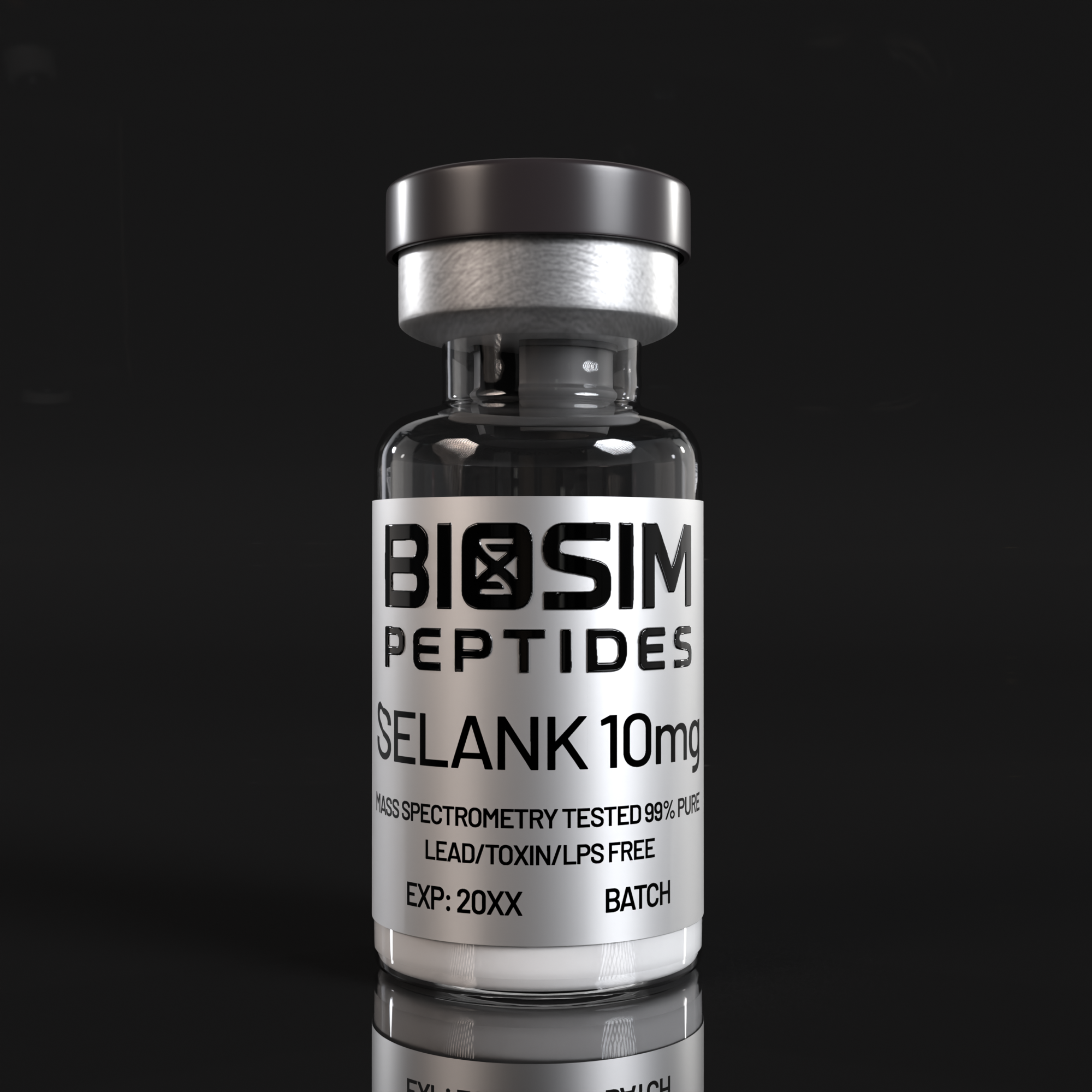
Selank 10mg: Research Overview
Selank (Thr-Lys-Pro-Arg-Pro-Gly-Pro) is a synthetic heptapeptide engineered as a stabilized analog of the endogenous immunomodulatory tetrapeptide tuftsin. Designed for laboratory research applications only, Selank has garnered significant interest within the preclinical neuroscience community for its dual anxiolytic and nootropic properties. Unlike conventional benzodiazepine-class anxiolytics, Selank does not appear to induce sedation, dependence, or withdrawal syndromes in preclinical models, making it a compelling subject for investigations into non-traditional mechanisms of anxiety modulation. The peptide is supplied as a lyophilized powder at 10mg per vial for in vitro and animal model research use exclusively — not for human consumption or clinical application.
Molecular Background & Mechanism of Action
Selank is a synthetic heptapeptide (molecular weight approximately 751.8 Da) sharing the Thr-Lys-Pro-Arg sequence with the endogenous tetrapeptide tuftsin, extended by an additional Pro-Gly-Pro tripeptide motif at the C-terminus. This C-terminal extension confers enhanced metabolic stability — a critical limitation of native tuftsin, which is rapidly degraded by plasma aminopeptidases with a half-life measured in minutes. The Pro-Gly-Pro (PGP) tail is not merely a stabilizing appendage; converging lines of evidence indicate it possesses independent biological activity relevant to neuroprotection and cognitive function. Selank’s mechanism is notably polyvalent, distinguishing it from single-target anxiolytics.
At the molecular level, Selank has been shown to modulate GABAergic neurotransmission through alteration of gene expression profiles in genes encoding GABA receptor subunits and transporters[1]. In IMR-32 neuroblastoma cells, Selank was demonstrated to affect the expression of multiple genes involved in GABAergic signaling, including GABA-A receptor subunits, with effects that were distinct from and complementary to those of olanzapine[1]. Electrophysiological investigations using patch-clamp recordings in rat hippocampal CA1 pyramidal neurons revealed that Selank modulates spontaneous synaptic activity by altering the frequency of inhibitory postsynaptic currents, supporting a direct influence on GABAergic interneuron signaling[2].
Beyond GABA, Selank engages the brain-derived neurotrophic factor (BDNF) system. Intranasal administration of Selank in rats was shown to significantly upregulate BDNF mRNA expression in the hippocampus in vivo[3], a finding later corroborated in models of ethanol-induced cognitive impairment where Selank’s memory-protective effects were associated with normalization of BDNF levels in both hippocampus and prefrontal cortex[4]. The peptide also modulates cytokine networks, with transcriptomic studies demonstrating that Selank alters the expression of inflammation-related genes including chemokines, interleukins, and their receptors[5], and in vivo work showing it can attenuate stress-induced elevations of pro-inflammatory cytokines[6].
Additionally, Selank interacts with monoaminergic systems. Research indicates that Selank influences the content and turnover of dopamine, norepinephrine, and serotonin in brain regions relevant to anxiety and cognition[1], and its efficacy in attenuating morphine withdrawal signs suggests interaction with the endogenous opioid system[7]. This multi-target profile — GABA modulation, BDNF enhancement, cytokine regulation, and monoamine/opioid system engagement — positions Selank as a uniquely polyvalent research molecule for investigating integrated stress-adaptation and cognitive processes.
Preclinical & Clinical Evidence
The preclinical evidence base for Selank spans two decades of investigation across multiple laboratories, primarily in rodent models. A comprehensive molecular review by Vyunova and colleagues (2018) synthesized the known mechanisms of Selank’s biological activity, characterizing it as a peptide-based anxiolytic with a fundamentally different pharmacological profile from benzodiazepines — engaging gene transcription regulation rather than direct allosteric modulation of the GABA-A receptor complex[1]. This transcriptional mechanism may explain the gradual onset and sustained nature of Selank’s behavioral effects observed in preclinical models.
In models of anxiety, Selank has demonstrated consistent anxiolytic efficacy. The chronic unpredictable mild stress (CUMS) paradigm — considered among the most translationally relevant rodent models — revealed that Selank not only reduced anxiety-like behavior independently but also enhanced the anxiolytic effect of diazepam when co-administered, suggesting a synergistic or adjunctive potential that warrants further investigation[8]. Critically, Selank did not produce the locomotor sedation characteristic of benzodiazepines in these studies. The peptide has also shown efficacy in attenuating the aversive somatic and affective signs of morphine withdrawal in rats, reducing withdrawal scores including wet-dog shakes, ptosis, and teeth chattering — findings that implicate the endogenous opioid system in Selank’s broader stress-adaptation profile[7].
The cognitive dimension of Selank’s activity has been explored in models of ethanol-induced memory impairment, where the peptide prevented deficits in spatial memory tasks while normalizing BDNF content in the hippocampus and prefrontal cortex[4]. Electrophysiological data further demonstrate that Selank application to hippocampal slices alters the frequency of both spontaneous excitatory and inhibitory postsynaptic currents in CA1 pyramidal neurons[2], providing a cellular substrate for the peptide’s cognitive effects. Transcriptomic profiling of hippocampal tissue following Selank treatment has identified alterations in pathways related to synaptic plasticity, neurotransmission, and neuroinflammation[1]. In stress models, Selank reduced stress-induced elevations of interleukin-6 (IL-6) and other pro-inflammatory cytokines, linking its anxiolytic properties to immunomodulatory activity[6].
Research Applications
- Anxiolytic Research: Investigate non-benzodiazepine mechanisms of anxiety reduction via GABAergic gene transcription modulation; compare to SSRIs and benzodiazepines in behavioral paradigms such as elevated plus maze, open field, and light-dark box.
- Nootropic & Cognitive Research: Study BDNF-mediated neuroplasticity and memory enhancement in models of cognitive impairment; evaluate in ethanol-induced, stress-induced, and age-related memory deficit paradigms.
- Neuroimmunology Research: Examine cytokine modulation and neuroimmune interactions in chronic stress models; investigate the interface between anxiety, inflammation, and immune signaling in the CNS.
- Substance Withdrawal Research: Explore opioid system interactions in attenuating withdrawal symptomatology; assess as a tool compound for understanding peptide modulation of addiction-related neurocircuitry.
- Synaptic Physiology Research: Characterize effects on spontaneous and evoked synaptic transmission in hippocampal and cortical slice preparations using patch-clamp electrophysiology.
- Transcriptomic & Proteomic Studies: Profile gene expression changes in GABAergic, neurotrophic, and inflammatory pathways in neuronal and glial cell cultures following Selank exposure.
Comparative Context: Nootropic Peptides
The landscape of research-grade nootropic peptides encompasses molecules derived from endogenous neuropeptide precursors, each with distinct structural origins and mechanistic emphases. The table below situates Selank among its pharmacological peers, highlighting their divergent origins, targets, and primary research applications.
| Peptide | Origin | Primary Target | Key Research Focus |
|---|---|---|---|
| Selank | Tuftsin analog (IgG Fc fragment) | GABA receptor genes, BDNF, cytokines | Anxiolysis without sedation; nootropic effects; immunomodulation |
| Semax | ACTH(4-7) fragment + PGP tail | Melanocortin receptors, BDNF/TrkB, neurotrophins | Neuroprotection; post-stroke recovery; cognitive enhancement |
| Noopept | Synthetic dipeptide (N-phenylacetyl-L-prolylglycine) | Cycloprolylglycine binding sites, HIF-1, NGF/BDNF | Cognitive enhancement; neuroprotection; memory consolidation |
| Cortexin | Bovine cerebral cortex polypeptide extract | Multi-target (complex mixture) | Neurorehabilitation; post-hypoxic recovery; neuroprotection |
| Pinealon | Synthetic tripeptide (Glu-Asp-Arg) | Gene transcription regulators, chromatin | Aging research; neurogeriatric protection; stress adaptation |
Among these compounds, Selank is distinguished by its origin from the immunoglobulin-derived tuftsin sequence and its primary emphasis on anxiolytic research with a notable absence of sedation — a profile not shared by Semax (which is more neuroprotective/nootropic), Noopept (primarily cognitive), or Cortexin (broad-spectrum neurorehabilitation). Selank’s combination of GABAergic, neurotrophic, and immunomodulatory activities makes it a uniquely valuable tool for investigating the intersection of affective and cognitive neuroscience within a single molecular scaffold.
Safety & Laboratory Handling
Store lyophilized Selank at -20°C protected from light and moisture. Under these conditions, the lyophilized peptide is stable for up to 24 months. For in vitro experimental use, reconstitute with sterile bacteriostatic water or appropriate buffered saline (not included). Reconstituted solutions should be stored at 2-8°C and used within 30 days to ensure peptide integrity. Avoid repeated freeze-thaw cycles, which can promote aggregation and loss of bioactivity. Use appropriate personal protective equipment (PPE) including gloves, lab coat, and eye protection when handling. All experimental procedures should be conducted in accordance with institutional biosafety guidelines. For laboratory research use only — not for human consumption, clinical use, or diagnostic purposes. This product has not been evaluated by the FDA for safety or efficacy in humans.
Physical Characteristics: White to off-white lyophilized powder. Soluble in water and aqueous buffers. Purity ≥ 98% as determined by HPLC analysis. Each vial contains 10mg of Selank (Thr-Lys-Pro-Arg-Pro-Gly-Pro) as the acetate salt. Molecular formula: C₃₃H₅₇N₁₁O₉. Molecular weight: 751.8 g/mol.
References
- Vyunova TV, Andreeva L, Shevchenko K, et al. (2018). “Peptide-based Anxiolytics: The Molecular Aspects of Heptapeptide Selank Biological Activity.” Protein Pept Lett. PMID: 30255741.
- Povarov IS, Kondratenko RV, Derevyagin VI, et al. (2017). “Effect of Selank on Spontaneous Synaptic Activity of Rat Hippocampal CA1 Neurons.” Bull Exp Biol Med. PMID: 28361410.
- Inozemtseva LS, Karpenko EA, Dolotov OV, et al. (2008). “Intranasal administration of the peptide Selank regulates BDNF expression in the rat hippocampus in vivo.” Dokl Biol Sci. PMID: 18841804.
- Kolik LG, Nadorova AV, Antipova TA, et al. (2019). “Selank, Peptide Analogue of Tuftsin, Protects Against Ethanol-Induced Memory Impairment by Regulating of BDNF Content in the Hippocampus and Prefrontal Cortex in Rats.” Bull Exp Biol Med. PMID: 31625062.
- Kolomin T, Shadrina M, Andreeva L, et al. (2011). “Expression of inflammation-related genes in mouse spleen under tuftsin analog Selank.” Regul Pept. PMID: 21609736.
- Leonidovna YA, Aleksandrovna SM, Aleksandrovna TA, et al. (2021). “The Influence of Selank on the Level of Cytokines Under the Conditions of ‘Social’ Stress.” Curr Rev Clin Exp Pharmacol. PMID: 32621722.
- Konstantinopolsky MA, Chernyakova IV, Kolik LG (2022). “Selank, a Peptide Analog of Tuftsin, Attenuates Aversive Signs of Morphine Withdrawal in Rats.” Bull Exp Biol Med. PMID: 36322304.
- Filatova E, Kasian A, Kolomin T, et al. (2017). “GABA, Selank, and Olanzapine Affect the Expression of Genes Involved in GABAergic Neurotransmission in IMR-32 Cells.” Front Pharmacol. PMID: 28293190.
⚠ Research Use Only: Sold for in vitro laboratory research only. Not FDA-evaluated for human use. Not intended for diagnostic, therapeutic, or prophylactic applications.

Reviews
There are no reviews yet.