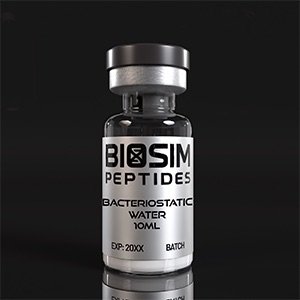
Product Overview
Bacteriostatic Water is a sterile, multi-dose diluent specifically formulated for use in peptide research and laboratory applications. Unlike sterile water for injection — which is intended for single use only — bacteriostatic water contains an antimicrobial preservative that inhibits the growth of bacteria, allowing the same vial to be accessed multiple times over a defined period without compromising sterility. Our Bacteriostatic Water 10ml is produced to USP (United States Pharmacopeia) standards, ensuring the highest level of purity, consistency, and reliability for your research protocols.
In peptide research, lyophilized (freeze-dried) peptides require reconstitution with an appropriate solvent before they can be used in experimental procedures. Bacteriostatic water serves as the default reconstitution solvent for the vast majority of research peptides. Its formulation — 0.9% benzyl alcohol in sterile water for injection — creates an environment that is hostile to bacterial proliferation while remaining chemically compatible with peptide molecules. This makes it an indispensable reagent in any laboratory conducting peptide-based research, whether the focus is on cellular signaling, metabolic pathways, receptor binding studies, or other biochemical investigations.
Each vial contains precisely 10ml of solution, a volume that balances practicality with laboratory economy. The vial is sealed with a rubber stopper and flip-off cap under aseptic conditions, ensuring that the contents remain sterile from manufacturing through initial puncture and throughout the multi-dose usage period. For researchers who require consistent, pharmaceutical-grade diluent for their peptide reconstitution workflows, this product represents the gold standard in quality and reliability.
Composition & Specifications
The formulation of our Bacteriostatic Water 10ml is straightforward yet precisely controlled to meet pharmaceutical standards. Understanding this composition is essential for researchers who need to account for all variables in their experimental design.
- Active Component: Sterile Water for Injection, USP — the base solvent, purified through multiple distillation and filtration stages to remove particulates, endotoxins, and chemical contaminants.
- Bacteriostatic Agent: Benzyl Alcohol, USP — present at a concentration of 0.9% (9mg/ml). This is the standard pharmaceutical concentration recognized by the USP for multi-dose parenteral preparations.
- Volume: 10ml per vial — sufficient for reconstituting multiple peptide vials or for protocols requiring larger solvent volumes.
- pH Range: 4.5 to 7.0 — within physiological compatibility parameters and suitable for the vast majority of peptide reconstitution applications.
- Sterility Assurance Level (SAL): 10-6 — indicating a one-in-one-million probability of a non-sterile unit, the industry standard for terminally sterilized pharmaceutical products.
- Container: Type I borosilicate glass vial with bromobutyl rubber stopper and aluminum flip-off seal — materials selected for chemical inertness and minimal extractables.
- Appearance: Clear, colorless, and free from visible particulates.
Why Benzyl Alcohol Matters
The distinction between sterile water and bacteriostatic water lies entirely in the presence of benzyl alcohol, and this distinction carries significant implications for laboratory practice.
Benzyl alcohol is an aromatic alcohol that functions as a bacteriostatic agent — it does not necessarily kill bacteria outright but rather inhibits their reproduction and metabolic activity. At a concentration of 0.9%, it creates conditions under which bacterial cells cannot effectively replicate. This is critically important because every puncture of a vial stopper introduces a theoretical risk of microbial contamination. Without a bacteriostatic agent, any bacteria introduced during needle insertion could multiply rapidly in the nutrient-free but habitable aqueous environment, potentially reaching levels that could compromise experimental results or — in the case of cell culture work — contaminate entire experimental setups.
The mechanism of action involves disruption of bacterial cell membrane integrity and interference with essential enzymatic processes. Benzyl alcohol intercalates into the lipid bilayer of bacterial membranes, increasing permeability and ultimately causing leakage of cytoplasmic contents. At the 0.9% concentration used in pharmaceutical preparations, this activity is sufficient to suppress the growth of most common environmental bacterial contaminants, including Staphylococcus species, Pseudomonas species, and other organisms commonly encountered in laboratory settings.
It is worth noting that benzyl alcohol is a bacteriostatic agent, not a sterilizing agent. It prevents proliferation of low-level contaminants but cannot sterilize a solution that is already heavily contaminated. Proper aseptic technique during vial access remains essential. Additionally, benzyl alcohol has limited efficacy against certain fungal spores and some gram-negative bacteria at this concentration, reinforcing the importance of maintaining rigorous laboratory hygiene.
Applications in Peptide Research
Bacteriostatic water is the workhorse solvent of peptide research, used across a diverse range of experimental applications. Its role in the laboratory extends from routine reconstitution to specialized protocols, making it an essential component of any well-stocked peptide research facility.
Primary Application — Reconstitution of Lyophilized Peptides: Most research peptides are supplied as lyophilized powders that must be reconstituted into solution before use. The researcher calculates the desired concentration, determines the appropriate volume of bacteriostatic water, and gently introduces the solvent into the peptide vial. The resulting solution can then be aliquoted or used directly in experimental procedures. Common peptides reconstituted with bacteriostatic water include:
- Growth hormone secretagogues (e.g., GHRP-2, GHRP-6, Ipamorelin, CJC-1295)
- Melanocortin receptor ligands (e.g., Melanotan I, Melanotan II, PT-141)
- Thymosin family peptides (e.g., Thymosin Beta-4, Thymosin Alpha-1)
- Collagen and extracellular matrix peptides (e.g., BPC-157, GHK-Cu)
- Metabolic and adipose-tissue research peptides (e.g., AOD9604, Fragment 176-191)
- Neural and cognitive function peptides (e.g., Semax, Selank, Cerebrolysin analogues)
- Antimicrobial peptides for microbiology research
Secondary Applications: Beyond peptide reconstitution, bacteriostatic water finds use as a diluent for concentrated stock solutions, a vehicle control in experimental design, and a solvent for water-soluble research compounds that require sterile, preserved aqueous media. It is also used in the preparation of calibration standards and quality control samples in analytical chemistry workflows involving peptide quantification.
Proper Handling & Storage
Maximizing the utility and safety of bacteriostatic water requires adherence to established handling and storage protocols. These guidelines are derived from USP standards and compounding pharmacy best practices.
Storage Conditions: Store vials at controlled room temperature, typically defined as 20°C to 25°C (68°F to 77°F), with excursions permitted between 15°C and 30°C (59°F to 86°F). Avoid exposure to temperatures exceeding 40°C (104°F), which can accelerate degradation of the benzyl alcohol preservative and compromise the integrity of the rubber stopper. Protect from direct sunlight and sources of ionizing radiation. Do not freeze — ice crystal formation can alter the concentration of benzyl alcohol upon thawing and may damage the container closure system.
Multi-Dose Usage and Vial Lifespan: Once a vial is punctured for the first time, the standard pharmaceutical guideline is that the contents should be used within 28 days. This 28-day beyond-use date (BUD) is established by USP <797> for multi-dose vials and reflects the period during which the benzyl alcohol preservative can be expected to maintain effective bacteriostatic activity under conditions of repeated access. After 28 days, the risk of microbial proliferation increases to a level that is no longer considered acceptable for pharmaceutical preparations.
Aseptic Technique: Every access to the vial must be performed using proper aseptic technique. This includes disinfecting the rubber stopper with a 70% isopropyl alcohol or ethanol swab before and after each puncture, using a sterile needle and syringe for each access, and never touching the stopper surface with non-sterile objects. The stopper should be inspected for coring or fragmentation before each use — a damaged stopper compromises the sterile barrier and necessitates disposal of the remaining contents.
Disposal: Partially used vials that have exceeded the 28-day period, show signs of contamination (turbidity, discoloration, or particulate formation), or have damaged stoppers should be disposed of in accordance with institutional guidelines for pharmaceutical waste.
Compatibility Guide
While bacteriostatic water is the most widely used diluent in peptide research, it is not universally suitable for all peptides. Understanding solvent compatibility is essential for maintaining peptide stability and biological activity.
Peptides Compatible with Bacteriostatic Water: The vast majority of research peptides — particularly those with neutral or near-neutral isoelectric points and good aqueous solubility — are fully compatible with bacteriostatic water. This includes most growth hormone secretagogues, melanocortin peptides, thymosin family members, and many metabolic research peptides. If a peptide dissolves readily in water and maintains stability in aqueous solution, bacteriostatic water is the solvent of choice.
Peptides Requiring Alternative Solvents: Certain peptides exhibit poor solubility in water or are chemically unstable in aqueous environments at neutral pH. For these peptides, alternative solvents are required:
- Acetic Acid Solution (0.1% to 1%): Required for peptides with high isoelectric points or those that are insoluble in neutral water. Examples include certain IGF-1 analogues and some amyloid-beta fragments. The dilute acid protonates basic residues, improving solubility.
- Dilute Hydrochloric Acid (HCl): Used for particularly stubborn peptides that resist dissolution in weaker acids.
- Dimethyl Sulfoxide (DMSO): Reserved for extremely hydrophobic peptides. DMSO should be used at the minimum effective concentration (typically <1% of final volume) due to its potential biological activity at higher concentrations.
- Acetonitrile or Ethanol: Occasionally used as co-solvents for peptides intended for analytical HPLC applications rather than biological assays.
- Phosphate-Buffered Saline (PBS): Can be used in place of bacteriostatic water when isotonicity is required, though PBS lacks bacteriostatic properties.
General Rule: Always consult the peptide-specific solubility data provided by the manufacturer before selecting a solvent. When in doubt, test a small quantity of peptide with the intended solvent to verify solubility and stability before committing to a full reconstitution.
Quality Assurance
Our Bacteriostatic Water 10ml is manufactured under rigorous quality control systems designed to meet or exceed USP standards for pharmaceutical-grade water and sterile preparations. Every batch undergoes comprehensive testing before release, ensuring that researchers receive a product they can trust.
USP Compliance: The product is manufactured in accordance with USP <797> (Pharmaceutical Compounding — Sterile Preparations), USP <71> (Sterility Tests), and the relevant monographs for Sterile Water for Injection and Benzyl Alcohol. This compliance ensures that the product meets established standards for sterility, endotoxin levels, particulate matter, and chemical purity.
Testing Parameters:
- Sterility Testing: Each batch is tested for bacterial and fungal contamination per USP <71> using membrane filtration methodology, with 14-day incubation periods to detect slow-growing organisms.
- Endotoxin Testing: Bacterial endotoxin levels are measured using Limulus Amebocyte Lysate (LAL) testing per USP <85>, with a specification of less than 0.5 EU/ml — consistent with Water for Injection standards.
- Chemical Purity: Benzyl alcohol concentration is verified by HPLC or GC analysis to confirm 0.9% ± 0.09% content. Absence of heavy metals, volatile organic compounds, and other potential contaminants is confirmed through compendial testing.
- Particulate Matter: Tested per USP <788> for sub-visible particulates, meeting the limits for small-volume parenterals.
- pH and Conductivity: Verified to meet USP specifications for Water for Injection, ensuring appropriate ionic purity.
- Container Closure Integrity: Vial seals are tested for integrity using dye ingress or vacuum decay methods to confirm maintenance of the sterile barrier.
Every vial is individually inspected for visible defects, and each batch is assigned a unique lot number for full traceability from raw materials through finished product distribution.
Frequently Asked Questions
Q: What is the difference between bacteriostatic water and sterile water for injection?
A: Sterile water for injection contains no antimicrobial preservative and is intended for single use only — once opened, any remaining contents must be discarded immediately. Bacteriostatic water contains 0.9% benzyl alcohol, which suppresses bacterial growth and allows the same vial to be accessed multiple times over a 28-day period. For peptide reconstitution in research settings, bacteriostatic water is almost always the preferred choice because it supports multi-dose usage and reduces waste.
Q: How long can I use a vial after opening?
A: Per USP <797> guidelines, a multi-dose vial of bacteriostatic water should be used within 28 days of first puncture, provided it has been stored under appropriate conditions and accessed using proper aseptic technique. After 28 days, the risk of microbial proliferation exceeds acceptable limits, and any remaining contents should be discarded. This guideline applies regardless of how much solution remains in the vial.
Q: Can bacteriostatic water be used for peptides that specify ‘reconstitute with sterile water’?
A: In almost all cases, yes. Manufacturers often list ‘sterile water’ as a general instruction, and bacteriostatic water serves this purpose while providing the additional benefit of antimicrobial preservation. The 0.9% benzyl alcohol concentration is well-tolerated by the vast majority of research peptides and does not interfere with peptide structure or biological activity. If a peptide is specifically noted to be incompatible with benzyl alcohol (rare), the manufacturer will typically specify an alternative diluent.
Q: Does bacteriostatic water need to be refrigerated?
A: No. Bacteriostatic water should be stored at controlled room temperature (20°C to 25°C). Refrigeration is unnecessary and may cause condensation inside the vial when it is removed and warmed to room temperature, potentially introducing moisture-related issues. Freezing, in particular, should be avoided as it can affect both the benzyl alcohol distribution and the integrity of the rubber stopper.
Q: What should I do if the solution becomes cloudy or I see particles?
A: Cloudiness, turbidity, or visible particulate matter are indicators of potential contamination and/or chemical degradation. Do not use the solution. The vial should be properly disposed of, and a new vial should be used for your research. In a properly manufactured and stored vial of bacteriostatic water, the solution should remain clear, colorless, and free of visible particles throughout its shelf life and usage period. Any deviation from this appearance warrants immediate discontinuation of use.
References
- United States Pharmacopeia (USP). General Chapter <797>: Pharmaceutical Compounding — Sterile Preparations. USP-NF. Rockville, MD: United States Pharmacopeial Convention.
- United States Pharmacopeia (USP). General Chapter <71>: Sterility Tests. USP-NF. Rockville, MD: United States Pharmacopeial Convention.
- United States Pharmacopeia (USP). General Chapter <85>: Bacterial Endotoxins Test. USP-NF. Rockville, MD: United States Pharmacopeial Convention.
- American Society of Health-System Pharmacists (ASHP). ASHP Guidelines on Compounding Sterile Preparations. American Journal of Health-System Pharmacy, 2014; 71:145-166.

Reviews
There are no reviews yet.