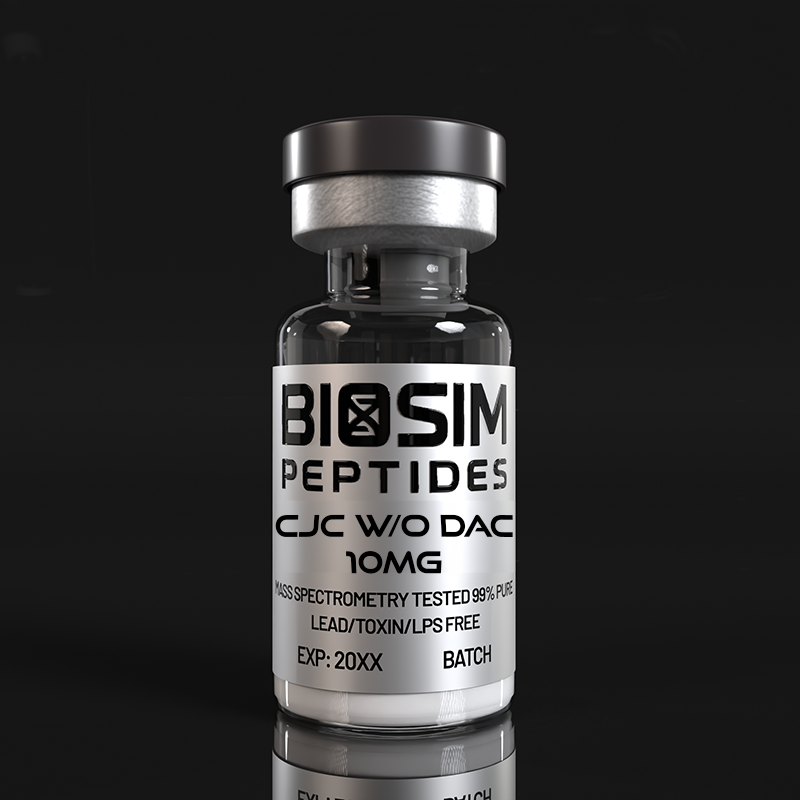
Research Overview
CJC-1295 No-DAC is a tetrasubstituted analog of growth hormone-releasing hormone (GHRH, also known as GRF 1–29) engineered to extend the peptide’s biological half-life while preserving the pulsatile pattern of growth hormone (GH) secretion characteristic of endogenous somatotroph signaling. Unlike the original CJC-1295 formulation — which incorporates a Drug Affinity Complex (DAC) that binds covalently to serum albumin, producing continuous GHRH receptor activation — the No-DAC variant eliminates this pharmacokinetic extension strategy. The result is a research peptide that offers enhanced resistance to proteolytic degradation through amino acid substitutions at key cleavage sites (Tyr¹→, Ala²→, Asn⁸→, and Arg²⁹→), yet retains a pharmacodynamic profile more closely aligned with the episodic, ultradian GH secretory rhythm observed under physiological conditions [1,2].
In preclinical models, GHRH receptor agonists increase GH synthesis and secretion from anterior pituitary somatotrophs via binding to the GHRH receptor (GHRHR), a class B G protein-coupled receptor (GPCR). Subsequent activation of the Gsα–adenylyl cyclase–cAMP–protein kinase A (PKA) signaling cascade drives both acute GH release from secretory granules and transcriptional upregulation of GH gene expression [5,7]. The downstream elevation of circulating insulin-like growth factor 1 (IGF-1), primarily of hepatic origin, mediates many of the anabolic and metabolic effects associated with GH axis activation. CJC-1295 No-DAC provides researchers with a tool to interrogate the GHRH–GH–IGF-1 somatotropic axis under conditions that approximate endogenous pulsatility, an important distinction from continuously activating DAC-conjugated analogs [1,2].
Molecular Background & Mechanism of Action
The native GHRH(1–44) peptide is synthesized in the arcuate nucleus of the hypothalamus and released into the hypophyseal portal circulation in a pulsatile fashion. Its biologically active core resides in the N-terminal 29 amino acids (GHRH 1–29), which contain the receptor-binding and activation domains. However, native GHRH(1–29) is subject to rapid enzymatic inactivation through multiple pathways: dipeptidyl peptidase IV (DPP-IV) cleavage at the Ala²–Asp³ bond, trypsin-like endopeptidase cleavage at the Lys¹²–Val¹³ bond, and oxidation of Met²⁷ [1,5]. These vulnerabilities result in a plasma half-life measured in minutes, limiting the utility of unmodified GHRH for sustained research protocols.
CJC-1295 No-DAC incorporates four strategic amino acid substitutions that collectively confer resistance to these degradation pathways while preserving high-affinity GHRHR binding. Upon receptor engagement, the agonist–receptor complex activates the stimulatory G protein (Gsα), which in turn stimulates adenylyl cyclase to increase intracellular cAMP concentrations. Elevated cAMP activates PKA, which phosphorylates the cAMP response element-binding protein (CREB) transcription factor, driving Pit-1/GHF-1-dependent transcription of the GH gene. Concomitantly, PKA-mediated phosphorylation of voltage-gated calcium channels promotes Ca²⁺ influx, triggering exocytotic release of pre-formed GH from somatotroph secretory vesicles [5,7]. The No-DAC variant preserves the episodic nature of this signaling cascade, enabling researchers to study temporal dynamics of GH release patterns without the confounding influence of sustained receptor occupancy associated with DAC-conjugated analogs [2].
🔬 Mechanism at a Glance
- Target: Growth hormone-releasing hormone receptor (GHRHR; a class B GPCR)
- Primary Signaling: Gsα → Adenylyl Cyclase → ↑cAMP → PKA → CREB phosphorylation
- Downstream Effectors: GH synthesis & secretion, hepatic IGF-1 production
- Stability Engineering: Four amino acid substitutions (Tyr¹, Ala², Asn⁸, Arg²⁹) confer resistance to DPP-IV, trypsin-like proteases, and oxidative degradation while eliminating albumin conjugation
- Pharmacodynamic Signature: Pulsatile, not continuous, GH release profile — more closely mimicking endogenous physiology
Preclinical & Clinical Evidence
The foundational characterization of CJC-1295 was reported by Teichman and colleagues (2006), who demonstrated in two randomized, placebo-controlled, double-blind ascending-dose trials that a single subcutaneous injection produced dose-dependent, sustained elevations in serum GH and IGF-1 in healthy human subjects over 28 days [1]. Critically, Ionescu and Frohman (2006) subsequently established that pulsatile GH secretion persists even during continuous GHRH receptor stimulation by the DAC-conjugated form, revealing that the ultradian GH pulse generator — driven by alternating hypothalamic GHRH and somatostatin tone — retains functional integrity despite sustained ligand availability [2]. This finding carries particular significance for the No-DAC variant, as it suggests that the pulsatile dynamics are further preserved (rather than dampened) when the albumin-binding moiety is removed.
The broader GHRH analog literature provides extensive validation of this therapeutic axis. Khorram and colleagues (1997) demonstrated that long-term administration of [Nle²⁷]GHRH(1–29)-NH₂ (sermorelin) in age-advanced men and women produced sustained GH and IGF-1 responses with favorable endocrine and metabolic effects over 16 weeks [4]. More recently, Granata and colleagues (2025) published a comprehensive review in Nature Reviews Endocrinology cataloguing the diverse physiological and pathophysiological roles of GHRH and its synthetic analogs across multiple organ systems, including pituitary, cardiac, pancreatic, and neural tissues [5]. The tesamorelin literature further corroborates the clinical translational potential of modified GHRH analogs: the FDA-approved agent has demonstrated efficacy in reducing visceral adipose tissue in HIV-associated lipodystrophy and favorable metabolic profiles in type 2 diabetes [3,6,8].
Research Applications
CJC-1295 No-DAC is supplied exclusively for in vitro and laboratory animal research. Investigators may employ this peptide in the following research domains:
- Somatotroph Cell Biology: Examination of GHRHR signaling kinetics, receptor desensitization and internalization dynamics, and the cAMP–PKA–CREB transcriptional cascade in pituitary cell lines (e.g., GH3, GH4C1 cells) under pulsatile versus continuous stimulation paradigms.
- GH Pulsatility Research: Comparative studies evaluating the temporal GH secretory profiles elicited by No-DAC, DAC-conjugated, and unmodified GHRH analogs using frequent-sampling microdialysis or perifusion systems in rodent models.
- IGF-1 Axis Pharmacology: Investigation of hepatic IGF-1 induction, IGFBP expression modulation, and downstream anabolic signaling (PI3K/Akt/mTOR) in skeletal muscle, bone, and adipose tissue.
- Aging & Metabolic Research: Studies examining the somatopause — the age-related decline in GH/IGF-1 axis activity — and its relationship to body composition, substrate metabolism, and tissue regeneration in aged rodent models.
- Comparative GHRH Analog Profiling: Head-to-head pharmacological characterization of CJC-1295 No-DAC against tesamorelin, sermorelin, and other modified GHRH superagonists in receptor binding affinity, cAMP accumulation, and GH release assays.
Comparative Context: CJC-1295 No-DAC vs. Related GHRH Analogs
CJC-1295 with DAC
The DAC-conjugated form of CJC-1295 incorporates a maleimidopropionic acid moiety that selectively forms a covalent thioether bond with the free cysteine-34 residue of circulating serum albumin. This bioconjugation extends the elimination half-life to approximately 6–8 days in humans, producing continuous GHRHR activation. While the increased half-life enables infrequent dosing, the sustained receptor occupancy may result in不同程度的 GHRHR desensitization over prolonged exposure. The No-DAC variant avoids this covalent conjugation, providing researchers with an intermediate-duration analog that retains engineered proteolytic stability but without the pharmacokinetic extension of albumin binding [1,2].
Sermorelin (GHRH 1–29 NH₂)
Sermorelin acetate represents the first-generation clinical GHRH analog, differing from endogenous GHRH(1–29) only by an amidated C-terminus. While extensively characterized in clinical trials [4], sermorelin retains the native amino acid sequence at key enzymatic cleavage sites, rendering it susceptible to rapid DPP-IV-mediated inactivation (plasma t½ ≈ 11–12 minutes). CJC-1295 No-DAC’s four strategic substitutions confer significantly enhanced proteolytic resistance while preserving the core GHRH(1–29) pharmacophore.
Tesamorelin (TH9507)
Tesamorelin is a modified GHRH(1–44) analog bearing a trans-3-hexenoic acid moiety at the N-terminus, which enhances metabolic stability while retaining the full-length sequence. FDA-approved as Egrifta® for HIV-associated lipodystrophy, tesamorelin provides the most clinically validated benchmark within the GHRH analog class [3,6,8]. CJC-1295 No-DAC differs in its use of the truncated 1–29 core with internal substitutions rather than N-terminal acylation, representing a distinct molecular engineering strategy.
Safety & Handling Information
⚠️ FOR LABORATORY RESEARCH USE ONLY. This product is not approved for human use. Not for diagnostic or therapeutic purposes. Not for use in food-producing animals.
- Appearance: White to off-white lyophilized powder
- Purity: ≥95% as determined by RP-HPLC
- Molecular Formula: C₁₅₂H₂₅₂N₄₄O₄₂ (approximate)
- Molecular Weight: ~3,367.9 Da
- Storage: Lyophilized peptide should be stored at -20°C, protected from light and moisture. Reconstituted solutions should be aliquoted, stored at -20°C to -80°C, and subjected to minimal freeze-thaw cycles.
- Reconstitution: For research purposes, sterile water, 0.9% sodium chloride, or appropriate buffered saline may be used. The choice of solvent should be determined by the specific experimental protocol.
- Stability: Lyophilized peptide is stable for 12–24 months when stored as recommended. Reconstituted peptide stability is application-dependent; researchers should validate stability under their specific experimental conditions.
- Handling Precautions: Use appropriate personal protective equipment (PPE) including gloves, lab coat, and eye protection. Handle in a biosafety cabinet or fume hood. Avoid inhalation of powder and contact with skin or eyes.
References
- PMID: 16352683 — Teichman SL, Neale A, Lawrence B, et al. Prolonged stimulation of growth hormone (GH) and insulin-like growth factor I secretion by CJC-1295, a long-acting analog of GH-releasing hormone, in healthy adults. J Clin Endocrinol Metab. 2006;91(3):799-805. doi:10.1210/jc.2005-1536
- PMID: 17018654 — Ionescu M, Frohman LA. Pulsatile secretion of growth hormone (GH) persists during continuous stimulation by CJC-1295, a long-acting GH-releasing hormone analog. J Clin Endocrinol Metab. 2006;91(12):4792-4797. doi:10.1210/jc.2006-1702
- PMID: 19243281 — Wang Y, Tomlinson B. Tesamorelin, a human growth hormone releasing factor analogue. Expert Opin Investig Drugs. 2009;18(3):395-403. doi:10.1517/13543780902763477
- PMID: 9141536 — Khorram O, Laughlin GA, Yen SS. Endocrine and metabolic effects of long-term administration of [Nle²⁷]growth hormone-releasing hormone-(1-29)-NH₂ in age-advanced men and women. J Clin Endocrinol Metab. 1997;82(5):1472-1479. doi:10.1210/jcem.82.5.3943
- PMID: 39537825 — Granata R, Leone S, Zhang X, et al. Growth hormone-releasing hormone and its analogues in health and disease. Nat Rev Endocrinol. 2025;21(3):165-180. doi:10.1038/s41574-024-01065-2
- PMID: 22298602 — Spooner LM, Olin JL. Tesamorelin: a growth hormone-releasing factor analogue for HIV-associated lipodystrophy. Ann Pharmacother. 2012;46(2):240-247. doi:10.1345/aph.1Q528
- PMID: 26891937 — Granata R. Peripheral activities of growth hormone-releasing hormone. J Endocrinol Invest. 2016;39(7):721-727. doi:10.1007/s40618-016-0440-x
- PMID: 28617838 — Clemmons DR, Miller S, Mamputu JC. Safety and metabolic effects of tesamorelin, a growth hormone-releasing factor analogue, in patients with type 2 diabetes: A randomized, placebo-controlled trial. PLoS One. 2017;12(6):e0179538. doi:10.1371/journal.pone.0179538
⚠️ Research Use Only — Important Disclaimer
This product is intended solely for laboratory research purposes and is not manufactured, tested, or certified for human or veterinary use. It is not a drug, food, dietary supplement, or cosmetic. Researchers must comply with all applicable institutional, local, state, and federal regulations governing the acquisition, storage, handling, and disposal of research peptides. Biosim Peptides makes no representations regarding the suitability of this product for any purpose other than bona fide scientific research conducted by qualified professionals in appropriate laboratory facilities. No statements on this page have been evaluated by the FDA or any other regulatory agency.
Frequently Asked Questions
Q: What is the difference between CJC-1295 with DAC and CJC-1295 No-DAC?
CJC-1295 with DAC incorporates a maleimidopropionic acid moiety that forms a covalent bond with serum albumin, extending its half-life to approximately 6–8 days and producing continuous GHRH receptor stimulation. CJC-1295 No-DAC omits this Drug Affinity Complex, retaining the four amino acid substitutions for proteolytic stability but eliminating the albumin-binding pharmacokinetic extension. The No-DAC variant thus produces a shorter-duration, more pulsatile GH release pattern that more closely approximates endogenous physiology [1,2].
Q: Is CJC-1295 No-DAC the same as Modified GRF 1-29?
Yes. “Modified GRF 1-29” is an alternative nomenclature for CJC-1295 No-DAC, referring to the tetrasubstituted growth hormone-releasing factor (1–29) sequence. The terms are used interchangeably in the research literature. Both denote the same peptide bearing the four protective amino acid substitutions at positions 1, 2, 8, and 29 without the DAC albumin-binding moiety.
Q: How does CJC-1295 No-DAC compare to sermorelin?
Sermorelin (GHRH 1–29 NH₂) is the first-generation clinical GHRH analog with only a C-terminal amidation distinguishing it from the native sequence. Sermorelin retains susceptibility to rapid DPP-IV cleavage and has a plasma half-life of approximately 11–12 minutes. CJC-1295 No-DAC incorporates four strategic substitutions that confer significantly enhanced proteolytic resistance. Both peptides target the GHRH receptor and elicit GH release through the same cAMP–PKA pathway, but the No-DAC variant offers extended stability without the pharmacokinetic extension of DAC conjugation [1,4].
Q: What research models are appropriate for CJC-1295 No-DAC studies?
CJC-1295 No-DAC is suitable for in vitro receptor pharmacology, cell-based signaling assays using pituitary somatotroph cell lines, and in vivo laboratory animal studies in appropriate model organisms. Common research applications include GH pulsatility studies in rodents, IGF-1 axis investigations, and comparative pharmacology against other GHRH analogs. All research must be conducted in compliance with institutional IACUC or equivalent oversight.
Q: How should CJC-1295 No-DAC be stored and reconstituted?
Lyophilized CJC-1295 No-DAC should be stored at -20°C, protected from light and moisture. For reconstitution, sterile water, 0.9% sodium chloride, or buffered saline appropriate to the research protocol may be used. Reconstituted peptide should be aliquoted, stored at -20°C to -80°C, and subjected to minimal freeze-thaw cycles to preserve bioactivity. Researchers should validate peptide stability under their specific experimental conditions.

Reviews
There are no reviews yet.