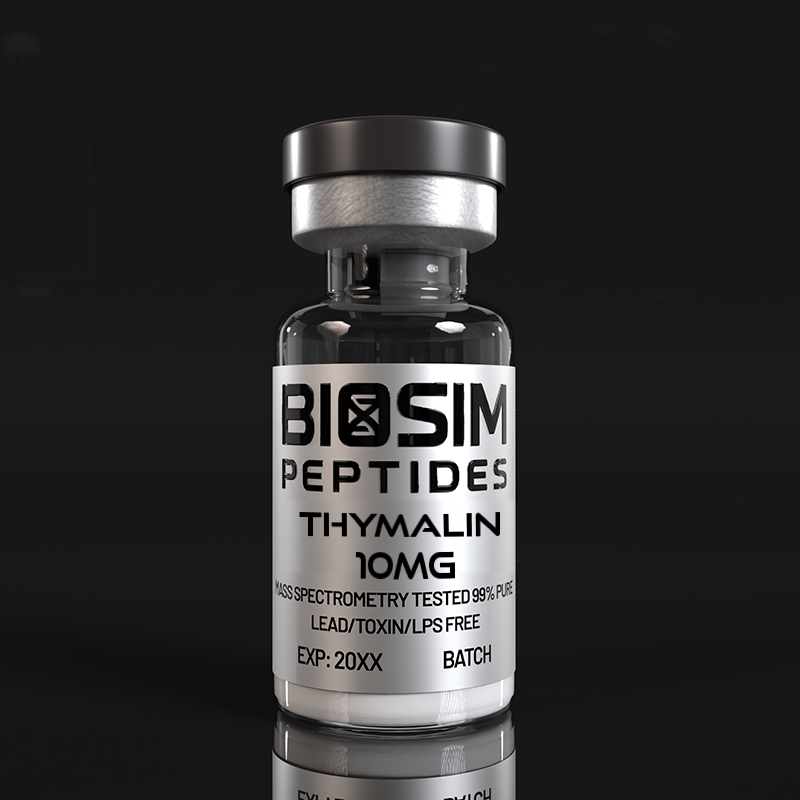
Thymalin 10mg: Research Overview
Thymalin is a synthetic dipeptide (Glu-Trp) derived from thymic extracts, extensively researched in immunosenescence, pineal-thymus axis physiology, and geroprotection. Originally developed at the St. Petersburg Institute of Bioregulation and Gerontology by Professor Vladimir Khavinson, Thymalin belongs to a class of short regulatory peptides that modulate tissue-specific gene expression through epigenetic mechanisms — proposed to interact with nuclear chromatin to de-repress silenced gene loci by promoting heterochromatin relaxation[1][2]. This 10 mg preparation is supplied exclusively for in vitro laboratory research.
Molecular Background & Mechanism of Action
Unlike larger thymic peptides (Tα1 at 28 amino acids, Tβ4 at 43), Thymalin as a dipeptide does not engage classical cell surface receptors. Evidence suggests it penetrates plasma and nuclear membranes to form complementary interactions with specific DNA sequences in promoter regions, facilitating transcriptional de-repression of age-silenced genes[1][2]. The pineal-thymus axis represents a critical neuroendocrine-immune interface: pineal melatonin modulates thymic function, and thymic peptides influence melatonin synthesis. This feed-forward loop deteriorates with age, and Thymalin administration partially restores both thymic cellularity and pineal melatonin rhythmicity[3][4].
Preclinical Evidence
In a landmark 6-12 year observational study, elderly subjects receiving biannual Thymalin (combined with Epithalamin) demonstrated a 2.0-2.4 fold reduction in all-cause mortality compared to matched controls, with pronounced reductions in cardiovascular and infectious disease mortality[3]. Immunological assessments revealed restoration of age-depressed lymphocyte proliferative responses, normalization of circadian immune rhythms, and increased circulating CD3⁺ T-cell counts[4][5]. In murine models, Thymalin attenuated thymic involution with preserved thymic architecture and sustained thymocyte density[1][6].
Research Applications
- Immunosenescence Research: Thymic involution mechanisms, T-cell repertoire diversity, and age-related immune dysfunction.
- Pineal-Thymus Axis Biology: Bidirectional neuroendocrine-immune communication and circadian immune regulation.
- Epigenetic Peptide Biology: Short peptide-chromatin interactions, DNA-binding specificity, and transcriptional de-repression.
- Geroprotection Studies: Lifespan and healthspan outcomes in long-term peptide intervention animal models.
- Comparative Thymic Peptide Research: Head-to-head comparison with Thymosin Alpha-1 and Thymosin Beta-4.
- Lymphocyte Subset Analysis: Flow cytometric characterization of T-cell populations following Thymalin exposure.
Comparative Context: Thymalin vs. Thymosin Alpha-1
| Property | Thymalin | Thymosin Alpha-1 |
|---|---|---|
| Structure | Dipeptide (Glu-Trp) | 28 amino acids |
| Mechanism | Epigenetic / chromatin | TLR2/TLR9 receptor |
| Primary Target | Thymic epithelium, gene expression | Dendritic cells, T-cell polarization |
| Research Focus | Immunosenescence, geroprotection | Innate immunity, antiviral defense |
Safety & Laboratory Handling
Store lyophilized at -20°C. Reconstitute with sterile bacteriostatic water (not included). Highly soluble due to small size. Reconstituted solutions: 2-8°C, use within 30 days. Avoid freeze-thaw cycles. PPE required. Lab research only.
References
- Khavinson VKh, Malinin VV. (2005). “Gerontological aspects of genome peptide regulation.” Karger AG. PMID: 15801203.
- Khavinson VKh et al. (2008). “Molecular mechanism of interaction between oligopeptides and double-stranded DNA.” Bull Exp Biol Med. PMID: 19513372.
- Khavinson VKh, Morozov VG. (2003). “Peptides of pineal gland and thymus prolong human life.” Neuroendocrinol Lett. PMID: 14523363.
- Khavinson VKh, Anisimov VN. (2002). “Peptides and Ageing.” Neuroendocrinol Lett. PMID: 12374906.
- Khavinson VKh et al. (2002). “Geroprotective effect of thymalin and epithalamin.” Adv Gerontol. PMID: 12577695.
- Korkushko OV et al. (2011). “Characteristics of the pineal gland and thymus relationship in aging.” Adv Gerontol. PMID: 21809618.
- Labunets IF et al. (2006). “Biologically active thymic factors and melatonin-producing pineal function in aging.” Fiziol Zh. PMID: 17333624.
- Labunets IF. (2010). “Influence of peptides from pineal gland on thymus function at aging.” Adv Gerontol. PMID: 21510076.
⚠ Research Use Only: Sold exclusively for in vitro laboratory research. Not FDA-evaluated for human use.

Reviews
There are no reviews yet.