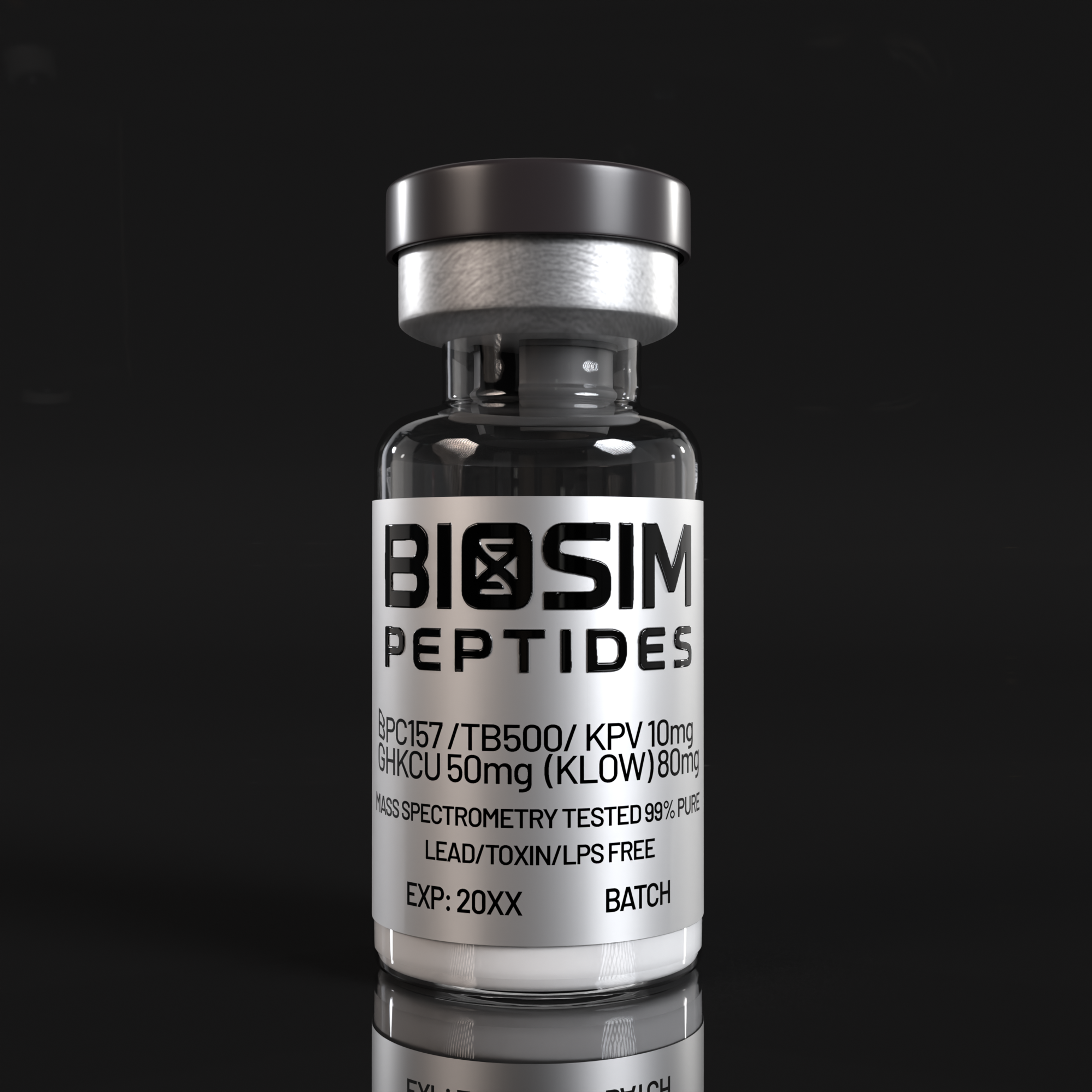
KLOW 80mg Research Blend: Overview
KLOW 80mg is a proprietary research peptide blend formulated for advanced laboratory investigation of combinatorial growth hormone (GH) secretagogue pharmacology. Each vial contains 10mg GHRP-2 (Growth Hormone-Releasing Peptide-2), 10mg CJC-1295 No-DAC (a long-acting GHRH analog), and 60mg Ipamorelin (a highly selective ghrelin receptor agonist). This tri-agonist blend is designed to enable in vitro and preclinical researchers to investigate the synergistic effects of simultaneous GHS-R1a (ghrelin receptor) agonism and GHRH receptor (GHRH-R) activation on the somatotropic axis, body composition regulation, and metabolic signaling networks. For laboratory research use only — not for human consumption.
Molecular Background & Mechanism of Action
The KLOW blend leverages two complementary receptor pathways that converge on somatotroph cells of the anterior pituitary to amplify growth hormone secretion beyond what either pathway can achieve independently. GHRP-2 (pralmorelin) is a potent synthetic ghrelin receptor (GHS-R1a) agonist that binds with high affinity to the Gq-coupled GHS-R1a, activating phospholipase C (PLC), increasing intracellular IP3 and Ca2+ mobilization, and depolarizing somatotroph membranes.[1] Ipamorelin, likewise a GHS-R1a agonist, is distinguished by its remarkable selectivity — it was the first growth hormone secretagogue shown to stimulate GH release without significant effects on prolactin, ACTH, or cortisol at therapeutic-equivalent doses.[2] Ipamorelin’s selectivity arises from its biased signaling profile at GHS-R1a, preferentially activating Gq-mediated pathways over alternative coupling.
CJC-1295 No-DAC (also known as modified GRF 1-29 or tesamorelin analog) is a synthetic analog of growth hormone-releasing hormone (GHRH) engineered with four amino acid substitutions (including D-Ala2, Gln8, Ala15, Leu27) that confer resistance to dipeptidyl peptidase-4 (DPP-4) cleavage, yielding an extended plasma half-life compared to native GHRH(1-29).[3] CJC-1295 binds to the Gs-coupled GHRH receptor (GHRH-R) on pituitary somatotrophs, stimulating adenylyl cyclase, elevating intracellular cAMP, and activating PKA-dependent transcription of the GH gene. Critically, this Gs-cAMP-PKA cascade is mechanistically distinct from the Gq-PLC-IP3 pathway engaged by GHRP-2 and Ipamorelin at GHS-R1a.[4]
The simultaneous activation of Gs-cAMP (via GHRH-R) and Gq-PLC (via GHS-R1a) produces a synergistic amplification of GH secretion — a phenomenon first described in 1995 by Leal-Cerro et al., who demonstrated that combined GHRH plus GHRP-6 administration in GH-deficient adults elicited GH responses significantly greater than the sum of individual responses.[5] This synergy is attributed to cross-talk between cAMP and IP3/Ca2+ second messenger systems at the level of the somatotroph, where PKA-dependent phosphorylation of voltage-gated calcium channels enhances Ca2+ influx and promotes GH vesicle exocytosis. Shuto et al. (2002) established the indispensable role of hypothalamic GHS-R1a in regulating pulsatile GH secretion, feeding behavior, and adiposity, providing the mechanistic rationale for dual-pathway GH secretagogue strategies.[6]
Preclinical & Clinical Evidence
The individual components of the KLOW blend have been extensively characterized in both preclinical models and human clinical trials. GHRP-2 has been shown to acutely stimulate food intake in healthy human subjects — Laferrère et al. (2005) demonstrated that a single bolus of GHRP-2 significantly increased ad libitum caloric intake compared to placebo, confirming ghrelin receptor-mediated orexigenic signaling in humans.[7] This finding positions GHRP-2 as a key tool for researchers investigating the ghrelinergic regulation of appetite and energy homeostasis.
CJC-1295 has been the subject of rigorous pharmacokinetic and pharmacodynamic characterization. Teichman et al. (2006) demonstrated in healthy adults that a single subcutaneous injection of CJC-1295 produced sustained elevations in GH and IGF-1 lasting up to 14 days, with preserved pulsatile GH secretory patterns — a critical finding for researchers concerned about tachyphylaxis or receptor desensitization.[3] Ionescu and Frohman (2006) subsequently confirmed using deconvolution analysis that pulsatile GH secretion persists during continuous GHRH-R stimulation by CJC-1295, indicating that somatotroph responsiveness is maintained under tonic receptor activation.[8] Alba et al. (2006) provided genetic validation in GHRH knockout mice, showing that once-daily CJC-1295 administration normalized longitudinal growth, body composition, and IGF-1 levels — effectively rescuing the phenotype of complete GHRH deficiency.[9]
Ipamorelin’s selectivity profile was established by Raun et al. (1998), who demonstrated in dose-response studies that ipamorelin releases GH with a potency and efficacy comparable to GHRP-6 but, critically, without the concomitant release of prolactin, ACTH, or cortisol observed with earlier-generation secretagogues.[2] This selectivity is attributed to ipamorelin’s distinct receptor interaction kinetics at GHS-R1a, which favor Gq coupling over promiscuous G protein activation. The translational relevance of ghrelin receptor pharmacology is further supported by Sun et al. (2004), who used Ghsr-null mice to conclusively demonstrate that ghrelin’s effects on GH release, appetite stimulation, and metabolic regulation are entirely dependent on GHS-R1a signaling.[10]
In metabolic research contexts, the combined activation of GHS-R1a and GHRH-R pathways has shown promise in models of catabolic stress. Preclinical studies with GHRP-2 have demonstrated anti-catabolic effects in burn injury and arthritis models, including attenuation of MuRF-1 and MAFbx expression — key E3 ubiquitin ligases in the muscle atrophy pathway — and reduction of pro-inflammatory cytokine cascades.[11] These data support the use of KLOW blend components in research investigating GH/IGF-1 axis modulation of protein turnover, inflammation, and tissue remodeling. The body composition implications of ghrelin receptor signaling were established by Shuto et al. (2002), who showed that GHS-R1a null mice exhibit reduced adiposity and altered feeding behavior, directly linking ghrelin receptor tone to energy storage and metabolic phenotype.[6]
Research Applications
- GH Secretagogue Synergy Studies: Investigate the signaling cross-talk between Gs-cAMP-PKA (CJC-1295 → GHRH-R) and Gq-PLC-IP3/Ca2+ (GHRP-2/Ipamorelin → GHS-R1a) pathways in primary pituitary cell cultures and somatotroph cell lines.
- Appetite & Energy Homeostasis Research: Model the ghrelinergic regulation of orexigenic neuropeptide (NPY/AgRP) expression in hypothalamic explant cultures and neuronal cell lines using GHRP-2 and Ipamorelin as selective GHS-R1a probes.
- Body Composition & Adiposity Research: Study GHS-R1a-dependent adipocyte metabolism, lipid uptake, and adipokine secretion in 3T3-L1 adipocyte differentiation models and adipose tissue organotypic cultures.
- Muscle Protein Metabolism Research: Examine the anti-proteolytic effects of GHS-R1a agonism on ubiquitin-proteasome pathway markers (MuRF-1, MAFbx, FOXO) in C2C12 myotube cultures treated with catabolic stimuli.
- IGF-1 Axis Pharmacology: Employ CJC-1295 to achieve sustained, physiologically relevant GHRH-R stimulation for longitudinal studies of hepatic IGF-1 synthesis, IGFBP regulation, and downstream target gene expression in hepatocyte models.
- Combination Peptide Pharmacodynamics: Characterize dose-response relationships and potential synergistic or antagonistic interactions between the three KLOW components using factorial experimental designs in validated in vitro bioassay systems.
Safety & Laboratory Handling
KLOW 80mg is supplied as a lyophilized powder blend and should be stored at -20°C in a desiccated environment, protected from light and moisture. The product should be reconstituted using sterile bacteriostatic water (0.9% benzyl alcohol) under aseptic conditions in a certified biosafety cabinet. Following reconstitution, the solution must be stored at 2-8°C and used within 30 days. Do not freeze reconstituted solutions, as this may cause peptide aggregation and loss of activity. Researchers must wear appropriate personal protective equipment (PPE), including laboratory gloves, eye protection, and a lab coat. All handling should be performed in a biosafety cabinet using sterile technique. Due to the multi-component nature of this blend, researchers should validate component stability and activity in their specific experimental conditions. This product is strictly for laboratory research use and is not intended for human or veterinary administration under any circumstances. Dispose of unused material in accordance with institutional guidelines for peptide waste.
References
- Sun Y, Wang P, Zheng H, et al. (2004). “Ghrelin stimulation of growth hormone release and appetite is mediated through the growth hormone secretagogue receptor.” Proceedings of the National Academy of Sciences. PMID: 15070777.
- Raun K, Hansen BS, Johansen NL, et al. (1998). “Ipamorelin, the first selective growth hormone secretagogue.” European Journal of Endocrinology. PMID: 9849822.
- Teichman SL, Neale A, Lawrence B, et al. (2006). “Prolonged stimulation of growth hormone (GH) and insulin-like growth factor I secretion by CJC-1295, a long-acting analog of GH-releasing hormone, in healthy adults.” Journal of Clinical Endocrinology & Metabolism. PMID: 16352683.
- Shuto Y, Shibasaki T, Otagiri A, et al. (2002). “Hypothalamic growth hormone secretagogue receptor regulates growth hormone secretion, feeding, and adiposity.” Journal of Clinical Investigation. PMID: 12045256.
- Leal-Cerro A, Garcia E, Astorga R, et al. (1995). “Growth hormone (GH) responses to the combined administration of GH-releasing hormone plus GH-releasing peptide 6 in adults with GH deficiency.” European Journal of Endocrinology. PMID: 7788011.
- Shuto Y, Shibasaki T, Otagiri A, et al. (2002). “Hypothalamic growth hormone secretagogue receptor regulates growth hormone secretion, feeding, and adiposity.” Journal of Clinical Investigation. PMID: 12045256.
- Laferrère B, Abraham C, Russell CD, et al. (2005). “Growth hormone releasing peptide-2 (GHRP-2), like ghrelin, increases food intake in healthy men.” Journal of Clinical Endocrinology & Metabolism. PMID: 15699539.
- Ionescu M, Frohman LA. (2006). “Pulsatile secretion of growth hormone (GH) persists during continuous stimulation by CJC-1295, a long-acting GH-releasing hormone analog.” Journal of Clinical Endocrinology & Metabolism. PMID: 17018654.
⚠ Research Use Only: This product is manufactured exclusively for in vitro laboratory research purposes. It is not a drug, food, dietary supplement, or cosmetic ingredient and has not been evaluated by the FDA for safety, efficacy, or quality in humans or animals. Not for human consumption, veterinary use, or clinical therapeutic application. Researchers must comply with all applicable institutional, local, state, and federal regulations governing the acquisition, handling, storage, and disposal of research-grade peptide compounds.

Reviews
There are no reviews yet.