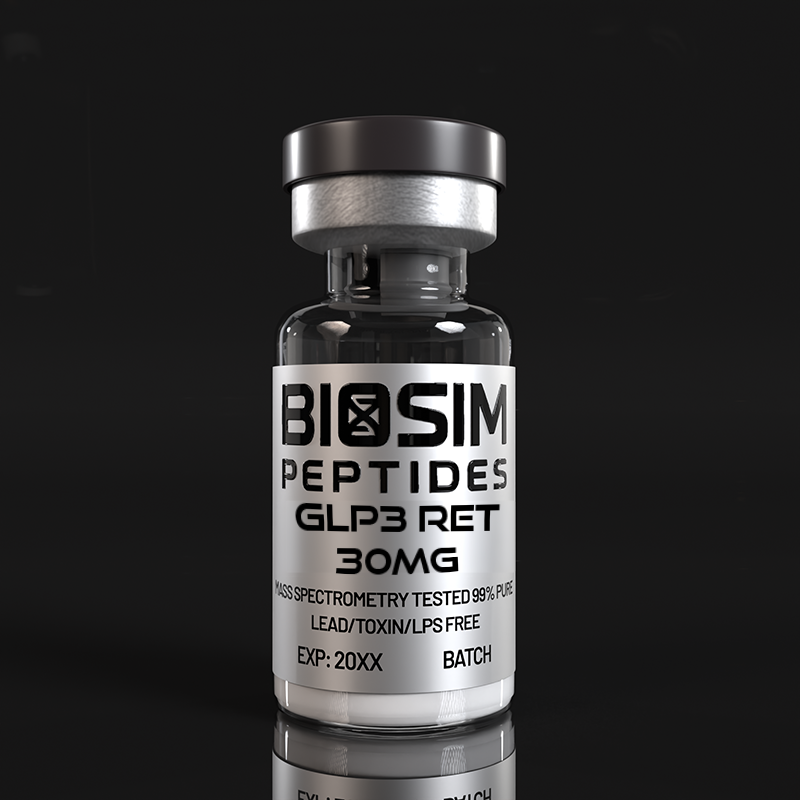
Retatrutide (development code LY3437943) is a synthetic single-molecule triagonist peptide that simultaneously engages the glucagon-like peptide-1 (GLP-1), glucose-dependent insulinotropic polypeptide (GIP), and glucagon receptors. BioSim Peptides supplies Retatrutide 30mg as a lyophilized research peptide intended exclusively for in-vitro laboratory use. This product is not a drug and is not approved for human consumption.
What is Retatrutide?
Retatrutide is a 39-amino-acid synthetic peptide developed as a next-generation incretin-class research molecule. Structurally, it is built on a modified glucagon backbone with strategic substitutions and a C20 fatty diacid moiety attached via a γGlu-2xOEG linker, which mediates non-covalent albumin binding and extends its in-vitro half-life relative to native incretins.
The compound emerged from Eli Lilly’s discovery program seeking to combine the complementary metabolic signaling of GLP-1, GIP, and glucagon receptor activation into a single chemical entity (Coskun et al., 2022). Unlike dual-agonist tirzepatide, retatrutide adds glucagon receptor (GCGR) activity, which in preclinical models recruits hepatic energy expenditure pathways and lipolysis distinct from incretin signaling alone.
Retatrutide is also referenced in published literature as LY3437943 and as the “triple-G” or “triagonist” peptide. It is classified pharmacologically as an incretin/glucagon multireceptor agonist. BioSim Peptides supplies it as a highly purified, lyophilized white powder for reconstitution in laboratory buffers, suitable for receptor-binding assays, adipocyte models, hepatocyte cultures, and other in-vitro metabolic research applications. Research-grade Retatrutide is widely used to probe the comparative pharmacology of mono-, dual-, and tri-agonist incretin systems.
Within the broader incretin research field, retatrutide sits alongside semaglutide (a GLP-1 monoagonist) and tirzepatide (a GLP-1/GIP dual agonist) as part of a structurally related family of long-acting albumin-binding analogs. The retatrutide molecule preserves the lipidation strategy that allows for extended in-vivo exposure while introducing simultaneous engagement of three receptor systems. This unique chemistry positions LY3437943 as a high-information reference compound for laboratory teams characterizing next-generation peptide therapeutics or designing comparative pharmacology campaigns.
Mechanism of Action in Research Models
Retatrutide acts as a balanced agonist across three class B G-protein-coupled receptors: GLP-1R, GIPR, and GCGR. In published in-vitro pharmacology, the molecule shows full agonist activity at GLP-1R and GIPR with somewhat attenuated potency at GCGR, a profile designed to bias signaling toward energy expenditure while limiting hyperglycemic risk in preclinical assays (Coskun et al., 2022).
At the molecular level, agonist binding triggers Gαs coupling and cyclic AMP accumulation in each receptor’s native cell type. In pancreatic β-cell models GLP-1R and GIPR engagement amplifies glucose-dependent insulin secretion, while in hepatocyte cultures GCGR signaling activates glycogenolysis, fatty-acid oxidation, and increased mitochondrial activity. Researchers using LY3437943 in differentiated human subcutaneous adipocyte cultures have demonstrated dose-dependent lipolytic responses consistent with concurrent GIPR and GCGR activation (Regmi et al., 2023).
The C20 fatty-diacid side chain confers albumin affinity, which in receptor-occupancy studies prolongs exposure and allows sustained downstream cAMP/PKA and β-arrestin recruitment. Published research suggests that the triagonist’s pharmacodynamics differ qualitatively from GLP-1 monoagonism: gastric emptying delay, observed in clinical-pharmacology studies, appears tachyphylactic on continued exposure, whereas adipose and hepatic metabolic effects accumulate over weeks (Urva et al., 2023). These observations make retatrutide a useful tool compound for dissecting tri-receptor pharmacology in laboratory settings.
Key Areas of Scientific Research
Metabolic and Adipose Tissue Research
Retatrutide is heavily studied as a probe of adipocyte biology. In differentiated human subcutaneous adipocytes, LY3437943 has been shown to stimulate lipolysis via GIPR-mediated cAMP signaling, providing a tractable assay for triagonist function (Regmi et al., 2023). Researchers use the peptide to compare lipolytic and lipogenic balance under combined incretin/glucagon signaling versus single-pathway controls. Investigators have also examined its effects on adipocyte differentiation markers and mitochondrial biogenesis programs in cell culture.
Hepatic Lipid Metabolism Research
The glucagon-receptor component of retatrutide drives interest in hepatic lipid handling. Phase 2 investigational data in metabolic dysfunction-associated steatotic liver disease (MASLD) cohorts have reported substantial reductions in hepatic fat fraction following exposure to the triagonist (Sanyal et al., 2024). In preclinical hepatocyte and rodent models, the compound is studied for its effects on lipogenesis, β-oxidation enzymes, and de-novo lipogenic transcription factors such as SREBP-1c and ChREBP.
Receptor Pharmacology and Signal Bias
Because retatrutide co-activates three structurally related class B GPCRs, it is a workhorse tool for signal-bias studies. Comparisons with tirzepatide (GLP-1R/GIPR), semaglutide (GLP-1R), and native glucagon allow researchers to deconstruct the contribution of each receptor arm to cAMP, β-arrestin, and internalization endpoints. Published receptor-binding analyses position retatrutide as having lower relative GCGR potency than mature glucagon, which is part of its rationale as a balanced research probe (Coskun et al., 2022).
Gastrointestinal Motility Studies
Gastric emptying is a classic downstream marker of GLP-1R activation. Acetaminophen-absorption and isotope-meal studies have characterized retatrutide’s effect on gastric emptying kinetics, finding meaningful delay at single doses with diminishing effect on chronic exposure (Urva et al., 2023). This dataset informs experimental design in animal and ex-vivo models of gut motility under multi-incretin stimulation.
Cardiometabolic Comorbidity Research
Because retatrutide modulates body weight, glycemia, and hepatic lipid endpoints simultaneously, it serves as a multi-axis probe in cardiometabolic research. Laboratory investigators combine biochemical readouts (HbA1c surrogates in animal models, ALT/AST in hepatic studies, lipid fractionation) with cellular pharmacology to ask how concurrent receptor activation translates into integrated metabolic phenotypes. Phase 2 human datasets provide the pharmacological context that frames these mechanistic experiments (Jastreboff et al., 2023; Rosenstock et al., 2023).
Renal and Cardiovascular Tissue Models
Researchers have begun extending retatrutide work to renal proximal tubule cell cultures and cardiomyocyte preparations, where GLP-1R and glucagon receptor expression has been documented. These models probe whether the triagonist’s metabolic effects extend to tissue-protective signaling in non-classical metabolic organs. While early-stage, this line of work is supported by the broader incretin literature in which related GLP-1R agonists have shown organ-protective signaling in preclinical assays.
Translational Pharmacokinetics and Albumin Binding
The C20 fatty-diacid linker on retatrutide drives reversible albumin binding, which extends the molecule’s effective in-vitro and in-vivo half-life. Researchers studying albumin-binding peptide pharmacokinetics use retatrutide as a benchmark for comparing linker chemistries across the incretin tool-compound class. Plasma protein binding, off-rate kinetics from albumin, and tissue distribution have all been examined in published characterization work (Coskun et al., 2022).
Published Research Highlights
- Coskun and colleagues described the discovery and in-vitro/in-vivo characterization of LY3437943 as a single peptide with potent activity at GLP-1R, GIPR, and GCGR, establishing the molecule’s foundational pharmacology (Coskun et al., 2022, Cell Metabolism).
- Urva and colleagues reported the first-in-human phase 1b pharmacokinetic and pharmacodynamic profile of LY3437943 in adults with type 2 diabetes, demonstrating dose-proportional exposure consistent with once-weekly research dosing models (Urva et al., 2022, Lancet).
- Jastreboff and coauthors published a 48-week phase 2 trial of retatrutide in adults with obesity, the largest dataset informing the molecule’s metabolic effects under sustained exposure (Jastreboff et al., 2023, New England Journal of Medicine).
- Rosenstock and coauthors reported phase 2 data on retatrutide in type 2 diabetes, providing comparative glycemic and weight-related endpoints used in many follow-on research models (Rosenstock et al., 2023, Lancet).
- Sanyal and colleagues conducted a phase 2a trial in MASLD that documented marked reductions in liver fat content following retatrutide exposure, anchoring its position in hepatic metabolic research (Sanyal et al., 2024, Nature Medicine).
- Regmi and colleagues published a STAR Protocols methods paper detailing differentiation of human subcutaneous adipocytes and measurement of lipolytic function induced by GIP or LY3437943, providing a reproducible in-vitro assay for triagonist research (Regmi et al., 2023, STAR Protocols).
Stability, Storage, and Handling in Laboratory Settings
Retatrutide 30mg is shipped as a lyophilized white powder in a sealed vial. Lyophilized peptide is most stable when stored at -20°C protected from light and moisture; published peptide-stability literature indicates that the lyophilized form retains integrity for extended periods under these conditions. For long-term archival storage, -80°C is appropriate.
For reconstitution in research workflows, bacteriostatic or sterile water is typically used; the solubilized peptide is then aliquoted and stored at 2-8°C for short-term use or frozen for longer-term retention. Repeated freeze-thaw cycles should be avoided, as they can accelerate aggregation and deamidation of long-chain incretin peptides. Researchers are encouraged to confirm activity by orthogonal assay (HPLC, mass spectrometry, or cAMP reporter assay) after extended storage. No dosing or administration instructions are provided; this product is for in-vitro laboratory research use only.
Product Specifications
- Product: Retatrutide (LY3437943) 30 mg per vial
- Sequence: 39-amino-acid synthetic peptide with γGlu-2xOEG-C20 diacid lipidation
- Molecular formula (free peptide backbone, approximate): C221H343N53O61
- Molecular weight: approximately 4731 Da
- Purity: ≥98% by HPLC
- Presentation: lyophilized white powder, sealed glass vial
- Certificate of Analysis (COA) available on request
- Shipping: USA-based, temperature-controlled
- Intended use: in-vitro laboratory research only
Why Researchers Choose BioSim Peptides
BioSim Peptides supplies Retatrutide that is independently tested every batch by reverse-phase HPLC and mass spectrometry to confirm identity and purity. Each lot is manufactured under controlled conditions and supported by a full Certificate of Analysis available on request. We guarantee minimum 98% purity on every vial and stand behind every shipment.
Our laboratory customers include academic principal investigators, contract research organizations, and biotech discovery teams who need reliable, well-characterized research peptides to support reproducible experiments. BioSim Peptides ships from US-based facilities with temperature-controlled logistics and provides responsive customer support for technical and order-related inquiries. Researchers interested in related incretin tool compounds may also consult our pages on tirzepatide and semaglutide for comparative pharmacology work.
References
- Coskun T, Urva S, Roell WC, et al. LY3437943, a novel triple glucagon, GIP, and GLP-1 receptor agonist for glycemic control and weight loss: From discovery to clinical proof of concept. Cell Metab. 2022;34(9):1234-1247. PMID: 36027857.
- Urva S, Coskun T, Loh MT, et al. LY3437943, a novel triple GIP, GLP-1, and glucagon receptor agonist in people with type 2 diabetes: a phase 1b, multicentre, double-blind, placebo-controlled, randomised, multiple-ascending dose trial. Lancet. 2022;400(10366):1869-1881. PMID: 36354040.
- Jastreboff AM, Kaplan LM, Frías JP, et al. Triple-Hormone-Receptor Agonist Retatrutide for Obesity – A Phase 2 Trial. N Engl J Med. 2023;389(6):514-526. PMID: 37366315.
- Rosenstock J, Frias J, Jastreboff AM, et al. Retatrutide, a GIP, GLP-1 and glucagon receptor agonist, for people with type 2 diabetes: a randomised, double-blind, placebo- and active-controlled, parallel-group, phase 2 trial conducted in the USA. Lancet. 2023;402(10401):529-544. PMID: 37385280.
- Urva S, Coskun T, Wang T, et al. The novel GIP, GLP-1 and glucagon receptor agonist retatrutide delays gastric emptying. Diabetes Obes Metab. 2023;25(9):2784-2788. PMID: 37311727.
- Regmi A, Aihara E, Christe ME, et al. Differentiation of human subcutaneous adipocytes and measurement of lipolytic function induced by GIP or LY3437943. STAR Protoc. 2023;4(2):102323. PMID: 37178114.
- Sanyal AJ, Bedossa P, Fraessdorf M, et al. Triple hormone receptor agonist retatrutide for metabolic dysfunction-associated steatotic liver disease: a randomized phase 2a trial. Nat Med. 2024;30(7):2037-2048. PMID: 38858523.
This peptide is supplied by BioSim Peptides for in-vitro laboratory research use only. It is not a drug, supplement, cosmetic, or food product and is not intended for human or veterinary use, consumption, diagnosis, treatment, cure, or prevention of any disease. All research must comply with applicable institutional and regulatory guidelines.
Frequently Asked Questions about Retatrutide
What is Retatrutide?
Retatrutide is a research peptide supplied by BioSim Peptides for in-vitro and laboratory use only. Each vial is lyophilized, lab-tested, and accompanied by a Certificate of Analysis (COA) verifying identity and purity above 98% by HPLC.
Is the Retatrutide from BioSim Peptides third-party tested?
Yes. Every lot of Retatrutide 30mg is independently tested by HPLC and mass spectrometry. The COA for the current batch is available on request and packaged with every order.
How should Retatrutide be stored?
Lyophilized Retatrutide should be stored at -20°C for long-term stability. After reconstitution with bacteriostatic water it is typically stored at 2-8°C and used within the timeframe described in the published literature for the peptide.
How fast does BioSim Peptides ship?
Orders placed before 2 PM ET ship same business day from our USA facility via tracked carriers. Most domestic orders arrive in 2-4 business days.
Is Retatrutide approved for human use?
No. Retatrutide is supplied for in-vitro laboratory research only. It is not a drug, dietary supplement, cosmetic, or food, and is not intended for diagnosis, treatment, cure, or prevention of any disease in humans or animals.


Reviews
There are no reviews yet.