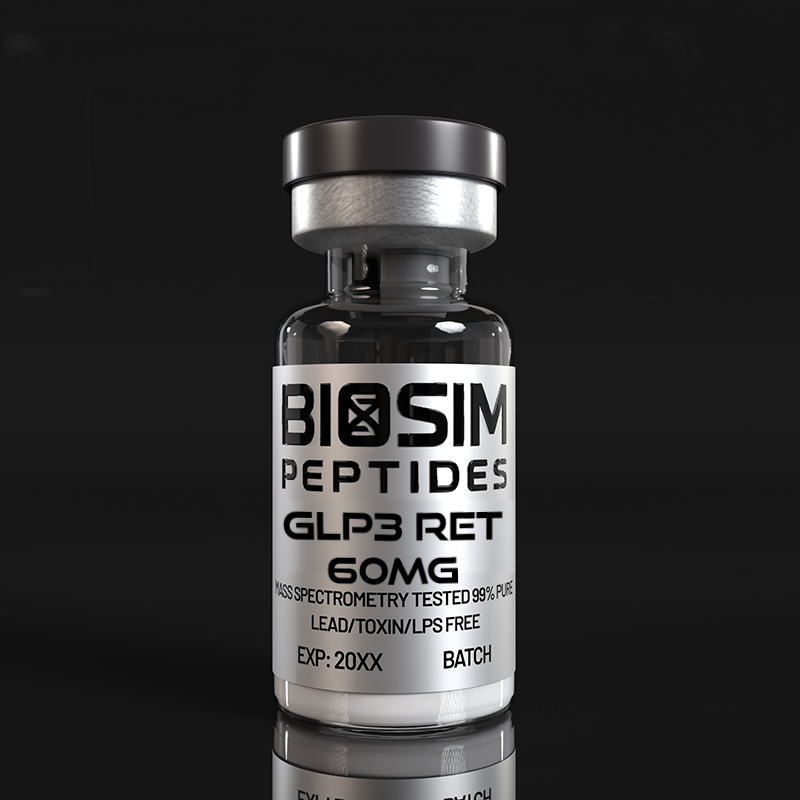
Retatrutide 60mg from BioSim Peptides is a high-fill research vial of the synthetic triagonist peptide LY3437943, intended for in-vitro laboratory studies that require larger working stocks of well-characterized triple-receptor agonist material. This peptide is supplied for research use only and is not a drug, supplement, or product approved for human use.
What is Retatrutide?
Retatrutide, originally designated LY3437943, is a 39-residue synthetic peptide engineered as a single-molecule agonist at three structurally related class B G-protein-coupled receptors: GLP-1R, GIPR, and the glucagon receptor (GCGR). It belongs to an emerging family of “multi-incretin” research peptides that extend the concept first reduced to practice with the dual GLP-1R/GIPR agonist tirzepatide.
The molecule was disclosed and pharmacologically characterized by Coskun and colleagues, who described its design strategy: a glucagon-derived peptide backbone with non-natural amino acid substitutions (including aminoisobutyric acid at positions 2 and 13) and a lipid moiety – a γGlu-2xOEG-C20 fatty diacid – attached via lysine side-chain to enable albumin binding and slow clearance in vivo (Coskun et al., 2022). The lipidation is responsible for the molecule’s extended elimination half-life observed in pharmacokinetic research.
Retatrutide is also referred to in the literature as the “triple G” agonist, the GIP/GLP-1/glucagon triagonist, or by the development code LY3437943. It is supplied by BioSim Peptides as a sterile lyophilized white powder in vialed quantities suitable for cell culture, ex-vivo tissue, and biochemical assays.
The 60 mg fill is intended for laboratories that consume larger working stocks – multi-arm dose-response studies, repeated reporter-cell assays, or extended in-vivo preclinical research workflows in animal models conducted under institutional oversight. Because retatrutide combines an incretin and glucagon pharmacophore in a single chemical entity, the larger vial size minimizes the number of reconstitution events required during a long-running research program, supporting reproducibility across timepoints.
Mechanism of Action in Research Models
Functionally, retatrutide engages GLP-1R, GIPR, and GCGR with a balanced but non-identical potency profile. In published in-vitro binding and cAMP accumulation assays it acts as a full agonist at GLP-1R and GIPR and as a partial-to-full agonist at GCGR, with potency at GCGR being intentionally attenuated relative to native glucagon to favor metabolic over hyperglycemic effects in preclinical models (Coskun et al., 2022).
The downstream consequences of receptor activation depend on cell type. In rodent and human pancreatic β-cell models, GLP-1R and GIPR co-activation produces glucose-dependent potentiation of insulin secretion via cAMP/PKA and Epac pathways. In hepatocyte cultures, GCGR signaling drives PKA-dependent activation of glycogenolysis, gluconeogenic enzymes, and notably fatty-acid β-oxidation, contributing to the hepatic lipid-lowering signature consistently reported in research datasets (Sanyal et al., 2024).
In adipose-tissue research, retatrutide has been shown to stimulate lipolysis in differentiated human subcutaneous adipocytes, with the GIPR component contributing significantly to the response in well-characterized in-vitro assays (Regmi et al., 2023). The molecule also delays gastric emptying acutely, a classic GLP-1R effect that has been formally documented for LY3437943 in pharmacology studies (Urva et al., 2023). Because retatrutide is a single, defined chemical entity yet acts at three distinct receptors, it is a uniquely informative reagent for dissecting the contribution of each receptor arm to integrated metabolic phenotypes.
Receptor-occupancy modeling and reporter-cell experiments allow researchers to translate retatrutide’s tri-receptor pharmacology into quantitative pathway-engagement metrics. These data feed into systems-pharmacology models that predict integrated metabolic responses across tissue compartments and species, an active area of laboratory research informed by the published characterization of LY3437943 (Coskun et al., 2022; Urva et al., 2022).
Key Areas of Scientific Research
Comparative Triagonist Pharmacology
A central use of retatrutide in research is as a tool compound for comparing single-, dual-, and triple-receptor agonism. Side-by-side experiments with semaglutide, liraglutide, tirzepatide, and native incretins help researchers attribute observed cellular and tissue effects to specific receptor arms. Coskun and colleagues established the foundational pharmacology that makes these comparisons possible (Coskun et al., 2022).
Hepatic Steatosis and MASLD Research
Retatrutide attracts considerable research attention for its effects on hepatic lipid content. A phase 2a trial in adults with metabolic dysfunction-associated steatotic liver disease (MASLD) demonstrated that the triagonist substantially reduced magnetic-resonance-measured liver fat versus placebo, with a sizeable proportion of participants reaching near-normalization of hepatic fat fraction (Sanyal et al., 2024). These findings drive ongoing in-vitro and animal-model research into the mechanistic basis of GCGR-driven hepatic lipid clearance.
Energy Expenditure and Mitochondrial Studies
Glucagon-receptor activation is associated in preclinical models with increased resting energy expenditure and mitochondrial activity in liver and brown adipose tissue. Researchers use retatrutide to examine whether the GCGR arm contributes additively to thermogenic and oxidative endpoints versus GLP-1R/GIPR-only comparators. Mitochondrial respirometry, fatty-acid oxidation flux, and uncoupling-protein expression are common readouts in this line of work.
Glycemic Control Models
In type 2 diabetes research, retatrutide has been characterized across phase 1b and phase 2 studies. Urva and colleagues described the first-in-human pharmacokinetic and glycemic profile, and Rosenstock and colleagues subsequently reported phase 2 efficacy and safety data in adults with type 2 diabetes, providing the comparative dataset against which mechanistic in-vitro work is interpreted (Urva et al., 2022; Rosenstock et al., 2023).
Gastric Emptying and Gut-Brain Axis
Retatrutide’s delay of gastric emptying, documented by isotopic and acetaminophen-absorption methods, makes it a useful probe for studying GLP-1R-mediated gut motility effects in concert with GIPR and GCGR co-activation (Urva et al., 2023). Researchers extend this work into ex-vivo gut preparations and neural pathway models.
Inflammation and Adipose Tissue Macrophage Studies
Chronic adipose-tissue inflammation is a focus of metabolic research, and retatrutide’s effects on adipocyte phenotype prompt investigation of secondary changes in resident macrophage populations. Co-culture systems combining differentiated adipocytes with primary macrophages allow researchers to probe whether triagonist-driven lipolysis is accompanied by shifts in pro- and anti-inflammatory cytokine profiles. These assays build on the validated adipocyte methodology described by Regmi and colleagues (Regmi et al., 2023).
Pancreatic Islet and β-Cell Studies
Combined GLP-1R and GIPR agonism is a hallmark of incretin-class pharmacology, and retatrutide adds the GCGR arm into the same chemical entity. Researchers use isolated rodent islets and human islet preparations to dissect the contribution of each receptor to glucose-stimulated insulin secretion, β-cell viability under glucolipotoxic stress, and α-to-β cell paracrine signaling. The triagonist’s distinct potency profile across the three receptors makes it a particularly informative tool in this context.
Comparative Receptor Selectivity Profiling
For laboratory groups building structure-activity relationships across the incretin field, retatrutide is a useful reference point. Cell-based reporter assays (cAMP, calcium flux, β-arrestin recruitment) using GLP-1R-, GIPR-, and GCGR-expressing cell lines can be calibrated against the triagonist’s well-characterized response to ensure assay performance is consistent across studies (Coskun et al., 2022).
Published Research Highlights
- Jastreboff and colleagues published a 338-participant 48-week phase 2 trial of retatrutide in adults with obesity, demonstrating dose-dependent reductions in body weight that exceeded historical comparators for GLP-1 monoagonist molecules (Jastreboff et al., 2023, New England Journal of Medicine).
- Sanyal and coauthors reported the first phase 2a clinical research on retatrutide in MASLD, showing major reductions in liver fat content within 24 weeks (Sanyal et al., 2024, Nature Medicine).
- Rosenstock and colleagues conducted a phase 2 trial of retatrutide in type 2 diabetes that informed glycemic and body-weight pharmacodynamics for the triagonist class (Rosenstock et al., 2023, Lancet).
- Urva and coauthors characterized the molecule’s effect on gastric emptying, an important determinant of postprandial glucose excursions in incretin-based pharmacology research (Urva et al., 2023, Diabetes Obesity and Metabolism).
- Regmi and colleagues developed a reproducible in-vitro adipocyte differentiation and lipolysis assay specifically for LY3437943, enabling standardized lab-scale pharmacology (Regmi et al., 2023, STAR Protocols).
- Coskun and coauthors disclosed the foundational discovery, structural design, receptor pharmacology, and proof-of-concept pharmacodynamics for LY3437943 as a triagonist (Coskun et al., 2022, Cell Metabolism).
Stability, Storage, and Handling in Laboratory Settings
Lyophilized Retatrutide 60mg should be stored at -20°C, protected from light and moisture, in its original sealed vial until ready for use. Long-term archival storage at -80°C is appropriate for extended programs. Published peptide stability data suggest lyophilized incretin-class peptides retain assay-grade integrity for many months under these conditions when handled correctly.
For laboratory use, the peptide is typically reconstituted in bacteriostatic or sterile water; the resulting solution can be held at 2-8°C for short-term experiments or aliquoted and frozen for longer-term storage. Avoid repeated freeze-thaw cycles, which can promote aggregation and chemical degradation of long peptides. Researchers should confirm post-reconstitution integrity by HPLC or mass spectrometry where assay precision is critical. No dosing or administration guidance is provided – this product is for in-vitro research use only.
Product Specifications
- Product: Retatrutide (LY3437943) 60 mg per vial
- Peptide class: synthetic 39-amino-acid triagonist with C20 fatty-diacid lipidation
- CAS designation: 2381089-83-2
- Approximate molecular weight: 4731 Da
- Purity: ≥98% by HPLC, identity confirmed by mass spectrometry
- Presentation: lyophilized white powder, sterile sealed vial
- Certificate of Analysis (COA): provided on request for every lot
- Shipping: USA-based, temperature-controlled
- Intended use: in-vitro laboratory research only – not for human or veterinary use
Why Researchers Choose BioSim Peptides
BioSim Peptides exists to give academic and industrial researchers a dependable source of high-purity research peptides, including specialty molecules such as Retatrutide. Every lot is independently analyzed by reverse-phase HPLC and electrospray mass spectrometry, with results documented in a Certificate of Analysis available on request.
Our Retatrutide 60mg vial provides the larger working quantity that multi-arm cell-culture studies, dose-response panels, and animal-model investigations frequently require. We ship from the United States with insulated, temperature-controlled packaging and provide direct technical support for reconstitution, storage, and assay design questions. For complementary research peptides in the incretin and metabolic class, see our pages on tirzepatide and survodutide.
References
- Coskun T, Urva S, Roell WC, et al. LY3437943, a novel triple glucagon, GIP, and GLP-1 receptor agonist for glycemic control and weight loss: From discovery to clinical proof of concept. Cell Metab. 2022;34(9):1234-1247. PMID: 36027857.
- Urva S, Coskun T, Loh MT, et al. LY3437943, a novel triple GIP, GLP-1, and glucagon receptor agonist in people with type 2 diabetes: a phase 1b, multicentre, double-blind, placebo-controlled, randomised, multiple-ascending dose trial. Lancet. 2022;400(10366):1869-1881. PMID: 36354040.
- Jastreboff AM, Kaplan LM, Frías JP, et al. Triple-Hormone-Receptor Agonist Retatrutide for Obesity – A Phase 2 Trial. N Engl J Med. 2023;389(6):514-526. PMID: 37366315.
- Rosenstock J, Frias J, Jastreboff AM, et al. Retatrutide, a GIP, GLP-1 and glucagon receptor agonist, for people with type 2 diabetes: a phase 2 trial. Lancet. 2023;402(10401):529-544. PMID: 37385280.
- Urva S, Coskun T, Wang T, et al. The novel GIP, GLP-1 and glucagon receptor agonist retatrutide delays gastric emptying. Diabetes Obes Metab. 2023;25(9):2784-2788. PMID: 37311727.
- Sanyal AJ, Bedossa P, Fraessdorf M, et al. Triple hormone receptor agonist retatrutide for metabolic dysfunction-associated steatotic liver disease: a randomized phase 2a trial. Nat Med. 2024;30(7):2037-2048. PMID: 38858523.
- Regmi A, Aihara E, Christe ME, et al. Differentiation of human subcutaneous adipocytes and measurement of lipolytic function induced by GIP or LY3437943. STAR Protoc. 2023;4(2):102323. PMID: 37178114.
This peptide is supplied by BioSim Peptides for in-vitro laboratory research use only. It is not a drug, supplement, cosmetic, or food product and is not intended for human or veterinary use, consumption, diagnosis, treatment, cure, or prevention of any disease. All research must comply with applicable institutional and regulatory guidelines.
Frequently Asked Questions about Retatrutide
What is Retatrutide?
Retatrutide is a research peptide supplied by BioSim Peptides for in-vitro and laboratory use only. Each vial is lyophilized, lab-tested, and accompanied by a Certificate of Analysis (COA) verifying identity and purity above 98% by HPLC.
Is the Retatrutide from BioSim Peptides third-party tested?
Yes. Every lot of Retatrutide 60mg is independently tested by HPLC and mass spectrometry. The COA for the current batch is available on request and packaged with every order.
How should Retatrutide be stored?
Lyophilized Retatrutide should be stored at -20°C for long-term stability. After reconstitution with bacteriostatic water it is typically stored at 2-8°C and used within the timeframe described in the published literature for the peptide.
How fast does BioSim Peptides ship?
Orders placed before 2 PM ET ship same business day from our USA facility via tracked carriers. Most domestic orders arrive in 2-4 business days.
Is Retatrutide approved for human use?
No. Retatrutide is supplied for in-vitro laboratory research only. It is not a drug, dietary supplement, cosmetic, or food, and is not intended for diagnosis, treatment, cure, or prevention of any disease in humans or animals.

Reviews
There are no reviews yet.