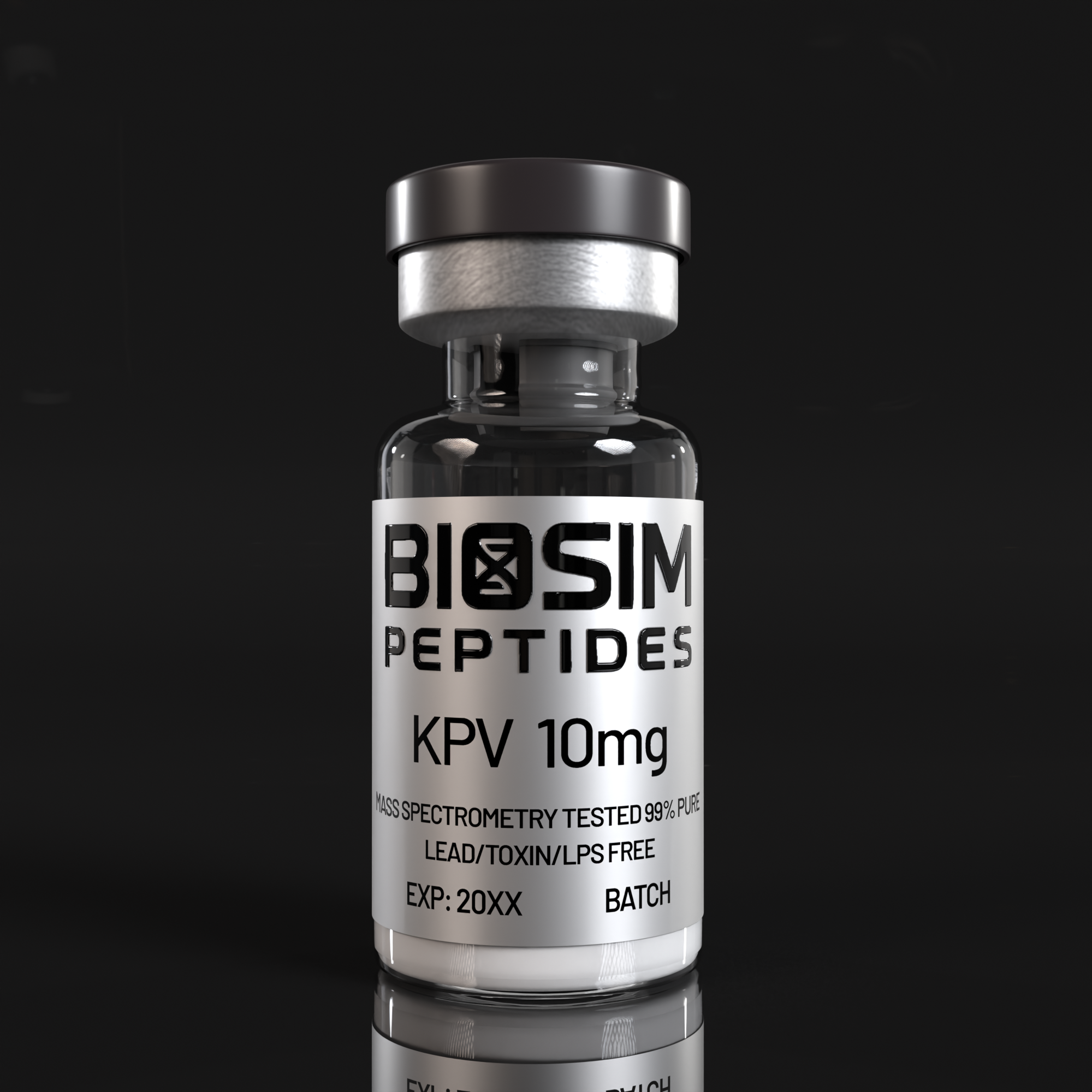
KPV 10mg: Research Overview
KPV (Lys-Pro-Val) is the C-terminal tripeptide fragment of alpha-melanocyte-stimulating hormone (α-MSH), corresponding to residues 11-13 of the full-length tridecapeptide. Despite its minimal size — just three amino acids — KPV retains the potent anti-inflammatory and immunomodulatory properties of the parent hormone while eliminating the pigmentary effects mediated by the N-terminal melanocortin pharmacophore. BioSim Peptides supplies KPV as a lyophilized powder at 10mg per vial, verified to ≥98% purity by HPLC and mass spectrometry, for use exclusively in controlled laboratory research investigating melanocortin-mediated inflammatory resolution, NF-κB signaling, and intestinal barrier biology.
The discovery that α-MSH’s anti-inflammatory activity could be dissociated from its melanogenic effects represented a significant advance in melanocortin pharmacology. Structure-activity studies established that the C-terminal tripeptide Lys-Pro-Val (KPV) is the minimal sequence sufficient to inhibit leukocyte migration, suppress pro-inflammatory cytokine production, and reduce NF-κB transcriptional activity, while the N-terminal region containing the His-Phe-Arg-Trp tetrapeptide mediates melanocortin receptor activation and melanogenesis12. This functional segregation makes KPV an exceptionally clean tool for researchers studying anti-inflammatory pathways without confounding effects on pigmentation or steroidogenesis.
Molecular Background & Mechanism of Action
KPV exerts its anti-inflammatory effects through multiple convergent mechanisms. The most thoroughly characterized is inhibition of the NF-κB signaling pathway — KPV suppresses phosphorylation and subsequent degradation of IκBα, the inhibitory protein that sequesters NF-κB dimers in the cytoplasm. By stabilizing the IκBα-NF-κB complex, KPV prevents nuclear translocation of p50/p65 (RelA) NF-κB subunits, thereby attenuating transcription of pro-inflammatory target genes including TNF-α, IL-1β, IL-6, and ICAM-123. This mechanism operates independently of melanocortin receptor engagement, consistent with KPV’s inability to activate MC1R through the canonical cAMP/PKA cascade — instead, KPV appears to interact with a distinct, as-yet-unidentified cell surface recognition site or to penetrate cells directly via the peptide transporter PepT1 (SLC15A1)45.
In intestinal epithelial cells and immune cell populations, KPV has been shown to modulate additional signaling nodes beyond NF-κB. These include attenuation of MAP kinase (ERK, JNK, p38) phosphorylation in response to inflammatory stimuli, reduction of reactive oxygen species (ROS) production through NADPH oxidase inhibition, and preservation of epithelial tight junction integrity by preventing TNF-α-induced redistribution of occludin and ZO-156. The tripeptide’s small size (molecular weight: 342.4 Da) and resistance to peptidase degradation — conferred by the unusual Lys-Pro N-terminal bond — enable effective transepithelial transport and intracellular access in colonic tissue preparations, distinguishing KPV from larger peptide and protein-based anti-inflammatory agents that require specialized delivery strategies35.
Preclinical & Clinical Evidence
The anti-inflammatory pharmacology of KPV was systematically dissected by Getting et al. (2003), who compared the full-length α-MSH peptide, the core melanocortin sequence, and the C-terminal KPV tripeptide in multiple models of acute inflammation. KPV proved equipotent to full-length α-MSH in inhibiting leukocyte migration and cytokine release while being completely devoid of melanocortin receptor-mediated effects on cAMP accumulation, formally establishing the functional independence of the C-terminal anti-inflammatory domain1. This work laid the foundation for the subsequent exploration of KPV as a research tool in mucosal and systemic inflammatory models.
KPV’s efficacy in intestinal inflammation has been demonstrated across multiple independent laboratories and model systems. Kannengiesser et al. (2008) provided the first direct evidence that KPV attenuates colitis in murine models of inflammatory bowel disease (IBD), showing that KPV treatment reduced histological disease scores, myeloperoxidase activity, and pro-inflammatory cytokine levels in both dextran sulfate sodium (DSS) and trinitrobenzene sulfonic acid (TNBS) colitis models3. Building on these findings, Viennois et al. (2016) elucidated the role of the peptide transporter PepT1 in mediating KPV uptake into colonic epithelial cells and demonstrated that KPV treatment not only reduced acute colitis severity but also decreased the incidence of colitis-associated colorectal cancer in a mouse model, linking PepT1-mediated KPV transport to both anti-inflammatory and anti-carcinogenic outcomes5.
Recent advances in biomaterials research have further expanded the applications of KPV. Zhao et al. (2022) developed a KPV-binding double-network hydrogel that enabled sustained, localized release of KPV to inflamed colonic tissue, demonstrating that the hydrogel-KPV system restored gut mucosal barrier function as measured by transepithelial electrical resistance, tight junction protein expression, and reduced bacterial translocation in a colitis model6. Sun et al. (2021) similarly reported that a self-cross-linked γ-polyglutamic acid hydrogel stabilized KPV and significantly enhanced its therapeutic index in TNBS-induced colitis in rats, with the hydrogel formulation reducing required dosing frequency while maintaining anti-inflammatory efficacy8. The authoritative review by Brzoska et al. (2008) in Endocrine Reviews comprehensively catalogues the biochemistry, signaling mechanisms, and translational potential of α-MSH-related tripeptides including KPV, and remains an essential reference for researchers entering this field7.
Research Applications
- NF-κB Signaling Studies: Use KPV as a pharmacological probe to dissect IκBα-dependent versus IκBα-independent mechanisms of NF-κB pathway inhibition in immune and epithelial cell lines. KPV offers a clean tool for suppressing canonical NF-κB activation without the pleiotropic effects of broad-spectrum kinase inhibitors23.
- Inflammatory Bowel Disease Modeling: Apply KPV in DSS-induced or TNBS-induced colitis models in rodents to study mechanisms of mucosal inflammation resolution, epithelial restitution, and immune cell trafficking. KPV’s PepT1-mediated uptake enables direct intracellular access in colonic epithelium without requiring delivery vehicles35.
- Gut Barrier Integrity Research: Investigate the effects of KPV on epithelial tight junction assembly and maintenance using transepithelial electrical resistance (TEER) measurements, immunofluorescence localization of claudins/occludin/ZO-1, and paracellular tracer flux assays in Caco-2 or T84 monolayer cultures6.
- Drug Delivery & Biomaterials: Incorporate KPV into hydrogel, nanoparticle, or microparticle delivery systems as a model small-peptide cargo for evaluating colon-targeted release kinetics, bioadhesive formulations, and sustained-release depot strategies68.
- Melanocortin Pharmacology: Use KPV as a control compound in studies examining the functional segregation of melanocortin receptor signaling (MC1R-MC5R) from receptor-independent anti-inflammatory mechanisms mediated by the α-MSH C-terminus14.
- Cytokine & Chemokine Profiling: Employ KPV in multiplex cytokine arrays or RNA-seq experiments to characterize its transcriptional targets in macrophages, dendritic cells, and intestinal epithelial cells under inflammatory stimulation.
Comparative Context
The melanocortin peptide family offers researchers a spectrum of tools with distinct pharmacological profiles. Full-length α-MSH (Ac-Ser-Tyr-Ser-Met-Glu-His-Phe-Arg-Trp-Gly-Lys-Pro-Val-NH₂) activates all five melanocortin receptors (MC1R-MC5R) and possesses both pigmentary and anti-inflammatory properties. In contrast, KPV is the minimal anti-inflammatory fragment that eliminates MC1R-mediated melanogenesis, making it ideal for experiments where receptor activation would confound interpretation. Related tripeptides such as K(D)PV (containing D-Pro for enhanced stability), KP(D)V, and the tetrapeptide GKPV (Gly-Lys-Pro-Val, α-MSH 10-13) offer incremental variations in potency and metabolic stability. Notably, the peptide (CKPV)₂ — a dimeric KPV derivative — has shown enhanced anti-endotoxin activity in surgical models but requires more complex synthesis127.
| Compound | Target | Key Property |
|---|---|---|
| KPV (Lys-Pro-Val) | NF-κB / IκBα stabilization | Minimal anti-inflammatory fragment; no MC-R activity |
| α-MSH (full-length) | MC1R-MC5R + NF-κB | Full melanocortin activity including pigmentation |
| GKPV (α-MSH 10-13) | NF-κB / IκBα stabilization | Enhanced potency vs KPV; still MC-R-independent |
| (CKPV)₂ dimer | NF-κB + TLR4 antagonism | Enhanced anti-endotoxin activity; dimeric format |
Safety & Laboratory Handling
Store lyophilized KPV at -20°C protected from light and moisture. The tripeptide is freely soluble in water, sterile PBS, or bacteriostatic water at concentrations up to 10 mg/mL. Unlike larger hydrophobic peptides, KPV does not require organic solvents or acidic conditions for reconstitution — simply add the desired volume of sterile aqueous solvent and gently swirl to dissolve. Reconstituted solutions should be stored at 2-8°C and used within 30 days. For long-term storage, aliquot and freeze at -20°C or -80°C. KPV demonstrates good stability through limited freeze-thaw cycles owing to its small size and the stabilizing Lys-Pro bond at the N-terminus, but repeated cycling should still be avoided as a general best practice. Use appropriate PPE including gloves, lab coat, and eye protection. Work in a certified biosafety cabinet when preparing sterile solutions for cell culture applications. This product is for laboratory research use only — not for diagnostic or therapeutic applications. Not for human or veterinary use.
References
- Getting SJ, Schiöth HB, Perretti M. “Dissection of the anti-inflammatory effect of the core and C-terminal (KPV) alpha-melanocyte-stimulating hormone peptides.” J Pharmacol Exp Ther. 2003 Aug;306(2):631-637. PMID: 12750433.
- Kelly JM, Moir AJ, Carlson K, Yang Y, MacNeil S, Haycock JW. “Immobilized alpha-melanocyte stimulating hormone 10-13 (GKPV) inhibits tumor necrosis factor-alpha stimulated NF-kappaB activity.” Peptides. 2006 Feb;27(2):431-437. PMID: 16274845.
- Kannengiesser K, Maaser C, Heidemann J, Luegering A, Ross M, Brzoska T, Böhm M, Luger TA, Domschke W, Kucharzik T. “Melanocortin-derived tripeptide KPV has anti-inflammatory potential in murine models of inflammatory bowel disease.” Inflamm Bowel Dis. 2008 Mar;14(3):324-331. PMID: 18092346.
- Elliott RJ, Szabo M, Wagner MJ, Kemp EH, MacNeil S, Haycock JW. “alpha-Melanocyte-stimulating hormone, MSH 11-13 KPV and adrenocorticotropic hormone signalling in human keratinocyte cells.” J Invest Dermatol. 2004 Apr;122(4):1010-1019. PMID: 15102092.
- Viennois E, Ingersoll SA, Ayyadurai S, Zhao Y, Wang L, Zhang M, Han MK, Garg P, Xiao B, Merlin D. “Critical role of PepT1 in promoting colitis-associated cancer and therapeutic benefits of the anti-inflammatory PepT1-mediated tripeptide KPV in a murine model.” Cell Mol Gastroenterol Hepatol. 2016 May;2(3):340-357. PMID: 27458604.
- Zhao Y, Xue P, Lin G, Tong M, Yang J, Zhang Y, Zhang K, Wang Y, Shen Y, Zhan Q. “A KPV-binding double-network hydrogel restores gut mucosal barrier in an inflamed colon.” Acta Biomater. 2022 Apr 15;143:233-247. PMID: 35245681.
- Brzoska T, Luger TA, Maaser C, Abels C, Böhm M. “Alpha-melanocyte-stimulating hormone and related tripeptides: biochemistry, antiinflammatory and protective effects in vitro and in vivo, and future perspectives for the treatment of immune-mediated inflammatory diseases.” Endocr Rev. 2008 Aug;29(5):581-602. PMID: 18612139.
- Sun J, Xue P, Liu J, Huang L, Lin G, Zhang K, Wang Y, Shen Y, Zhan Q. “Self-Cross-Linked Hydrogel of Cysteamine-Grafted γ-Polyglutamic Acid Stabilized Tripeptide KPV for Alleviating TNBS-Induced Ulcerative Colitis in Rats.” ACS Biomater Sci Eng. 2021 Oct 11;7(10):4875-4886. PMID: 34547895.
⚠ Research Use Only: This product is sold exclusively for in vitro laboratory research. Not evaluated by FDA for human use. Not for diagnostic, therapeutic, veterinary, or clinical applications. Proper institutional biosafety and IACUC approvals are the purchaser’s responsibility.

Reviews
There are no reviews yet.