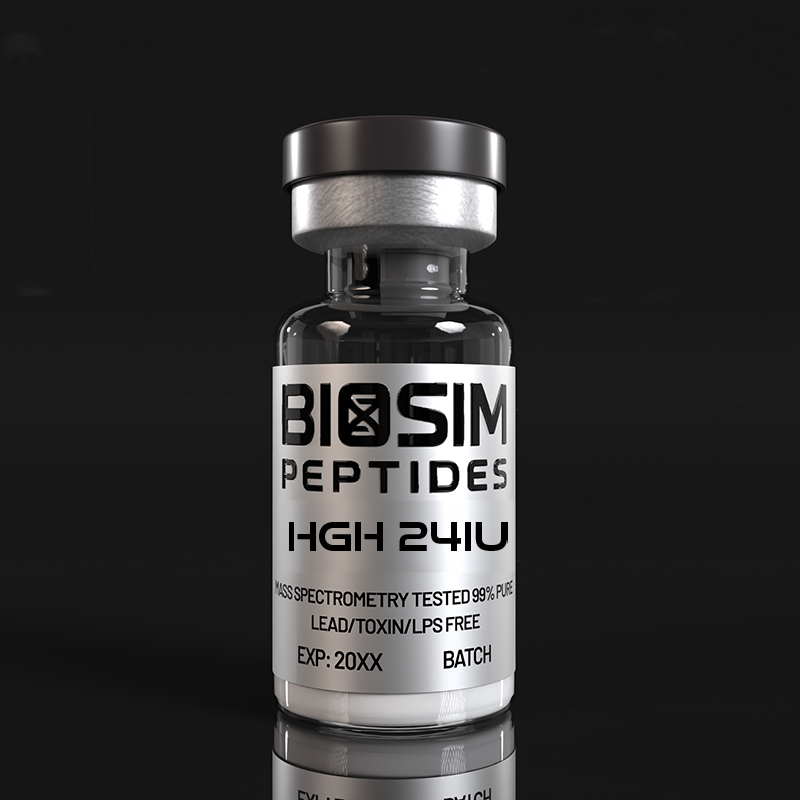
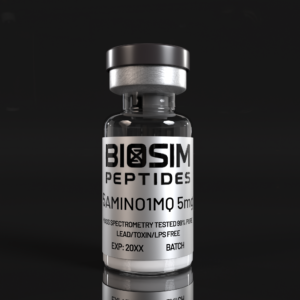
Human Growth Hormone (HGH), also referred to in pharmacological literature as somatropin, is a 191-amino-acid recombinant polypeptide identical in sequence to endogenous pituitary growth hormone. BioSim Peptides supplies HGH 24iu as a lyophilized research-grade preparation intended exclusively for in-vitro laboratory research use only.
This product page summarizes the chemistry, mechanism, and published research surrounding recombinant human growth hormone (rhGH) to support investigators designing studies in cell culture, tissue, and preclinical model systems. It is not a clinical reference and contains no dosing or human-use information.
What is HGH (Somatropin)?
Human growth hormone is a single-chain polypeptide hormone of 191 amino acid residues with a molecular weight of approximately 22.1 kDa. The molecule contains two intramolecular disulfide bridges and folds into a four-helix bundle characteristic of the somatotropin/prolactin cytokine family. Native GH is synthesized and secreted by somatotroph cells of the anterior pituitary under hypothalamic control by growth-hormone-releasing hormone (GHRH) and somatostatin.
The recombinant form supplied for research, somatropin, is produced in Escherichia coli expression systems and is structurally indistinguishable from the dominant 22 kDa pituitary isoform. Discovery of growth hormone dates to the 1920s with pituitary extract work, while purification of the human protein was achieved by Li and Papkoff in 1956. Recombinant production by Genentech in the early 1980s eliminated reliance on cadaveric pituitary sources and standardized the protein for laboratory and pharmaceutical research. As a research compound, rhGH/somatropin is widely used to interrogate the GH–IGF-1 axis, JAK/STAT signaling, and somatic growth regulation in model systems.
Mechanism of Action in Research Models
HGH exerts its biological effects by binding the growth hormone receptor (GHR), a single-pass transmembrane receptor of the class I cytokine receptor superfamily. A single GH molecule engages two GHR protomers in a sequential 1:2 stoichiometry, repositioning the receptor dimer and activating receptor-associated Janus kinase 2 (JAK2). Activated JAK2 phosphorylates tyrosine residues on the receptor and on signal transducer and activator of transcription 5b (STAT5b), which dimerizes, translocates to the nucleus, and drives transcription of GH target genes including IGF1, IGFBP3, and ALS (Velloso, 2008).
Many of the anabolic effects historically attributed to GH are mediated indirectly through hepatic and locally produced insulin-like growth factor 1 (IGF-1), which engages the IGF-1 receptor tyrosine kinase and activates PI3K/AKT and MAPK cascades. Direct GH effects on adipocytes promote lipolysis through hormone-sensitive lipase activation, while GH signaling in skeletal muscle modulates protein synthesis pathways and satellite cell behavior in conjunction with IGF-1 (Kraemer et al., 2017; Fink et al., 2018). The bidirectional crosstalk between GH/IGF-1 signaling and insulin signaling is a central topic in metabolic research models.
Key Areas of Scientific Research
Somatotropic Axis and Growth Biology
Recombinant somatropin is a standard tool for dissecting the somatotropic axis in pituitary-deficient animal models and in cultured hepatocytes that recapitulate GH-responsive IGF1 transcription. Comparative work in adults with documented GH deficiency has informed how endogenous GH withdrawal alters body composition, lipid handling, and bone turnover markers (Gasco et al., 2017; Pricci et al., 2022).
Skeletal Muscle and Connective Tissue Research
The interplay of GH, IGF-1, and mechanical loading is studied extensively in myoblast and explant cultures. Investigations of resistance-exercise paradigms have characterized the acute pulsatile release of GH and its kinetics relative to circulating IGF-1, providing reference data for ex-vivo muscle work (Kraemer et al., 2017). Reviews of muscle hypertrophy signaling consistently place the GH–IGF-1 axis alongside androgens and mechanotransduction inputs (Fink et al., 2018; Velloso, 2008).
Metabolic and Adipose Tissue Studies
GH is a potent lipolytic and counter-regulatory hormone, and somatropin is used in adipocyte and hepatocyte models to probe insulin sensitivity, free fatty acid flux, and lipid partitioning. The phenomenon of GH-induced insulin resistance has been a productive area of investigation for understanding the metabolic consequences of GH excess and deficiency states (Profka et al., 2021).
Neurocognitive and CNS Models
GH receptors are expressed in multiple CNS regions, and somatropin has been used in studies of hippocampal plasticity, neurogenesis, and behavioral phenotypes in GH-deficient rodent models. Early critical reviews summarized the cognitive endpoints observed in such preclinical and observational programs (van Dam, 2006).
Published Research Highlights
- Velloso CP demonstrated that GH and IGF-I act in concert through PI3K/AKT and MAPK pathways to regulate skeletal muscle mass, with distinct direct and indirect contributions (Velloso, 2008, British Journal of Pharmacology).
- Kraemer and colleagues characterized the recovery kinetics of testosterone, GH, and IGF-1 after resistance exercise, providing reference timepoints for endocrine assays (Kraemer et al., 2017, Journal of Applied Physiology).
- Fink and coauthors reviewed hormonal contributions to hypertrophy, placing GH/IGF-1 within an integrated anabolic network (Fink et al., 2018, Physician and Sportsmedicine).
- Gasco and colleagues summarized contemporary investigative frameworks for adult GH deficiency, including biomarkers used in preclinical translation (Gasco et al., 2017, Best Practice & Research Clinical Endocrinology & Metabolism).
- van Dam reviewed somatropin and cognitive endpoints in adult GH deficiency, illustrating CNS exposure of the somatotropic axis (van Dam, 2006, Treatments in Endocrinology).
- Profka and colleagues catalogued how GH deficiency interacts with other pituitary axes, informing multi-hormone in-vitro paradigms (Profka et al., 2021, Frontiers in Endocrinology).
Bone, Cartilage, and Connective Tissue Models
The GH–IGF-1 axis is a recognized regulator of osteoblast proliferation, type-I collagen synthesis, and chondrocyte function. Investigators studying skeletal modeling in cell culture frequently use recombinant somatropin to probe how GHR engagement modulates osteogenic transcription factors such as RUNX2, and how IGF-1 secondary signaling alters extracellular matrix deposition. Comparative endocrine reviews underscore the long-term skeletal consequences of GH deficiency states (Profka et al., 2021).
Translational Endocrinology Readouts
Translational programs commonly evaluate GH dynamics through provocative testing paradigms in animal and ex-vivo systems, with glucagon and arginine-based stimulation protocols used in parallel clinical research to validate biomarkers of pituitary reserve (Fava et al., 2024). These endpoints inform how laboratory investigators design GH-responsive assay panels for translational studies of the somatotropic axis.
Receptor Pharmacology and Antagonist Comparison
Somatropin is frequently used as the reference agonist in comparative experiments with GH receptor antagonists such as pegvisomant, which binds the receptor without enabling productive dimerization. Co-treatment paradigms allow investigators to deconvolute direct GHR-mediated effects from IGF-1-dependent downstream signaling, particularly in hepatocyte and adipocyte cultures where both axes converge on insulin signaling intermediates.
Pulsatility, Circadian, and Sex-Specific Effects
Endogenous GH is secreted in pulsatile bursts that differ markedly between sexes and across the diurnal cycle. Studies using sustained somatropin exposure in cell culture and pulsed delivery in perfusion systems have helped characterize how pulsatility influences STAT5b activation kinetics and downstream IGF-1 gene transcription, which differs in magnitude and persistence from continuous receptor occupancy.
Stability, Storage, and Handling in Laboratory Settings
Lyophilized recombinant human growth hormone is supplied as a sterile, white-to-off-white powder and should be stored desiccated at -20°C protected from light. Under these conditions the lyophilized protein is generally stable for extended periods consistent with manufacturer specifications and published stability data for class I cytokine proteins.
For research use, reconstitution is typically performed in sterile bacteriostatic water or an appropriate buffered diluent within a laminar flow hood, gently swirling rather than vortexing to minimize foaming and aggregation. Reconstituted solutions are commonly stored at 2–8°C for short-term use and may be aliquoted and stored at -20°C or below for longer intervals to avoid repeated freeze–thaw cycles, which can promote denaturation of the four-helix bundle.
Product Specifications
- CAS Number: 12629-01-5
- Molecular formula: C990H1528N262O300S7
- Molecular weight: ~22,124 Da
- Sequence: 191 amino acids; identical to endogenous 22 kDa human GH
- Source: recombinant E. coli expression
- Purity: ≥98% by HPLC
- Presentation: lyophilized white powder, 24 IU per vial (~8 mg)
- Certificate of Analysis: included on request
- Shipping: USA-based, tracked dispatch
Why Researchers Choose BioSim Peptides
BioSim Peptides supplies investigators across the United States with reference-grade research compounds suitable for demanding in-vitro and preclinical model work. Every batch produced under our supply program is independently tested by HPLC for chromatographic purity and confirmed by mass spectrometry for accurate molecular identity, with a Certificate of Analysis available on request for each lot.
Researchers working with our material benefit from a guaranteed minimum purity of 98%, lyophilized presentation in tamper-evident vials, domestic USA shipping with tracked carriers, and responsive technical support for handling, reconstitution, and storage questions. Our quality program is designed to deliver the lot-to-lot consistency that reproducible laboratory science requires.
Assay Considerations and In-Vitro Workflow Notes
Investigators using recombinant somatropin in cell-culture work typically validate biological activity through STAT5b phosphorylation, IGF-1 mRNA induction in HepG2 or primary hepatocytes, or proliferation assays in BaF/3 cells engineered to express the human GH receptor. These orthogonal readouts allow rigorous characterization of agonist potency, lot-to-lot consistency, and time-course behavior in defined model systems.
In serum-free conditions, exogenous somatropin produces transient receptor activation that decays as receptor internalization and SOCS feedback engage. SOCS2, in particular, is a key negative regulator of GH signaling, and its induction must be accounted for in extended exposure paradigms. Researchers comparing somatropin to long-acting fusion variants or pegylated derivatives often anchor their assays to a reference somatropin standard such as the WHO International Standard for recombinant human GH.
For investigators conducting comparative pharmacology, recombinant somatropin is also a useful tool for cross-species GHR engagement studies, given the species-restricted binding of human GH to primate receptors versus the relatively promiscuous binding seen with bovine and ovine growth hormones. This selectivity has been exploited in transgenic and humanized mouse models to dissect species-specific aspects of GHR biology.
Related Research Compounds
Investigators studying the somatotropic axis often pair recombinant somatropin with related research compounds that act upstream or in parallel to GH signaling. Growth-hormone-releasing peptides and analogs of GHRH are used to probe pituitary somatotroph responsiveness, while IGF-1 and IGF-binding-protein reagents help isolate direct versus IGF-1-mediated effects in cultured cells. Combination paradigms enable dissection of the GH–IGF-1 axis in mechanistic detail.
References
- Velloso CP. Regulation of muscle mass by growth hormone and IGF-I. Br J Pharmacol. 2008;154(3):557-568. PMID: 18500379.
- Kraemer WJ, Ratamess NA, Nindl BC. Recovery responses of testosterone, growth hormone, and IGF-1 after resistance exercise. J Appl Physiol (1985). 2017;122(3):549-558. PMID: 27856715.
- Fink J, Schoenfeld BJ, Nakazato K. The role of hormones in muscle hypertrophy. Phys Sportsmed. 2018;46(1):129-134. PMID: 29172848.
- Gasco V, Caputo M, Lanfranco F, Ghigo E, Grottoli S. Management of GH treatment in adult GH deficiency. Best Pract Res Clin Endocrinol Metab. 2017;31(1):13-24. PMID: 28477728.
- van Dam PS. Somatropin therapy and cognitive function in adults with growth hormone deficiency: a critical review. Treat Endocrinol. 2006;5(3):159-170. PMID: 16677058.
- Profka E, Rodari G, Giacchetti F, Giavoli C. GH deficiency and replacement therapy in hypopituitarism. Front Endocrinol (Lausanne). 2021;12:678778. PMID: 34737721.
- Pricci F, Villa M, Maccari S, et al. Somatropin therapy in Italian adults with growth hormone deficiency. BMC Endocr Disord. 2022;22(1):60. PMID: 35241041.
This peptide is supplied by BioSim Peptides for in-vitro laboratory research use only. It is not a drug, supplement, cosmetic, or food product and is not intended for human or veterinary use, consumption, diagnosis, treatment, cure, or prevention of any disease. All research must comply with applicable institutional and regulatory guidelines.
Frequently Asked Questions about HGH
What is HGH?
HGH is a research peptide supplied by BioSim Peptides for in-vitro and laboratory use only. Each vial is lyophilized, lab-tested, and accompanied by a Certificate of Analysis (COA) verifying identity and purity above 98% by HPLC.
Is the HGH from BioSim Peptides third-party tested?
Yes. Every lot of HGH 24iu is independently tested by HPLC and mass spectrometry. The COA for the current batch is available on request and packaged with every order.
How should HGH be stored?
Lyophilized HGH should be stored at -20°C for long-term stability. After reconstitution with bacteriostatic water it is typically stored at 2-8°C and used within the timeframe described in the published literature for the peptide.
How fast does BioSim Peptides ship?
Orders placed before 2 PM ET ship same business day from our USA facility via tracked carriers. Most domestic orders arrive in 2-4 business days.
Is HGH approved for human use?
No. HGH is supplied for in-vitro laboratory research only. It is not a drug, dietary supplement, cosmetic, or food, and is not intended for diagnosis, treatment, cure, or prevention of any disease in humans or animals.

Reviews
There are no reviews yet.