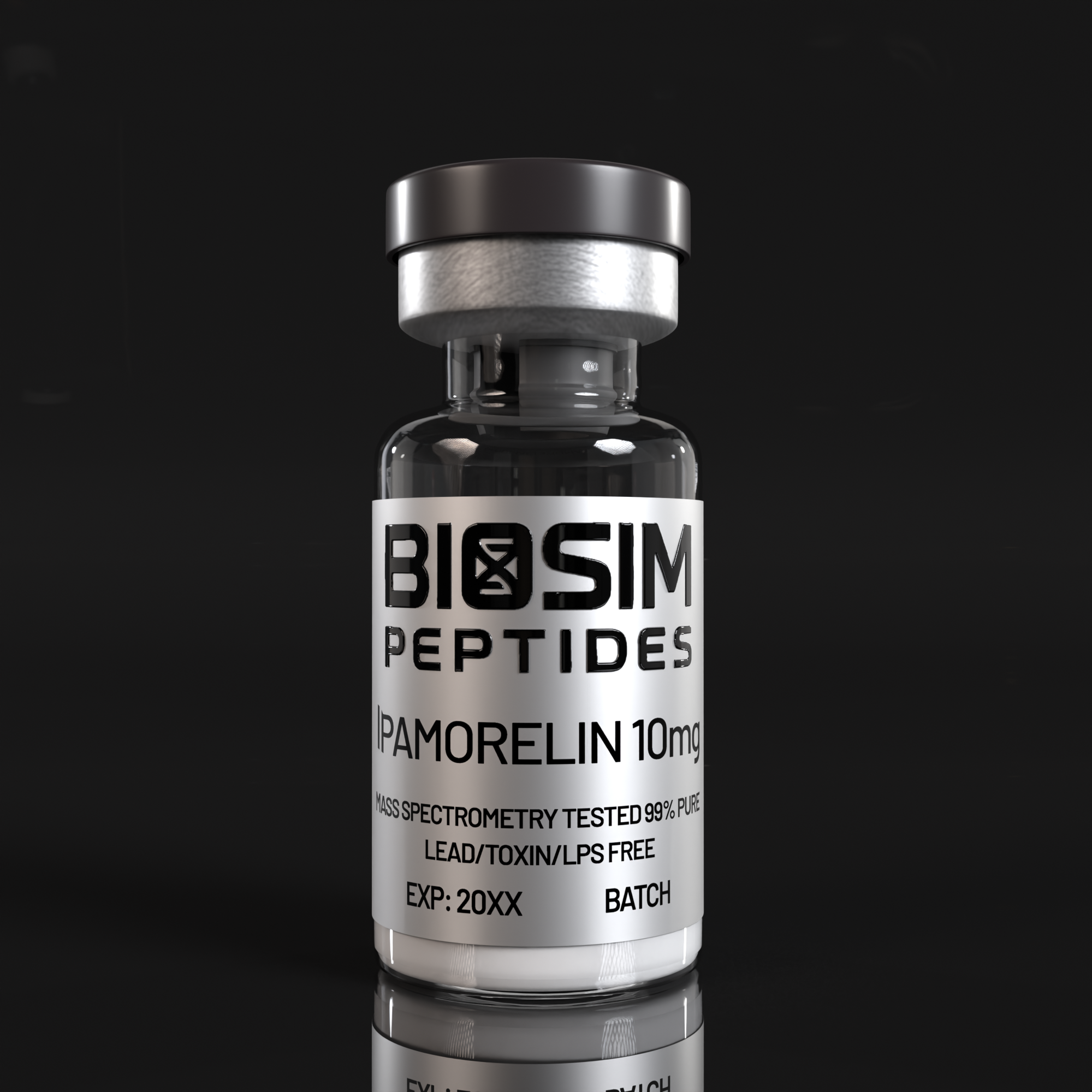
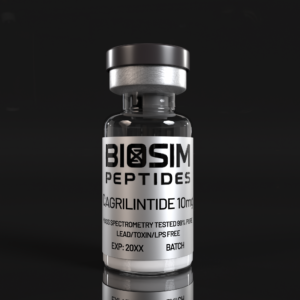
Ipamorelin is a pentapeptide growth hormone secretagogue that selectively activates the ghrelin/growth hormone secretagogue receptor (GHSR-1a) to drive pulsatile GH release without significantly elevating prolactin or cortisol in research models. BioSim Peptides supplies Ipamorelin 10mg as a high-purity lyophilized powder intended strictly for in-vitro laboratory research use. This product is not a drug, supplement, or therapeutic agent.
What is Ipamorelin?
Ipamorelin is a synthetic pentapeptide with the sequence Aib-His-D-2-Nal-D-Phe-Lys-NH₂, originally characterized by Raun and colleagues at Novo Nordisk in the late 1990s as the first selective growth hormone secretagogue (Raun et al., 1998). It belongs to a class of small, non-natural peptides developed to mimic the action of the endogenous hormone ghrelin at its cognate receptor.
Structurally, ipamorelin is built on a peptidomimetic scaffold that incorporates non-proteinogenic residues — α-aminoisobutyric acid (Aib) and D-2-naphthylalanine — to confer protease resistance and conformational rigidity. This design yielded a compound with high in-vivo stability relative to native ghrelin, and good selectivity for GHSR-1a over related GPCRs (Johansen et al., 1998).
In the published research literature, ipamorelin has served as a widely cited tool compound to interrogate the selectivity of growth hormone secretagogue receptor signaling. It is frequently studied alongside, or compared to, related secretagogues such as GHRP-6, hexarelin, and tesamorelin (which acts upstream at the GHRH receptor). Sinha and colleagues have reviewed ipamorelin and its peers in the broader context of GH-secretagogue pharmacology (Sinha et al., 2020).
Mechanism of Action in Research Models
Ipamorelin acts as an agonist at the ghrelin receptor (GHSR-1a), a Gq/11-coupled class A GPCR expressed in anterior pituitary somatotropes and in selected hypothalamic and peripheral tissues. Receptor activation triggers phospholipase Cβ-mediated generation of IP₃ and diacylglycerol, elevation of intracellular calcium, and subsequent release of growth hormone from secretory granules. Pharmacokinetic-pharmacodynamic modeling has characterized the time-course of GH release in response to ipamorelin in rats and pigs (Gobburu et al., 1999).
A defining pharmacological feature of ipamorelin is its selectivity. Studies have shown that, in contrast to several earlier GH secretagogues, ipamorelin stimulates GH release without significant concurrent elevation of adrenocorticotropic hormone, cortisol, or prolactin (Raun et al., 1998). This selectivity profile has made it an attractive probe of GHSR-1a–specific signaling in laboratory research.
Downstream of GH release, research suggests effects on insulin-like growth factor 1, bone-growth biomarkers, and gut motility in preclinical models. Longitudinal bone-growth studies in rats demonstrated increased growth plate activity (Johansen et al., 1999), while gastrointestinal models have explored ipamorelin’s prokinetic actions in postoperative ileus (Venkova et al., 2009).
The pentapeptide’s small size and incorporation of Aib and D-amino acid residues confer notable resistance to proteolytic degradation, supporting reproducible exposure in research dosing schemes (Johansen et al., 1998). As with native ghrelin signaling, downstream consequences of GHSR-1a activation extend beyond GH release into modulation of appetite circuits, energy expenditure, and gastrointestinal function — although the magnitude of these effects with ipamorelin is generally reported to be modest compared with non-selective ghrelin mimetics. This makes ipamorelin a useful tool for laboratories aiming to dissociate canonical somatotrope signaling from broader ghrelin-system biology.
Key Areas of Scientific Research
Growth Hormone and IGF-1 Axis Studies
Ipamorelin is one of the most extensively characterized selective GH secretagogues in the literature. Raun and colleagues established its core selectivity profile (Raun et al., 1998), and follow-up pharmacokinetic-pharmacodynamic work defined the dose–response relationship for GH release in animal models (Gobburu et al., 1999). These studies make ipamorelin a benchmark tool compound for in-vitro GHSR-1a research.
Bone Growth and Skeletal Research
Preclinical data indicates ipamorelin promotes longitudinal bone growth in rats, with histomorphometric evidence of increased growth plate width and altered chondrocyte dynamics (Johansen et al., 1999). Subsequent work in young rats characterized chronic exposure effects on pituitary cell populations (Jiménez-Reina et al., 2002).
Catabolism and Glucocorticoid-Antagonism Research
Research in rodent models has explored whether ipamorelin can counteract aspects of glucocorticoid-induced changes in bone metabolism and growth, with measurable effects on bone mineral parameters (Andersen et al., 2001). These findings support the use of ipamorelin as a probe of GH-axis modulation of skeletal homeostasis.
Gastrointestinal Motility Research
Beyond the pituitary, ghrelin-receptor signaling is implicated in GI motility, and ipamorelin has been investigated in rodent postoperative ileus models, where it accelerated normalization of gastric and intestinal transit (Venkova et al., 2009). This area of work positions ipamorelin as a useful tool for studying enteric ghrelin-receptor pharmacology.
Pharmacokinetics and Peptide Stability
The pharmacokinetic profile of ipamorelin has been characterized in multiple species. Comparative work showed that ipamorelin exhibits favorable plasma stability and bioavailability versus earlier peptidyl secretagogues, supporting its widespread adoption as a tool compound (Johansen et al., 1998; Gobburu et al., 1999). These data inform laboratory protocol design for in-vitro experiments where peptide degradation kinetics can confound dose–response analysis.
Pituitary Histomorphology Research
Chronic-exposure studies in young female rats characterized changes in pituitary somatotrope populations and hormone-content distributions following ipamorelin administration, providing morphological context for the functional GH-release data (Jiménez-Reina et al., 2002). These studies illustrate how ipamorelin is used not only as a GH-stimulus but as a tool to probe pituitary plasticity itself.
Selectivity Profiling Versus Other Secretagogues
A core attraction of ipamorelin in mechanistic research is its clean selectivity profile. Sinha and colleagues, in their broader review of growth hormone secretagogues, contrasted ipamorelin against GHRP-6, hexarelin, and MK-677, highlighting the relative absence of cortisol/prolactin co-stimulation as a defining feature (Sinha et al., 2020). This positions ipamorelin as a benchmark agent for laboratories aiming to isolate GH-release effects from other neuroendocrine perturbations.
Receptor Signaling and Beta-Arrestin Bias Research
The ghrelin receptor exhibits complex pharmacology including constitutive activity, biased agonism, and heterodimerization with other GPCRs. Ipamorelin’s well-defined selectivity makes it a useful probe in research dissecting G-protein versus β-arrestin signaling at GHSR-1a, and in comparative studies with other ghrelin mimetics (Sinha et al., 2020). These investigations contribute to a broader understanding of how small synthetic peptides can be designed to elicit specific receptor-coupled outputs.
Translational Endocrine Research
Beyond mechanistic pharmacology, ipamorelin has been examined in translational endocrine research contexts including post-surgical recovery and catabolic states (Venkova et al., 2009; Sinha et al., 2020). The peptide continues to be cited in the broader literature on growth hormone secretagogues as a foundational example of selective design.
Published Research Highlights
- Raun et al. (1998, European Journal of Endocrinology) introduced ipamorelin as the first selective growth hormone secretagogue, characterizing its receptor pharmacology and the absence of cortisol/prolactin co-release.
- Johansen et al. (1999, Growth Hormone and IGF Research) reported that ipamorelin induced longitudinal bone growth in rats, with concomitant changes in skeletal growth parameters.
- Gobburu et al. (1999, Pharmaceutical Research) developed PK/PD models describing GH release kinetics following ipamorelin exposure.
- Andersen et al. (2001, Growth Hormone and IGF Research) showed that ipamorelin counteracted glucocorticoid-induced decreases in bone formation markers in a rodent model.
- Venkova et al. (2009, Journal of Pharmacology and Experimental Therapeutics) reported that ipamorelin reduced the duration of postoperative ileus in a rodent model.
- Sinha et al. (2020, Translational Andrology and Urology) reviewed growth hormone secretagogues including ipamorelin in the context of modern endocrine research.
- Johansen et al. (1998, Xenobiotica) presented comparative pharmacokinetic evaluations of ipamorelin and other peptidyl growth hormone secretagogues, supporting its laboratory utility.
Research Context and Comparative Notes
Ipamorelin’s clean selectivity profile and well-characterized pharmacology make it a frequent reference compound for laboratories investigating GHSR-1a signaling. In comparative experimental designs it is often paired with GHRH analogs such as tesamorelin or CJC-1295 to distinguish upstream (GHRH-receptor) from downstream (ghrelin-receptor) contributions to somatotrope activation. This complementary positioning is part of why ipamorelin remains widely cited more than two decades after its initial description (Raun et al., 1998; Sinha et al., 2020).
Researchers should be aware that the published literature on ipamorelin spans a range of species, doses, and exposure regimens. Cross-study comparisons benefit from careful attention to model-system differences, particularly in pharmacokinetic exposure (Gobburu et al., 1999; Johansen et al., 1998). The peptide’s stability and selectivity, however, make it among the more reproducible secretagogues for in-vitro pituitary research.
Stability, Storage, and Handling in Laboratory Settings
Ipamorelin is supplied as a lyophilized white powder. Standard peptide-handling literature recommends long-term storage of the lyophilized vial at −20 °C, protected from light and moisture. Under these conditions ipamorelin is generally reported to remain stable for extended periods.
For laboratory reconstitution, sterile bacteriostatic water or sterile water for injection is typically used in published protocols. Reconstituted solutions should be stored at 2–8 °C and protected from light, with use within a short timeframe — typically a few weeks — consistent with stability windows reported for small pentapeptide secretagogues. Repeated freeze–thaw cycles should be avoided, and aseptic technique should be observed throughout. No dosing or administration route is implied; this product is for in-vitro research use only.
Product Specifications
- Product name: Ipamorelin 10mg
- Sequence: Aib-His-D-2-Nal-D-Phe-Lys-NH₂
- Molecular formula: C₃₈H₄₉N₉O₅
- Molecular weight: ~711.86 Da
- Purity: ≥98% by HPLC
- Presentation: Lyophilized white powder, single-use research vial
- Quantity: 10 mg per vial
- Certificate of Analysis: Included; HPLC and mass spectrometry data available on request
- Shipping: USA-based fulfillment
Why Researchers Choose BioSim Peptides
BioSim Peptides supplies research-grade Ipamorelin manufactured to a ≥98% purity specification and verified batch-by-batch by reversed-phase HPLC and mass spectrometry. Certificates of analysis are made available to laboratory customers on request, supporting transparent documentation of peptide identity and quality.
Our USA-based facility offers prompt domestic shipping, protective packaging suitable for lyophilized peptides, and responsive customer support for questions on specifications, handling, and documentation. Researchers investigating the growth hormone axis often pair ipamorelin with related research peptides — for example, the GHRH analog tesamorelin or CJC-1295 — to compare GHSR-1a and GHRHR signaling in parallel in-vitro experiments.
References
- Raun K, et al. Ipamorelin, the first selective growth hormone secretagogue. European Journal of Endocrinology. 1998. PMID: 9849822.
- Johansen PB, et al. Ipamorelin, a new growth-hormone-releasing peptide, induces longitudinal bone growth in rats. Growth Hormone and IGF Research. 1999. PMID: 10373343.
- Gobburu JV, et al. Pharmacokinetic-pharmacodynamic modeling of ipamorelin, a growth hormone releasing peptide. Pharmaceutical Research. 1999. PMID: 10496658.
- Andersen NB, et al. The growth hormone secretagogue ipamorelin counteracts glucocorticoid-induced decrease in bone formation. Growth Hormone and IGF Research. 2001. PMID: 11735244.
- Jiménez-Reina L, et al. Influence of chronic treatment with the growth hormone secretagogue ipamorelin in young female rats. Histology and Histopathology. 2002. PMID: 12168778.
- Johansen PB, et al. Pharmacokinetic evaluation of ipamorelin and other peptidyl growth hormone secretagogues. Xenobiotica. 1998. PMID: 9879640.
- Venkova K, et al. Efficacy of ipamorelin, a novel ghrelin mimetic, in a rodent model of postoperative ileus. Journal of Pharmacology and Experimental Therapeutics. 2009. PMID: 19289567.
- Sinha DK, et al. Beyond the androgen receptor: the role of growth hormone secretagogues in the modern management of andrological disorders. Translational Andrology and Urology. 2020. PMID: 32257855.
This peptide is supplied by BioSim Peptides for in-vitro laboratory research use only. It is not a drug, supplement, cosmetic, or food product and is not intended for human or veterinary use, consumption, diagnosis, treatment, cure, or prevention of any disease. All research must comply with applicable institutional and regulatory guidelines.
Frequently Asked Questions about Ipamorelin
What is Ipamorelin?
Ipamorelin is a research peptide supplied by BioSim Peptides for in-vitro and laboratory use only. Each vial is lyophilized, lab-tested, and accompanied by a Certificate of Analysis (COA) verifying identity and purity above 98% by HPLC.
Is the Ipamorelin from BioSim Peptides third-party tested?
Yes. Every lot of Ipamorelin 10mg is independently tested by HPLC and mass spectrometry. The COA for the current batch is available on request and packaged with every order.
How should Ipamorelin be stored?
Lyophilized Ipamorelin should be stored at -20°C for long-term stability. After reconstitution with bacteriostatic water it is typically stored at 2-8°C and used within the timeframe described in the published literature for the peptide.
How fast does BioSim Peptides ship?
Orders placed before 2 PM ET ship same business day from our USA facility via tracked carriers. Most domestic orders arrive in 2-4 business days.
Is Ipamorelin approved for human use?
No. Ipamorelin is supplied for in-vitro laboratory research only. It is not a drug, dietary supplement, cosmetic, or food, and is not intended for diagnosis, treatment, cure, or prevention of any disease in humans or animals.

Reviews
There are no reviews yet.