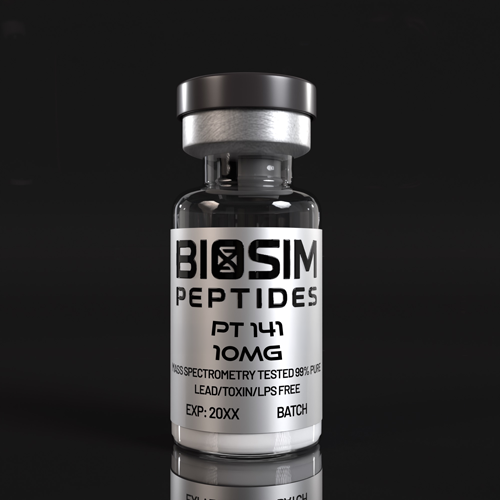
PT-141 (Bremelanotide) 10mg — Research Peptide
PT-141 is a synthetic cyclic heptapeptide that functions as a selective melanocortin-4 receptor (MC4R) agonist. Originally developed from the peptide hormone alpha-MSH (alpha-melanocyte-stimulating hormone), PT-141 has a distinct mechanism of action among melanocortin peptides due to its receptor selectivity profile and its ability to cross the blood-brain barrier after systemic administration. Supplied as lyophilized powder at 99%+ purity by HPLC. For laboratory research use only.
Molecular Characteristics & Structure-Activity Relationships
PT-141 (C50H68N14O10, molecular weight 1025.2 g/mol) is a cyclic heptapeptide with the sequence Ac-Nle-cyclo(Asp-His-D-Phe-Arg-Trp-Lys)-OH. The N-terminal acetylation and lactam cyclization between Asp and Lys side chains confer metabolic stability significantly greater than linear melanocortin analogs. The D-Phe residue at position 3 is critical for MC4R selectivity — substitution with L-Phe dramatically reduces receptor affinity. The cyclic constraint pre-organizes the pharmacophore into a conformation complementary to the MC4R binding pocket, reducing the entropic penalty of binding and contributing to nanomolar potency.
MC4R is a Gs protein-coupled receptor (GPCR) primarily expressed in the central nervous system, with high density in the hypothalamus, brainstem, and spinal cord. Upon agonist binding, MC4R activates adenylyl cyclase via Gαs, increasing intracellular cAMP and triggering downstream signaling cascades including protein kinase A (PKA) activation and cAMP response element-binding protein (CREB) phosphorylation. High-resolution structural studies have provided atomic-level insights into MC4R ligand recognition, revealing that PT-141 engages a binding pocket spatially distinct from the endogenous agonist α-MSH, with the macrocyclic scaffold making contacts with transmembrane helices 2, 3, and 6 that account for its unique selectivity profile across the melanocortin receptor family (PMID: 34433901).
Neurobiology of Melanocortin-Mediated Sexual Function
The melanocortin system plays a central role in neurobiological regulation beyond its well-characterized effects on energy homeostasis. MC4R is densely expressed in hypothalamic nuclei that integrate autonomic, endocrine, and behavioral responses, including the medial preoptic area (mPOA), paraventricular nucleus (PVN), and ventromedial hypothalamus (VMH) — regions critically implicated in sexual behavior circuitry. Preclinical microinjection studies have demonstrated that direct MC4R agonist administration into the PVN elicits erectile responses, while MC4R antagonists block these effects.
Bremelanotide (PT-141) was evaluated in randomized, placebo-controlled clinical trials for its effects on subjective and physiological sexual response. A landmark study in premenopausal women with sexual arousal disorder demonstrated that bremelanotide produced significant effects on multiple domains of sexual function — including genital arousal, sexual desire, and overall sexual satisfaction — compared to placebo, with the mechanism linked to melanocortin-mediated modulation of central dopaminergic pathways in the mPOA and PVN (PMID: 16839319). The neurobiology of sexual response involves a dynamic balance between excitatory (dopamine, melanocortin, norepinephrine) and inhibitory (serotonin, opioid, endocannabinoid) signaling systems, with MC4R agonism shifting this balance toward excitation through enhanced dopamine release and suppressed serotonergic tone (PMID: 29198512).
The clinical translation of these findings led to FDA approval of bremelanotide for hypoactive sexual desire disorder (HSDD), making it one of only two centrally-acting agents approved for this indication. The approval validated the melanocortin pathway as a druggable target for central nervous system disorders with behavioral endpoints (PMID: 31893927).
Metabolic & Appetite Research Applications
MC4R is a critical regulator of energy homeostasis, and its role in appetite control has made it a target of intense investigation. Agonist activity at MC4R in the hypothalamic arcuate nucleus and PVN promotes satiety by activating pro-opiomelanocortin (POMC) neuron-driven circuits while inhibiting Agouti-related peptide (AgRP)/neuropeptide Y (NPY) orexigenic neurons. The net effect is reduced food intake and increased energy expenditure, positioning MC4R agonists as potential anti-obesity agents.
Clinical trial data from phase 1 studies examined bremelanotide’s effects on body weight in obese women, exploring whether MC4R-mediated appetite suppression could translate to meaningful weight outcomes. The studies investigated dose-response relationships, pharmacokinetics, and metabolic endpoints including resting energy expenditure and substrate oxidation (PMID: 35170192). While the appetite-suppressive effects of MC4R agonism are well-established preclinically, translating these to sustained weight loss in clinical populations has required addressing tolerability considerations related to MC4R’s broader physiological roles.
MC4R Polymorphisms & Disease Susceptibility
Genetic variation in melanocortin receptor genes has been linked to a spectrum of human diseases. MC4R mutations are the most common monogenic cause of severe obesity, with heterozygous loss-of-function mutations found in 2-6% of severely obese individuals. Beyond MC4R, polymorphisms across the melanocortin receptor family (MC1R through MC5R) have been associated with inflammatory traits, metabolic diseases, and cancer susceptibility (PMID: 41002740). These genetic associations underscore the pleiotropic roles of melanocortin signaling in human physiology and suggest that MC4R ligands may have therapeutic applications extending beyond the conditions for which they are currently approved.
Macrocyclic Peptides as a Therapeutic Modality
PT-141 belongs to the class of mid-size macrocyclic peptides that have achieved clinical and commercial success (alongside setmelanotide, cyclosporine, and vancomycin) by occupying a “Goldilocks” chemical space between small molecules and biologics. These macrocycles balance conformational preorganization with sufficient flexibility for selective receptor engagement, achieving pharmacokinetic and pharmacodynamic properties that neither smaller nor larger modalities can replicate. The recent clinical success of macrocyclic peptides highlights this modality’s capacity to target GPCRs, protein-protein interactions, and other historically “undruggable” targets (PMID: 42340853). PT-141’s macrocyclic scaffold serves as a template in medicinal chemistry for designing next-generation melanocortin ligands with improved subtype selectivity, extended half-life, and oral bioavailability.
Laboratory Handling & Storage
Lyophilized PT-141 is supplied as a white to off-white powder. Recommended storage is at -20°C in a desiccated environment, protected from light and moisture. For in vitro experiments, reconstitution in sterile bacteriostatic water, phosphate-buffered saline (PBS), or suitable assay buffer is recommended. Working solutions should be prepared fresh and used within 24 hours when stored at 4°C. Avoid repeated freeze-thaw cycles of reconstituted peptide, as this promotes aggregation and loss of bioactivity. The lyophilized peptide is stable when stored under recommended conditions. Researchers should consult relevant literature for compound-specific solubility limits, stability under various buffer conditions, and bioactivity assay protocols appropriate to their experimental system.
Related Research


Reviews
There are no reviews yet.