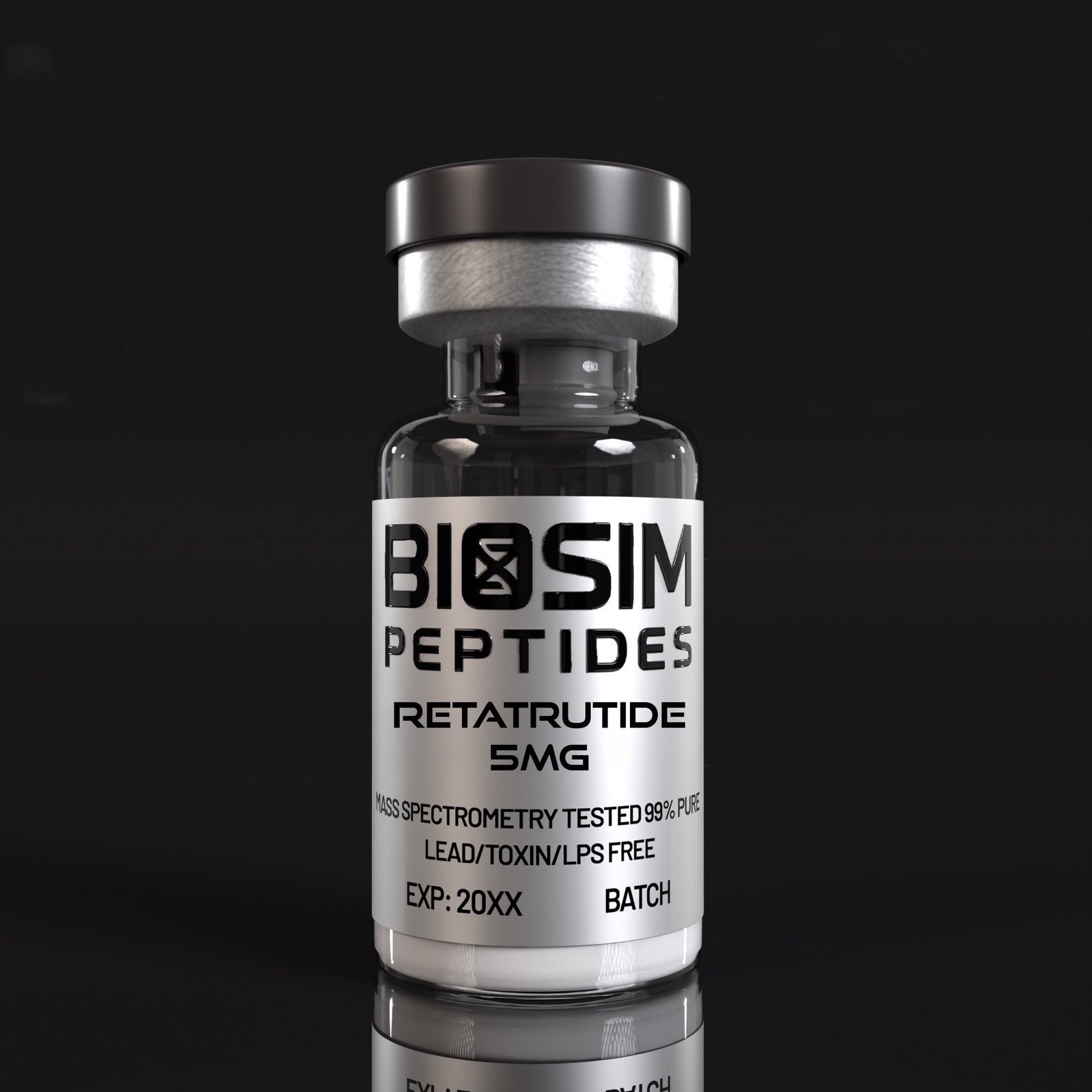
Retatrutide 5mg: Research Overview
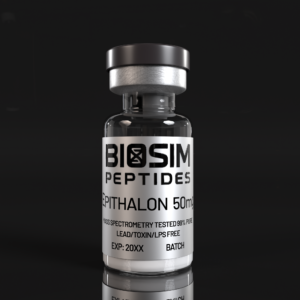
Retatrutide 5mg is a single vial containing 5 mg of lyophilized retatrutide (LY3437943), a synthetic peptide that activates three class B G-protein-coupled receptors: the glucagon-like peptide-1 receptor (GLP-1R), the glucose-dependent insulinotropic polypeptide receptor (GIPR) and the glucagon receptor (GCGR). The 5 mg vial suits pilot experiments, assay development and method validation. Laboratories running longer or larger study series may prefer Retatrutide 30mg or Retatrutide 60mg, which contain the same peptide in larger quantities.
For laboratory research use only; not for human consumption.
Structure at a Glance
Retatrutide is a 39-amino-acid peptide built on a modified glucagon-family backbone. A C20 fatty diacid is attached through a γGlu-2xOEG linker. The lipid chain binds serum albumin non-covalently, which extends the molecule’s half-life relative to native incretin hormones. In the literature the compound appears under its development code LY3437943 and is often called a “triagonist” or “triple agonist”.
Retatrutide belongs to the same family of long-acting, albumin-binding incretin analogs as semaglutide (GLP-1R only) and tirzepatide (GLP-1R and GIPR). Its added glucagon-receptor activity sets it apart and makes it a useful reference compound for comparative receptor pharmacology.
How the Triple Agonist Signals
- GLP-1R and GIPR. Published in-vitro pharmacology shows full agonist activity at both receptors. In pancreatic β-cell models, their activation couples to Gαs and cyclic AMP and amplifies glucose-dependent insulin secretion.
- GCGR. Potency at the glucagon receptor is deliberately lower than that of native glucagon. In hepatocyte cultures, GCGR signaling drives glycogenolysis, fatty-acid oxidation and increased mitochondrial activity.
- Downstream. Across all three receptors, agonist binding leads to cAMP/PKA signaling and β-arrestin recruitment. In receptor-occupancy studies, albumin binding prolongs exposure.
Coskun and colleagues (2022) described this balanced profile in the paper that introduced LY3437943.
What Laboratories Study With Retatrutide
Adipocyte biology. Regmi and colleagues (2023) published a STAR Protocols method for differentiating human subcutaneous adipocytes and measuring lipolysis induced by GIP or LY3437943. It gives laboratories a reproducible in-vitro assay for triagonist activity, used alongside readouts of differentiation markers and mitochondrial biogenesis programs.
Hepatic lipid handling. The glucagon-receptor arm makes retatrutide a probe for hepatocyte and rodent studies of lipogenesis, β-oxidation enzymes and lipogenic transcription factors such as SREBP-1c and ChREBP. A phase 2a study that measured hepatic fat content (Sanyal et al., 2024) provides clinical-pharmacology context for this preclinical work.
Receptor pharmacology and signal bias. Because it co-activates three related receptors, retatrutide is compared with semaglutide, tirzepatide and native glucagon to separate each receptor’s contribution to cAMP, β-arrestin and receptor-internalization endpoints.
Gastrointestinal motility. Gastric emptying is a classic downstream marker of GLP-1R activation. Urva and colleagues (2023) characterized a delay in gastric emptying that diminished with continued exposure. That finding informs the design of ex-vivo and animal models of gut motility.
Albumin-binding pharmacokinetics. Researchers comparing lipidation and linker chemistries use retatrutide as a benchmark for plasma protein binding, off-rate kinetics from albumin and tissue distribution.
Emerging tissue models. Early work extends retatrutide studies to renal proximal tubule cells and cardiomyocyte preparations, where GLP-1R and glucagon receptor expression has been documented.
Key Publications
- Coskun et al., 2022 (Cell Metabolism): discovery and in-vitro/in-vivo characterization of LY3437943.
- Urva et al., 2022 (Lancet): first phase 1b pharmacokinetic and pharmacodynamic profile.
- Jastreboff et al., 2023 (New England Journal of Medicine): 48-week phase 2 trial, the largest dataset under sustained exposure.
- Rosenstock et al., 2023 (Lancet): a second phase 2 trial with comparative metabolic endpoints.
- Urva et al., 2023 (Diabetes, Obesity and Metabolism): gastric-emptying kinetics.
- Regmi et al., 2023 (STAR Protocols): adipocyte differentiation and lipolysis assay.
- Sanyal et al., 2024 (Nature Medicine): phase 2a study measuring hepatic fat content.
The broader context and a longer literature summary are in our Retatrutide research guide.
Handling and Storage
Retatrutide 5mg ships as a lyophilized white powder in a sealed glass vial. The lyophilized peptide is most stable at -20°C, protected from light and moisture; -80°C suits long-term archival storage. For reconstitution in research workflows, sterile water or bacteriostatic water is typically used. The solution is then aliquoted and kept at 2-8°C for short-term use or frozen for longer retention. Avoid repeated freeze-thaw cycles, which can promote aggregation and deamidation of long-chain incretin peptides. After extended storage, confirm activity with an orthogonal assay such as a cAMP reporter assay. We do not provide dosing or administration instructions.
Specifications
- Product: Retatrutide (LY3437943), 5 mg per vial
- Structure: 39-amino-acid synthetic peptide with γGlu-2xOEG-C20 diacid lipidation
- Molecular formula (free peptide backbone, approximate): C221H343N53O61
- Molecular weight: approximately 4731 Da
- Purity: 99%+
- Testing: third-party tested by an independent laboratory
- Certificate of analysis: published on our COA page, not shipped with the order
- Form: lyophilized white powder, sealed glass vial
- Shipping: orders ship in 2 business days
- Intended use: laboratory research only
References
- Coskun T, Urva S, Roell WC, et al. Cell Metab. 2022;34(9):1234-1247.e9. PMID: 35985340.
- Urva S, Coskun T, Loh MT, et al. Lancet. 2022;400(10366):1869-1881. PMID: 36354040.
- Jastreboff AM, Kaplan LM, Frías JP, et al. N Engl J Med. 2023;389(6):514-526. PMID: 37366315.
- Rosenstock J, Frias J, Jastreboff AM, et al. Lancet. 2023;402(10401):529-544. PMID: 37385280.
- Urva S, Coskun T, Wang T, et al. Diabetes Obes Metab. 2023;25(9):2784-2788. PMID: 37311727.
- Regmi A, Aihara E, Christe ME, et al. STAR Protoc. 2023;4(2):102304. PMID: 37178114.
- Sanyal AJ, Bedossa P, Fraessdorf M, et al. Nat Med. 2024;30(7):2037-2048. PMID: 38858523.
Retatrutide 5mg is supplied by BioSim Peptides for laboratory research use only; not for human consumption. It is not a drug, supplement, cosmetic, or food product and is not intended for human or veterinary use, diagnosis, treatment, cure, or prevention of any disease. All research must comply with applicable institutional and regulatory guidelines.

Reviews
There are no reviews yet.